Topics
Roman Numerals
Number Work
Addition and Subtraction
Multiplication and Division
Fractions
- Types of Fractions
- Concept of Equivalent Fractions
- Like and Unlike Fraction
- Concept of Mixed Fractions
- Concept of Proper and Improper Fractions
- Conversion between Improper and Mixed fraction
- Conversion between Unlike and Like Fractions
- Comparing Fractions
- Addition of Fraction
- Subtraction of Fraction
- Multiplication of Fraction
- Using Operator 'Of' with Multiplication and Division
Angles
Circles
Multiples and Factors
Decimal Fractions
Measuring Time
Problems on Measurement
Perimeter and Area
Three Dimensional Objects and Nets
Pictographs
Patterns
Preparation for Algebra
Measures of Time
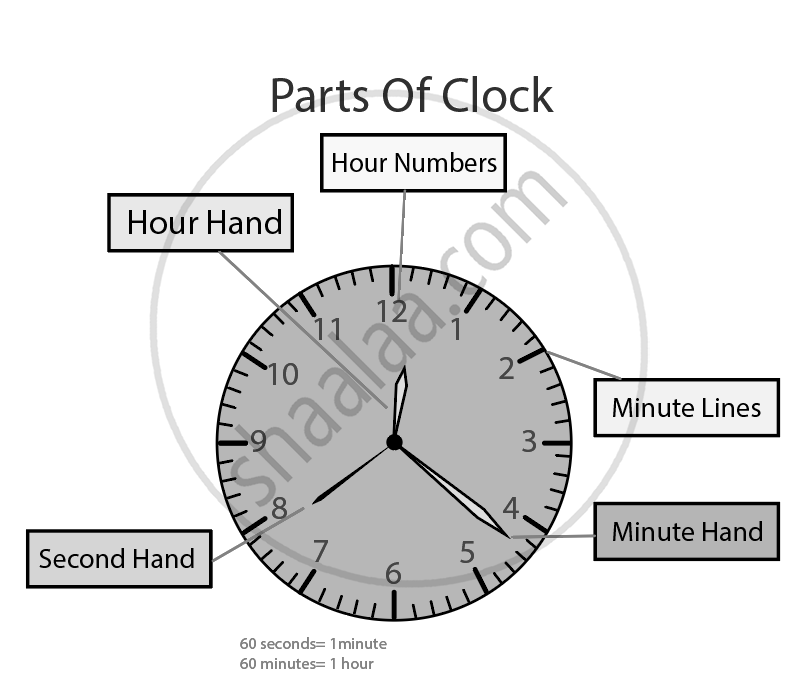
The tool used for measuring time is a clock. Clocks have markings at equal distances on a circular surface. It is divided into 12 parts, and one cycle of the hour hand through those 12 segments is considered half a day. The hour hand goes twice around those 12 segments to complete a day. There are minute hands on a clock as well that go around the segments once to complete an hour. The second hand on a clock goes around those segments to complete a minute.
Measurement of Time:
On a clock, the two major hands have different lengths, and one end is fixed at the centre of the dial.
The small and wider hand is known as the hour hand.
The longer and thinner hand is the minute hand.
The hour hand moves slower than the minute hand.
The third hand represents the second hand, and one full revolution of the clock equals one minute.
The following is the relation between time and seconds
24 hours = 1 day
60 minutes = 1 hour
60 seconds = 1 minute
Related QuestionsVIEW ALL [18]

Match the following:
| Column A | Column B |
| (i) 9.55 | a. 20 minutes past 2 |
| (ii) 11.50 | b. quarter past 4 |
| (iii) 4.15 | c. quarter to 8 |
| (iv) 7.45 | d. 5 minutes to 10 |
| (v) 2.20 | e. 10 minutes to 12 |