Topics
Relations and Functions
Relations and Functions
Inverse Trigonometric Functions
Algebra
Matrices
- Concept of Matrices
- Types of Matrices
- Equality of Matrices
- Operation on Matrices
- Multiplication of a Matrix by a Scalar
- Properties of Matrix Addition
- Properties of Matrix Multiplication
- Transpose of a Matrix
- Symmetric and Skew Symmetric Matrices
- Invertible Matrices
- Overview of Matrices
- Negative of Matrix
- Operation on Matrices
- Proof of the Uniqueness of Inverse
- Elementary Transformations
Calculus
Vectors and Three-dimensional Geometry
Determinants
- Determinants of Matrix of Order One and Two
- Determinant of a Matrix of Order 3 × 3
- Minors and Co-factors
- Inverse of a Square Matrix by the Adjoint Method
- Applications of Determinants and Matrices
- Elementary Transformations
- Properties of Determinants
- Determinant of a Square Matrix
- Rule A=KB
- Overview of Determinants
- Geometric Interpretation of the Area of a Triangle
Linear Programming
Continuity and Differentiability
- Concept of Continuity
- Algebra of Continuous Functions
- Concept of Differentiability
- Derivatives of Composite Functions - Chain Rule
- Derivatives of Implicit Functions
- Derivatives of Inverse Trigonometric Functions
- Exponential and Logarithmic Functions
- Logarithmic Differentiation
- Derivatives of Functions in Parametric Forms
- Second Order Derivative
- Derivative - Exponential and Log
- Proof Derivative X^n Sin Cos Tan
- Infinite Series
- Higher Order Derivative
- Continuous Function of Point
- Mean Value Theorem
- Overview of Continuity and Differentiability
Applications of Derivatives
- Introduction to Applications of Derivatives
- Rate of Change of Bodies or Quantities
- Increasing and Decreasing Functions
- Maxima and Minima
- Maximum and Minimum Values of a Function in a Closed Interval
- Simple Problems on Applications of Derivatives
- Graph of Maxima and Minima
- Approximations
- Tangents and Normals
- Overview of Applications of Derivatives
Probability
Sets
Integrals
- Introduction of Integrals
- Integration as an Inverse Process of Differentiation
- Some Properties of Indefinite Integral
- Methods of Integration: Integration by Substitution
- Integration Using Trigonometric Identities
- Integrals of Some Particular Functions
- Methods of Integration: Integration Using Partial Fractions
- Methods of Integration: Integration by Parts
- Fundamental Theorem of Calculus
- Evaluation of Definite Integrals by Substitution
- Properties of Definite Integrals
- Definite Integrals
- Indefinite Integral Problems
- Comparison Between Differentiation and Integration
- Geometrical Interpretation of Indefinite Integrals
- Indefinite Integral by Inspection
- Definite Integral as the Limit of a Sum
- Evaluation of Simple Integrals of the Following Types and Problems
- Overview of Integrals
Applications of the Integrals
Differential Equations
- Differential Equations
- Order and Degree of a Differential Equation
- General and Particular Solutions of a Differential Equation
- Linear Differential Equations
- Homogeneous Differential Equations
- Solutions of Linear Differential Equation
- Differential Equations with Variables Separable Method
- Formation of a Differential Equation Whose General Solution is Given
- Procedure to Form a Differential Equation that Will Represent a Given Family of Curves
- Overview of Differential Equations
Vectors
- Vector
- Basic Concepts of Vector Algebra
- Direction Cosines
- Vector Operations>Addition and Subtraction of Vectors
- Properties of Vector Addition
- Vector Operations>Multiplication of a Vector by a Scalar
- Components of Vector
- Vector Joining Two Points
- Section Formula
- Vector (Or Cross) Product of Two Vectors
- Scalar (Or Dot) Product of Two Vectors
- Projection of a Vector on a Line
- Geometrical Interpretation of Scalar
- Scalar Triple Product of Vectors
- Position Vector of a Point Dividing a Line Segment in a Given Ratio
- Magnitude and Direction of a Vector
- Vectors Examples and Solutions
- Introduction of Product of Two Vectors
- Overview of Vectors
Three - Dimensional Geometry
- Introduction of Three Dimensional Geometry
- Direction Cosines and Direction Ratios of a Line
- Relation Between Direction Ratio and Direction Cosines
- Equation of a Line in Space
- Angle Between Two Lines
- Shortest Distance Between Two Lines
- Three - Dimensional Geometry Examples and Solutions
- Equation of a Plane Passing Through Three Non Collinear Points
- Forms of the Equation of a Straight Line
- Coplanarity of Two Lines
- Distance of a Point from a Plane
- Angle Between Line and a Plane
- Angle Between Two Planes
- Vector and Cartesian Equation of a Plane
- Equation of a Plane in Normal Form
- Equation of a Plane Perpendicular to a Given Vector and Passing Through a Given Point
- Distance of a Point from a Plane
- Plane Passing Through the Intersection of Two Given Planes
- Overview of Three Dimensional Geometry
Linear Programming
Probability
- Area of the Region Bounded by a Curve & X-axis Between two Ordinates
- Area of the Region Bounded by a Curve & Y-axis Between two Abscissa
- Circle-line, elipse-line, parabola-line
Notes
We will find the area of the region bounded by a line and a circle, a line and a parabola, a line and an ellipse.Equations of above mentioned curves will be in their standard forms only as the cases in other forms.
For example :
Find the area of the region bounded by the curve y = x2 and the line y = 4.
⇒ 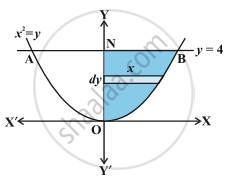
Since the given curve represented by the equation y = x2 is a parabola symmetrical about y-axis only, therefore, in above Fig.
The required area of the region AOBA is given by `2int _0^4 xdy` =
`2("area of the region BONB bounded by curve, y - axis and the lines"
y =0 and y = 4)`
`= 2 int _0^4 sqrt y dy = 2 xx 2/3 [y^(3/2)]_0^4 = 4/3 xx 8 = 32/3 `
Here,we have taken horizontal stripes as indicating in the above Fig.
Alternatively, we may consider the vertical strips like PQ as shown in the following Fig.
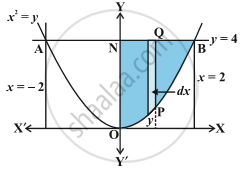
in fig the area of the region AOBA. To this end, we solve the equations x2 = y and y = 4 which gives x = –2 and x = 2. Thus, the region AOBA may be stated as the region bounded by the curve y = x2, y = 4 and the ordinates x = –2 and x = 2.
Therefore, the area of the region AOBA
=`int _-2^2 y dx`
[y=(y-coordinate of Q) - (y-coordinate of P) = 4 - `x^2`]
= `2 int _0^2(4 - x^2) dx`
= `2[4x - x^3/3]_0^2 = 2[4 xx 2 - 8/3 ] = 32 / 3`
Remark: From the above examples, it is inferred that we can consider either vertical strips or horizontal strips for calculating the area of the region.
Video link : https://youtu.be/RvjY8_QPBfo
Shaalaa.com | Application of Integrals part 3 (Area bounded by curve and line)
Series: 1
00:10:01 undefined
00:14:07 undefined
00:12:56 undefined
00:08:49 undefined
00:12:04 undefined
