Topics
Mathematical Logic
- Concept of Statements
- Truth Value of Statement
- Logical Connective, Simple and Compound Statements
- Statement Patterns and Logical Equivalence
- Tautology, Contradiction, and Contingency
- Duality
- Quantifier and Quantified Statements in Logic
- Negations of Compound Statements
- Converse, Inverse, and Contrapositive
- Algebra of Statements
- Application of Logic to Switching Circuits
- Overview of Mathematical Logic
Matrices
- Elementry Transformations
- Properties of Matrix Multiplication
- Application of Matrices
- Applications of Determinants and Matrices
- Overview of Matrices
Trigonometric Functions
- Trigonometric Equations and Their Solutions
- Solutions of Triangle
- Inverse Trigonometric Functions
- Overview of Trigonometric Functions
Pair of Straight Lines
- Combined Equation of a Pair Lines
- Homogeneous Equation of Degree Two
- Angle between lines represented by ax2 + 2hxy + by2 = 0
- General Second Degree Equation in x and y
- Equation of a Line in Space
- Overview of Pair of Straight Lines
Vectors
Line and Plane
- Vector and Cartesian Equations of a Line
- Distance of a Point from a Line
- Distance Between Skew Lines and Parallel Lines
- Equation of a Plane
- Angle Between Planes
- Coplanarity of Two Lines
- Distance of a Point from a Plane
- Overview of Line and Plane
Linear Programming
Differentiation
- Differentiation
- Derivatives of Composite Functions - Chain Rule
- Geometrical Meaning of Derivative
- Derivatives of Inverse Functions
- Logarithmic Differentiation
- Derivatives of Implicit Functions
- Derivatives of Parametric Functions
- Higher Order Derivatives
- Overview of Differentiation
Applications of Derivatives
- Applications of Derivatives in Geometry
- Derivatives as a Rate Measure
- Approximations
- Rolle's Theorem
- Lagrange's Mean Value Theorem (LMVT)
- Increasing and Decreasing Functions
- Maxima and Minima
- Overview of Applications of Derivatives
Indefinite Integration
Definite Integration
- Definite Integral as Limit of Sum
- Integral Calculus
- Methods of Evaluation and Properties of Definite Integral
- Overview of Definite Integration
Application of Definite Integration
- Application of Definite Integration
- Area Bounded by the Curve, Axis and Line
- Area Between Two Curves
- Overview of Application of Definite Integration
Differential Equations
- Differential Equations
- Order and Degree of a Differential Equation
- Formation of Differential Equations
- Homogeneous Differential Equations
- Linear Differential Equations
- Application of Differential Equations
- Solution of a Differential Equation
- Overview of Differential Equations
Probability Distributions
- Random Variables and Its Probability Distributions
- Types of Random Variables
- Probability Distribution of Discrete Random Variables
- Probability Distribution of a Continuous Random Variable
- Variance of a Random Variable
- Expected Value and Variance of a Random Variable
- Overview of Probability Distributions
Binomial Distribution
- Bernoulli Trial
- Binomial Distribution
- Mean of Binomial Distribution (P.M.F.)
- Variance of Binomial Distribution (P.M.F.)
- Bernoulli Trials and Binomial Distribution
- Overview of Binomial Distribution
Notes
The two curve represented by y = f (x), y = g (x), where f(x) ≥ g(x) in [a, b] as shown in following Fig. Here the points of intersection of these two curves are given by x = a and x = b obtained by taking common values of y from the given equation of two curves. To take elementary area in the form of vertical strips has height f(x) - g(x) and width dx so that the elementary area
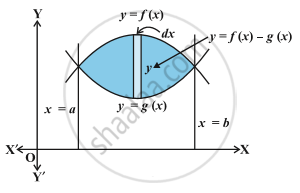
dA = [f(x) – g(x)] dx, and the total area A can be taken as
A = `int _a^b [f(x) - g(x)]` dx , and the total area A can be taken as
Alternatively,
A = [area bounded by y = f (x), x-axis and the lines x = a, x = b] –
[area bounded by y = g (x), x-axis and the lines x = a, x = b]
= `int _a^b f(x) dx - int _a^b g(x) dx = int _a^b[f(x) - g(x)] dx` , where f(x) `>=` g(x) in [a,b]
If f (x) ≥ g (x) in [a, c] and f (x) ≤ g (x) in [c, b], where a < c < b as shown in the following Fig. then the area of the regions bounded by curves can be written as
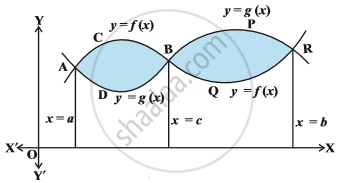
Total Area = Area of the region ACBDA + Area of the region BPRQB
=`int _a^c [f(x) - g(x)] dx `+` int _c^b [g(x) - f(x)] dx`
Video link : https://youtu.be/tVKcJLMbgDo
Shaalaa.com | Application of Integrals part 8 (Area between two curves)
Series: 1
00:14:38 undefined
00:14:16 undefined
00:12:21 undefined
00:12:44 undefined
