Topics
Introduction to Book-Keeping and Accountancy
- Accounting
- Book-Keeping
- Accountancy
- Book-Keeping vs. Accountancy
- Basis (Methods) of Accounting System
- Qualitative Characteristics of Accounting Information
- Basic Terms in Accounting
- Transaction
- Capital and Drawings
- Debtors, Creditors and Bad Debts
- Expenditure and Its Types
- Discount and Its Types
- Solvent Person vs. Insolvent Person
- Accounting Year
- Trading Concerns vs. Not for Profit Concerns
- Concept of Goodwill
- Fundamentals of Business Earnings
- Concepts of Assets, Liabilities and Net Worth
- Accounting Principles
- Accounting Concepts
- Core Accounting Concepts
- Accounting Standards
Meaning and Fundamentals of Double Entry Book-Keeping
Journal
- Accounting Documents
- Goods and Service Tax(GST)
- Types of Accounting Documents
- Voucher
- Tax Invoice (Under GST)
- Credit Memo
- Receipt
- Cheque
- Types of Cheques
- Books of Accounts
- Books of Accounts > Journal
- Journal Entries
- Journal Entries > Goods Account
- Journal Entries > Recording Discount in Journal
- Journal Entries > Other Important Journal Entries
Ledger
Subsidiary Books
- Concept of Subsidiary Books
- Cash Book
- Cash Book > Simple Cash Book (Single Column Cash Book)
- Cash Book > Two Column Cash Book (With Cash and Bank Columns)
- Cash Book > Petty Cash Book
- Simple Petty Cash Book
- Analytical Petty Cash Book
- Purchase Book
- Purchase Return Book
- Sales Book
- Sales Return Book
- Journal Proper
Bank Reconciliation Statement
- Accounting Documents Used in Banking
- Accounting Documents Used in Banking
- Pay-in-Slip
- Withdrawal Slip
- Bank Pass Book
- Bank Statement
- Bank Advice
- Concept of Virtual Banking
- Bank Reconciliation Statement(BRS)
- Cash Book vs Pass Book : Causes of Differences
- Time Difference(Regarding BRS)
- Errors and Omission Made by Bank or Businessman
- Formats of BRS
- Preparation of BRS
- Cash Book and Pass Book Comparison for Common Period
- Cash Book and Pass Book Balances for Different Periods
- Bank Balance as per Cash Book (Favourable / Debit Balance)
- Bank Balance as per Pass Book (Favourable / Credit Balance)
- Overdraft as per Cash Book (Unfavourable / Credit Balance)
- Overdraft as per Pass Book (Unfavourable/Debit balance)
- Reconciliation of Debtors and Creditors
Depreciation
Rectification of Errors
Final Accounts of a Proprietary Concern
Single Entry System
- Concept of Single Entry System
- Single Entry System vs. Double Entry System
- Parts of Single Entry System
- Statements of Affairs
- Statement of Profit or Loss
- Statement of Profit or Loss > Net Worth Method
- Practical Problems on Single Entry System
- Definition: Document
- Definition: Accounting Document
- Some Common Accounting Documents
- Importance of Accounting Documents
- Steps in Recording Transactions
- Real-Life Examples
- Key Takeaways
Maharashtra State Board: Class 11
Definition : Document
A document is any paper, file, or digital record that gives information about something.
Maharashtra State Board: Class 11
Definition : Accounting Document
In accounting, a document is a paper or digital record that proves a business transaction has happened.
Maharashtra State Board: Class 11
Some Common Accounting Documents
| Document | When Used |
|---|---|
| Cash Memo | Buying/selling goods for cash |
| Receipt | Receiving money from someone |
| Invoice | Selling goods on credit |
| Cheque | Payment by bank |
| Debit Note | Returning goods to supplier |
| Credit Note | Seller accepts returned goods |
Maharashtra State Board: Class 11
Importance of Accounting Documents
| Point | Explanation |
|---|---|
| Legal Proof | They prove transactions are real and can be shown in audits or courts or to the government |
| Accurate Recording of Transactions | Only transactions with documents get recorded in the books. |
| Required by Law | Needed by certain authorities to check the collection and usage of funds by organisations. |
| Easy Reference | Kept in files for checking or solving disputes later. |
What is an Audit?
- An audit is a careful check of a company's financial records.
- The person performing an audit is called an auditor
- Its main purpose is to make sure that the company’s accounts and statements are correct, honest, and complete.
- Audits help find and prevent mistakes or fraud and build trust of owners, investors, and government officials.
Maharashtra State Board: Class 11
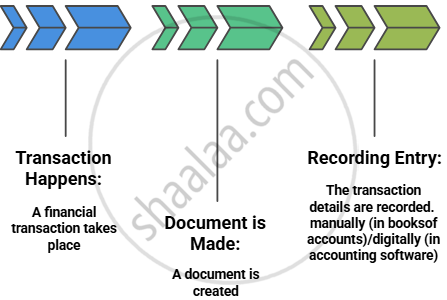
Steps in Recording Transactions
Maharashtra State Board: Class 11
Real-Life Examples
| Point/Concept | Example |
|---|---|
| Document | School report card, Aadhar card, or an electricity bill that gives you important information |
| Accounting Document | A cash memo showing the payment for a new computer |
| Importance of Accounting Documents | |
| Legal Proof | Showing a receipt in court to prove you actually paid for a service |
| Recording Transactions | Entering a rent expense in books when the landlord's rent receipt is received |
| Required by Law | A charity gives donation receipts to the charity commissioner for checking. |
| Easy Reference |
|
| Types of Accounting Documents | |
| Cash Memo | The store gives you a bill after buying shoes with cash |
| Receipt | You get a receipt when you pay your school or tuition fees |
| Invoice | The mobile store gives an invoice when you buy a phone on credit |
| Cheque | Writing a cheque to pay your hostel’s monthly rent |
| Debit Note | Returning damaged books to the supplier and sending them a debit note |
| Credit Note | Receiving a note from a supplier after returning goods purchased earlier |
| Steps in Recording Transaction |
|
Maharashtra State Board: Class 11
Key Takeaways
-
Every entry in account books is based on a document.
-
Accounting documents include memos, receipts, invoices, cheques, and notes.
-
These documents ensure accuracy, transparency, and legal safety for the business.
Related QuestionsVIEW ALL [11]
Complete the following table:
| Reasons | When Normal balance as per Cash Book is given Add/Less | When Normal balance as per Pass Book is given Add/Less |
| 1) Interest debited in Pass Book only. | ||
| 2) Direct deposit made by customer in bank recorded in Pass Book | (+) | |
| 3) Cheque deposited into bank but not yet collected by bank | ||
| 4) Cheque deposited into bank is dishonoured | (+) | |
| 5) Cheque issued but not presented for payment. | (-) |
