Topics
Introduction to Book-Keeping and Accountancy
- Accounting
- Book-Keeping
- Accountancy
- Book-Keeping vs. Accountancy
- Basis (Methods) of Accounting System
- Qualitative Characteristics of Accounting Information
- Basic Terms in Accounting
- Transaction
- Capital and Drawings
- Debtors, Creditors and Bad Debts
- Expenditure and Its Types
- Discount and Its Types
- Solvent Person vs. Insolvent Person
- Accounting Year
- Trading Concerns vs. Not for Profit Concerns
- Concept of Goodwill
- Fundamentals of Business Earnings
- Concepts of Assets, Liabilities and Net Worth
- Accounting Principles
- Accounting Concepts
- Core Accounting Concepts
- Accounting Standards
Meaning and Fundamentals of Double Entry Book-Keeping
Journal
- Accounting Documents
- Goods and Service Tax(GST)
- Types of Accounting Documents
- Voucher
- Tax Invoice (Under GST)
- Credit Memo
- Receipt
- Cheque
- Types of Cheques
- Books of Accounts
- Books of Accounts > Journal
- Journal Entries
- Journal Entries > Goods Account
- Journal Entries > Recording Discount in Journal
- Journal Entries > Other Important Journal Entries
Ledger
Subsidiary Books
- Concept of Subsidiary Books
- Cash Book
- Cash Book > Simple Cash Book (Single Column Cash Book)
- Cash Book > Two Column Cash Book (With Cash and Bank Columns)
- Cash Book > Petty Cash Book
- Simple Petty Cash Book
- Analytical Petty Cash Book
- Purchase Book
- Purchase Return Book
- Sales Book
- Sales Return Book
- Journal Proper
Bank Reconciliation Statement
- Accounting Documents Used in Banking
- Accounting Documents Used in Banking
- Pay-in-Slip
- Withdrawal Slip
- Bank Pass Book
- Bank Statement
- Bank Advice
- Concept of Virtual Banking
- Bank Reconciliation Statement(BRS)
- Cash Book vs Pass Book : Causes of Differences
- Time Difference(Regarding BRS)
- Errors and Omission Made by Bank or Businessman
- Formats of BRS
- Preparation of BRS
- Cash Book and Pass Book Comparison for Common Period
- Cash Book and Pass Book Balances for Different Periods
- Bank Balance as per Cash Book (Favourable / Debit Balance)
- Bank Balance as per Pass Book (Favourable / Credit Balance)
- Overdraft as per Cash Book (Unfavourable / Credit Balance)
- Overdraft as per Pass Book (Unfavourable/Debit balance)
- Reconciliation of Debtors and Creditors
Depreciation
Rectification of Errors
Final Accounts of a Proprietary Concern
Single Entry System
- Concept of Single Entry System
- Single Entry System vs. Double Entry System
- Parts of Single Entry System
- Statements of Affairs
- Statement of Profit or Loss
- Statement of Profit or Loss > Net Worth Method
- Practical Problems on Single Entry System
- Definition: Withdrawal Slip
- Comparison with Pay-in Slip
- Sample
- Advantages and Disadvantages
- Process Flow of a Withdrawal Slip
- Key Takeaways
Definition : Withdrawal Slip
A withdrawal slip is a simple paper form used at a bank branch to take money out of your own bank account.
Sample
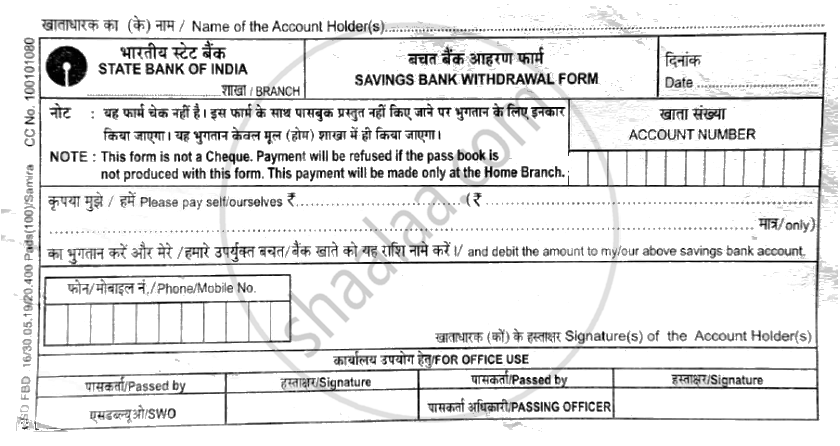
Contents:
-
Name of the Account Holder(s): The full name(s) of the person(s) who holds the account from which money is to be withdrawn.
-
Branch: The name of the specific bank branch where the form is being used.
-
Date: The day on which the withdrawal request is being made.
-
Account Number: The unique bank account number from which you want to withdraw money.
-
Note Section (in Hindi and English): This clarifies that the form is not a cheque; withdrawal will be refused if the passbook is not shown, and withdrawal is only allowed at the home branch.
The home branch refers to the specific branch of the bank where an account was originally opened and where the customer’s records are maintained -
Amount Section: The amount to be withdrawn, entered in both figures (₹) and words (Rupees ____ only).
-
Phone/Mobile No.: Space to enter the account holder’s contact number for correspondence or verification.
-
Signature of the Account Holder(s): The withdrawal slip must be signed by the account holder (or all holders, if joint) to authorize the transaction.
For Bank Use:
-
Passed by/Signature: Signature and designation of the bank staff who authorizes and processes the transaction.
-
SWO (Single Window Operator): Space for the operator’s signature to confirm processing.
A Single Window Operator (SWO) is a multi-tasking banking clerk responsible for handling a variety of customer transactions through one service window. In the context of the withdrawal slip -
Passing Officer: A higher-level officer’s signature for final approval.
Comparison with Pay-in Slip
| Basis | Withdrawal Slip | Pay-in Slip |
|---|---|---|
| Purpose | To withdraw money from a bank account | To deposit money into a bank account |
| Used by | Account holder only | Account holder or depositor |
| Transaction Type | Debit (removing funds) | Credit (adding funds) |
| Important Details | Account holder’s name, account number, amount (figures/words), date, account type, signature (front/back) | Account holder’s name, account number, amount, depositor’s signature, type of deposit (cash/cheque) |
| Bank’s Verification | Signature match with specimen signature, ID check | Signature (may be needed for identification), count of cash/cheque |
| Document Record | Slip retained by bank/passbook entry to customer | Slip retained by bank/stamped counterfoil to depositor |
| Additional Requirements | PAN card copy for withdrawals above ₹50,000 | Cheque number, denominations of notes (if cash) |
| Shows in Passbook? | Yes | Yes |
| Physical Appearance | Usually single slip with spaces for double signature | Usually contains a counterfoil for depositor |
| Other Notes | Cheque can also be used for cash withdrawal | Used for both cash and cheque deposits |
What is a Passbook?
A passbook is a small booklet given by the bank that shows a record of all the money you put in and take out of your account, so you always know your balance and transactions in one place.
Advantages and Disadvantages

Process Flow of a Withdrawal Slip

Key Takeaways
-
A withdrawal slip is a bank form to take cash from your account, used at your home branch and recorded in your passbook.
-
Fill the slip with your name, account number, branch, date, amount, and signature; attach a PAN copy if withdrawing over ₹50,000.
-
Only the account holder can use the slip; security relies on matching signatures and proper documents.
-
Pay-in slips are for depositing money; withdrawal slips are for taking out money.
