Topics
Understanding the Basics of Markets and Marketing
Markets and Marketing
- Concept of Market
- Types of Market
- Concept of Marketing
- Stages of Marketing
- Role of Marketing
- Meaning and Nature of Product
- Meaning and Nature of Service
- Difference Between a Product and a Service (With Examples)
- Reasons for Increasing Importance of Services
Marketing Mix - 4 P’S
- Concept of Marketing Mix
- Factors Influencing Marketing Mix
- Marketing Mix> Product
- Packaging
- Product Mix - Labeling
- Product Life Cycle (PLC)
- Price - Pricing Strategies
- Place - Distribution Channels
- Factors Determining Choice of Channel of Distribution
- Promotion and Promotional Techniques
Advertising and Brand Promotion
- Advertising and Brand Promotion
- Concept of Marketing
- Types of Advertising
- Objectives of Advertising
- Advantages of Advertising
- Criticism of Advertising
- Distinction Between Advertising and Publicity
- Features of a Good Advertisement
- Advertising Media
- Sales Promotion
- Distinction Between Advertising and Sales Promotion
- Definition and Merits of Brand and Branding
- How to Bring About Brand Promotion
Sales and the Selling Process
- Sales and the Selling Process
- Meaning of Sales
- Comparison Between Marketing and Selling
- Personal Selling
- Importance of Personal Selling
- Distinction Between Advertising and Personal Selling
- Steps in Personal Selling Process
- Qualities of a Good Salesman
- Distinction Between Sales and Selling Process
Understanding Finance
Generally Accepted Accounting Principles (GAAP)
- Generally Accepted Accounting Principles (GAAP)
- Meaning and Purposes of Accounting
- Book-Keeping vs. Accountancy
- Accounting Cycle
- Accounting Conventions Or Modifying Principles
Principles of Financial Accounting and Reporting
- Financial Accounting and Reporting
- Receipts and Payments Account
- Income and Expenditure Account
- Balance Sheet
- Concepts of Assets, Liabilities and Net Worth
Banking and Bank Transactions
- Banking
- Types of Bank
- Meaning of Central Bank
- Central Bank
- Central Bank as a Controller of Credit
- Functions of Commercial Bank
- Types of Bank Deposit Accounts
- Procedure of Opening a Bank Account
- Operating a Bank Account
- Types of Bank Accounts
- Advantages of Bank Account
- Cheque
- Types of Cheques
- Crossing of Cheques
- Bank Draft
- Travellers' Cheque
Fundamental Concept of Cost
- Fundamental Concept of Cost
- Elements of Cost
- Cost Unit, Cost Centre and Cost Sheet
- Classification of Costs
- Controllable and Uncontrollable Costs
Understanding Human Resources
Human Resource
- Human Resource in a Commercial Organization
- Role of Human Resource Management
- Functions of Human Resource Management
- Qualities of a Good Human Resource Manager
Recruitment, Selection and Training
- Aspects of Staffing > Recruitment
- Nature of Recruitment
- Sources of Recruitment
- Methods of Recruitment
- Importance of Employee Selection
- Advantages and Disadvantages of Recruitment
- Methods of Selection
- Interviews
- Types of Interviews
- Training
- Importance of Training
- Types of Training
- Methods of Training
Development of Public Relations
Public Relations
- Public Relations
- Nature of Public Relations
- Scope of Public Relations
- Public Relations as a Management Function
- Importance of Public Relations
- Scope of Public Relations
- Elements of Public Relations
- History of Public Relations
- Present Status of Public Relations
- Ethics in Public Relations
- Image Building
Issues of the Environment
- Ecosystem and Its Destruction
- Excessive Consumption of Resources
- Energy Crisis
- Environmental Values and Ethics
- Consumer Education
- Consumer Rights
- Effects of Pollution on Environment
- Community Participation and Public Awareness for Ecological Restoration and Conservation
- Definition: Cheque
- Definition: Chequebook
- Parties to a Cheque
- Sample Cheque
- Contents of Cheque
- Advantages vs. Disadvantages
- Real-Life Example
- Journey of a Cheque
- Example: Journey of Cheque
- Definition: Bouncing of Cheque
- Common Reasons for Cheque Bouncing
- Effects of Cheque Bouncing
- Tips for Writing a Cheque
- Key Takeaways
Definition : Cheque
A cheque is a written order from an account holder to their bank to pay a specified amount to another person or the bearer (anyone physically holding or presenting it). It is mostly valid for 3 months from the date of issue.
Definition : Chequebook
A chequebook contains several blank cheques, which can be used when payments or money transfers are needed. Banks give a chequebook to their account holders if they keep a certain minimum balance.
Parties to a Cheque
| Party | Role |
|---|---|
| Drawer | Person drawing (writing) the cheque |
| Drawee | Bank upon whom the cheque is drawn (that is, to whom the payment order is given), where the cheque will be processed |
| Payee | Person to whom payment is made |
Sample Cheque
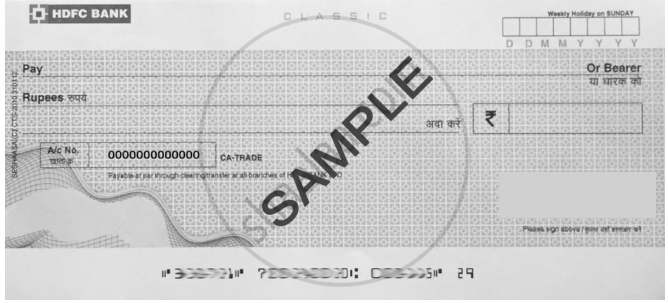
Contents of Cheque
| Content Item | Where Is It Found on Cheque? | Explanation |
|---|---|---|
| Bank Name & Branch | Top of cheque | Identifies the bank and the branch which issued the cheque |
| Date | Top right | The date when the cheque is issued; the format is DD/MM/YYYY (Day/Month/Year). |
| Payee’s Name | Beside “Pay” field | The person or entity to whom the payment is to be made |
| Amount in Words | Middle section (“Rupees”) | The amount is written in words with the word "only" to avoid confusion and fraud |
| Amount in Figures | In the rectangular box | The amount is written in numerical format to ensure clarity |
| Drawer’s Name | Printed on cheque | Name of account holder who issues the cheque |
| Drawer’s Signature | Bottom right | Authorizes payment; must match bank records |
| Cheque Number | Bottom left/top | A unique number assigned to each cheque for identification |
| Account Number | Bottom | Identifies the account from which the money will be deducted |
| MICR Code | Bottom (left side, 9 digits) | Magnetic Ink Character Recognition: Helps banks quickly and securely process cheques by reading branch and bank details with special magnetic ink |
| IFSC Code | Top/bottom (11 characters) | Indian Financial System Code: Used for electronic money transfers; identifies bank branch for online NEFT/RTGS/IMPS payments |
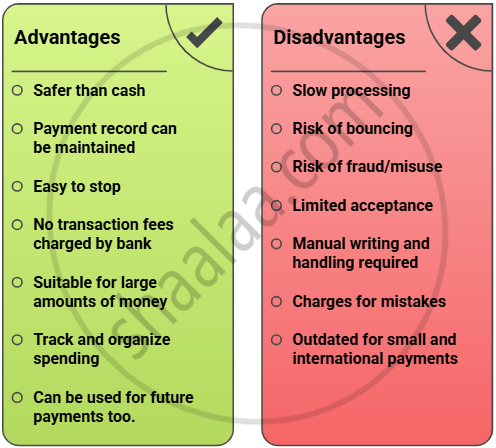
Advantages vs. Disadvantages
Real-Life Example
Imagine a shopkeeper wants to pay a supplier. He writes a cheque in favor of the supplier, fills in all the details properly, and gives it to the supplier. The supplier deposits it in the bank, and the money is transferred securely.
Journey of a Cheque
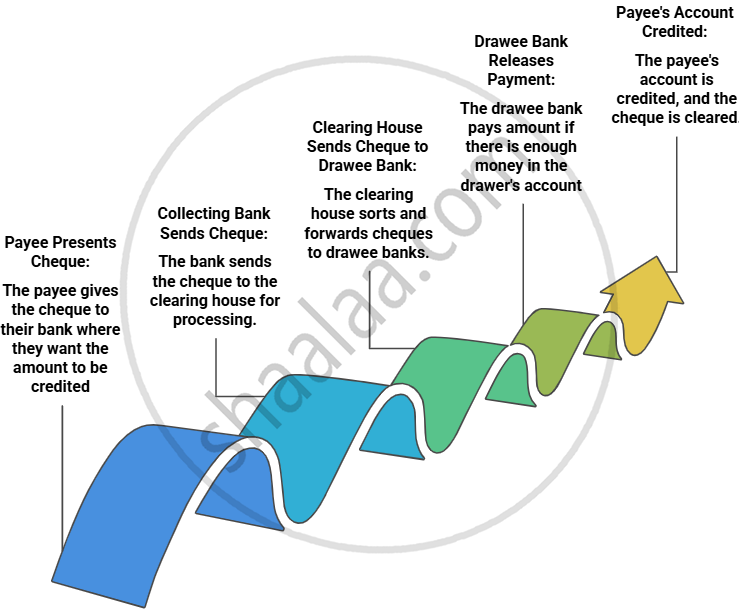
Important Terms:
- Collecting Bank: Bank where payee presents cheque
- Drawee Bank: Bank to whom payment order is given,by drawer of cheque.
- Crediting of Account : Money is received in the bank account.
- Clearing House & Sorting Cheques: A clearing house is an organisation (usually run by RBI or banks) where cheques from different banks are collected and sorted.
Cheques are sorted by the bank and branch they are drawn on using codes like MICR and IFSC. Once sorted, they are sent electronically to the correct banks for approval and payment.
Examples : Journey of Cheque
| Step | Action | Example |
|---|---|---|
| 1 | Issue/drawing of cheque by drawer to payee | A writes a cheque and gives it to B to pay him ₹10,000 |
| 2 | The payee deposits cheque in their bank | B presents the cheque to his bank (Bank Y). |
| 3 | The collecting bank sends cheque to clearing house | Bank Y forwards cheque to clearing house. |
| 4 | Clearing house sorts cheques, sends to drawee bank | Clearing house sends A’s cheque to Bank X (A’s bank). |
| 5 | Drawee’s bank checks for sufficiency of funds and other details | Bank X verifies if:
|
| 6 | If all is correct, clearance happens and the amount is credited to the payee. | B’s account with Bank Y is credited with ₹10,000. |
Definition : Bouncing of Cheque
A cheque is said to be bounced or dishonoured when the bank refuses to pay the amount written on the cheque.
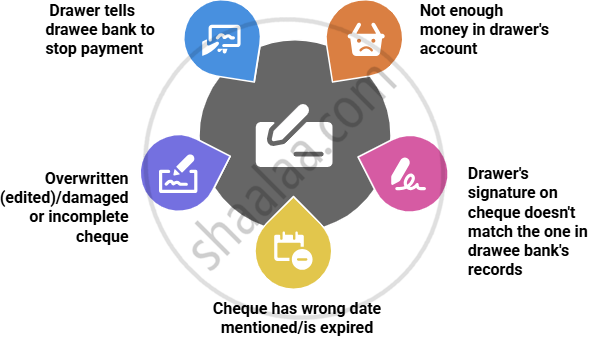
Common Reasons for Cheque Bouncing
Effects of Cheque Bouncing
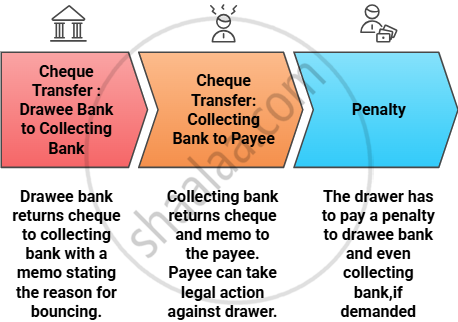
In India, if you draw a cheque and it bounces (the bank refuses to pay) because there is not enough money in your account, it is treated as a crime.
This rule is given in Section 138 of the Negotiable Instruments Act, 1881.
If your cheque bounces, the payee can complain in court. The punishment can be a fine or even jail.
Tips for Writing a Cheque
- Always check there is enough money in your account before issuing a cheque.
- Use permanent ink and avoid overwriting (editing what you have written).
- Never leave blank spaces—fill all columns clearly.
- Your signature must match the one registered at the bank.
Key Takeaways
- A cheque is a written order to the bank to pay money to someone.
- It is safer than carrying cash and helps keep records.
- Good for big payments and gives legal proof.
- Cheques take a few days to clear—they are not instant.
- Can “bounce” (dishonoured) if there’s not enough money or mistakes in writing.
- If a cheque bounces, the person may have to pay a penalty and can face legal trouble.
- Cheques are less used for small or online payments today.
