Advertisements
Chapters
*: Use of Literary Devices in Acts-1 and 2 - Scene 1
*: Use of Literary Devices in Acts-1 and 2 - Scene 2
*: Use of Literary Devices in Acts-1 and 2 - Scene 3
Act 2
*: Use of Literary Devices in Acts-1 and 2 - Scene 1
*: Use of Literary Devices in Acts-1 and 2 - Scene 2
*: Use of Literary Devices in Acts-1 and 2 - Scene 3
*: Use of Literary Devices in Acts-1 and 2 - Scene 4
*: Project Work- Acts-1 and 2
Act 3
*: Use of Literary Devices in Acts 3, 4 and 5 - Scene 1
*: Use of Literary Devices in Acts 3, 4 and 5 - Scene 2
*: Use of Literary Devices in Acts 3, 4 and 5 - Scene 3
Act 4
*: Use of Literary Devices in Acts 3, 4 and 5 - Scene 1
*: Use of Literary Devices in Acts 3, 4 and 5 - Scene 2
*: Use of Literary Devices in Acts 3, 4 and 5 - Scene 3
Act 5
*: Use of Literary Devices in Acts 3, 4 and 5 - Scene 1
*: Use of Literary Devices in Acts 3, 4 and 5 - Scene 2
▶ *: Use of Literary Devices in Acts 3, 4 and 5 - Scene 3
*: Use of Literary Devices in Acts 3, 4 and 5 - Scene 4
*: Use of Literary Devices in Acts 3, 4 and 5- Scene 5
*: Project Work- Acts-3, 4 and 5
Advertisements
Solutions for Chapter *: Use of Literary Devices in Acts 3, 4 and 5 - Scene 3
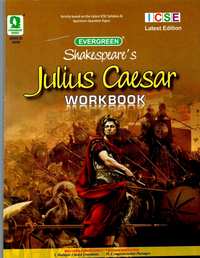
Below listed, you can find solutions for Chapter * of CISCE Shirin Puri Lama for English Shakespeare's Julius Caesar Workbook Class 9 and 10 ICSE.
Shirin Puri Lama solutions for English Shakespeare's Julius Caesar Workbook Class 9 and 10 ICSE * Use of Literary Devices in Acts 3, 4 and 5 - Scene 3 ASSIGNMENTS [Pages 240 - 250]
MULTIPLE CHOICE QUESTIONS Choose the correct answers to the questions from the given options: Analysis, Application and Evaluation:
Which of the given options lists the sequence of events in the correct order?
- During the battle at Philippi, Brutus's army inflicts an early defeat on Octavius' troops.
- Seeing some troops in the distance, Cassius sends Titinius on horseback to check if they are 'friend or foe'.
- Meanwhile, in another part of the battleground, Cassius learns that his camp has been surrounded by Antony's soldiers and is being attacked.
- Pindarus, seeing Titinius surrounded by horsemen, assumes that he has fallen into enemy hands and reports to Cassius that he (Titinius) has been taken captive.
- Next, Cassius instructs his servant Pindarus to climb a hill nearby so that he can give him a detailed account of all that happens to Titinius.
ii, iv, iii, v, i
iv, v, i, iii, iv
i, v, ii, iv, iii
i, iii, ii, v, iv
To whom does Brutus refer when he says, “Are yet two Romans living such as these?”
Antony and Octavius.
Cassius and Titinius.
Pindarus and Lucius.
Strato and Lucillius.
When Cassius says about his soldiers running away from the battlefield.
“O, look Titinius look, the Vallains fly!”
He says this in a tone which can be identified as ______.
surprised.
alarmed.
angry.
pleasant.
Honourable Brutus’ men indulging in looting instead of helping Cassius is something ______.
ironical.
amusing.
sarcastic.
joyful.
We see a changed Cassius here. How has his temperament undergone this change?
- He appears to be even more scheming and cunning.
- He appears to be ruthless and uncaring.
- He loves Titinius like his best friend and is sentimental.
- He wants his slave Pindarus to become a free man.
1 and 2
3 and 4
1 and 4
3 and 2
How is Caesar's spirit active whereas Cassius' death is concerned?
Cassius hates Caesar till the very end.
Cassius dies by the same sword with which he had struck Caesar.
The spirit of Caesar descends into Cassius.
The spirit of Caesar kills Cassius.
How does Titinius show his love for Cassius in the end?
By praising Cassius.
By piercing his heart with Cassius’ sword.
By crying and weeping bitterly.
By following Pindarus to Rome.
Brutus does not want Cassius’ funeral to take place in the camp because ______.
it would cause delay.
it would be a waste of time.
it would discomfort the soldiers.
it would make the soldiers feel weak and exhausted.
What was the reason that made Cassius commit suicide?
Frustration and anger.
Disillusionment.
Error of judgement.
Pessimism.
Recalling and Understanding:
Brutus at the end of the scene prepares for ______.
a second battle.
a third battle.
reconciliation.
death.
Cassius slew the standard-bearer because he was not ______.
loyal to him.
obedient to him.
wanting to live.
interested to fight any more.
Where are Cassius’ troops in this scene?
They, having been defeated by Antony, have run away.
They have climbed up a hill.
They are marching to attack Antony’s troops.
They are on a looting spree.
According to Titinius, what is the result of Brutus giving orders to attack too early?
Brutus’ army got defeated and ran away.
Brutus’ soldiers engaged themselves in looting whereas they could have come to Cassius’ help.
Brutus’ army advanced far too late, ending in their defeat.
Brutus was a good general and acted wisely.
What terrible news does Pindarus bring as he comes to Cassius?
Octavius’ army is marching towards them.
Cassius’ men have deserted him.
Mark Antony has entered his tents and Cassius must run away.
Mark Antony has entered his tents and wants Cassius to escape.
What does Cassius tell himself as Pindarus ascends the hill?
This day is not only his birthday but his day of death as well.
It is his birthday and he will rejoice.
He will wait for Brutus to come and wish him.
He will not celebrate his birthday as he is dejected.
What news does Pindarus give Cassius?
Titinius has been captured by the enemy troops who have surrounded him.
Titinius has joined the enemy camp against Cassius.
Titinius has not followed Cassius’ orders.
Titinius has run away.
What does Cassius lament?
Pindarus has been taken prisoner.
His best friend, Titinius, has been captured and he is helpless.
Titinius has betrayed him.
Titinius will never come back to him.
What does Cassius cry out as Pindarus stabs him?
Pindarus, you traitor!
Caesar, where art thou?
Caesar, thou art revenged…
Come hither, sirrah.
What does Pindarus tell himself after he stabs Cassius?
He will never desert Cassius.
He will stay by his side.
He is now free to run so far away that no Roman can find him.
He will run away to Rome to become a Roman citizen.
Where had Titinius left Cassius before he left?
Inside his tent in a happy mood.
Outside his tent in a sad mood.
Sad and sorrowful with Pindarus on the hill.
On the battlefield with his soldiers.
‘The sun of Rome is set’ is a tribute paid to Cassius by ______.
Pindarus.
Cato.
Titinius.
Brutus.
What does Titinius place on his beloved Cassius’ forehead?
A wreath of thorns given to him by Antony.
A wreath of victory given to him by Brutus to give to Cassius.
A garland of flowers.
A bouquet of flowers.
Brutus calls out to Julius Caesar, whose spirit
Turns their own swords into their bodies.
Goes around spying.
Hovers around doing harm.
Helps Antony to win the battle.
Who, according to Brutus, is ‘the last of all the Romans’?
Cassius.
Titinius.
Pindarus.
He himself.
CONTEXT QUESTIONS
Read the following extract from Julius Caesar and answer the questions that follow:
| Messala: Is not that he? Titinius: No, this was he, Messala, But Cassius is no more, - O setting Sun, As in thy red rays thou dost sink to-night, So in his red blood Cassius’ day is set; The sun of Rome is set! Our day is gone; Clouds, dews, and dangers come; our deeds are done! Mistrust of my success hath done this deed. |
- Where does this scene take place? What is the nature of the relationship that Titinius and Cassius shared? (Recall & Analysis)
- Give two words that would best describe Titinius’ mood in the given extract. Justify your choice of words. (Evaluate)
- Earlier in Act V, Cassius shares some facts about himself with Messala - what are these facts? (Recall)
- How did Cassius die? What were his dying words? (Recall)
- What does the phrase, ‘this deed' in the last line of extract refer to? Explain in your own words what Titinius means by, 'Mistrust of my success hath done this deed'. (Understanding)
Read the following extract from Julius Caesar and answer the questions that follow:
| CASSIUS - O, look, Titinius, look, the villains fly! Myself have to mine own turn’d enemy: This ensign here of mine was turning back; I slew the coward and did take it from him. |
- Who have been called 'The villains'? (Recalling)
- Why did Cassius turn enemy to some of his own soldiers? (Understanding)
- What error had Brutus made? What was the result of his error? (Understanding & Analysis)
- What disastrous effect did this error have on Cassius and Titinius? (Analysis)
- Did Brutus realize his error? Give reasons for your answer. (Recalling & Analysis)
Read the following extract from Julius Caesar and answer the questions that follow:
| CASSIUS - Go, Pindarus, get higher on that hill; My sight was ever thick; regard Titinius, And tell me what thou not’st about the field. |
- Who is Pindarus? What does Cassius ask Pindarus to do? (Recalling)
- After the exit of Pindarus, what does Cassius say about himself? (Recalling)
- What news has Pindarus already brought? What is Cassius's reaction on hearing the news? (Recalling & Understanding)
- Why is the day significant to Cassius apart from being his 'birthday' the day he was born? (Understanding & Analysis)
- What had Cassius earlier advised Brutus in the play? How had Cassius disagreed with Brutus? (Recalling & Analysis)
Read the following extract from Julius Caesar and answer the questions that follow:
| TITINIUS - These tidings will well comfort Cassius MESSALA - Where did you leave him? TITINIUS - All disconsolate, With Pindarus his bond man, on this hill. |
- What are the tidings that would comfort Cassius? (Recalling)
- In what condition is Cassius found? (Recalling)
- State briefly how Titinius expresses his devotion to Cassius. (Recalling & Understanding)
- What is the word used by Titinius for the deed to be committed? (Recalling)
- What are your feelings for Cassius at this point of the play? Was this act of Cassius justified? Give reasons for your answer. (Understanding & Evaluation)
Read the following extract from Julius Caesar and answer the questions that follow:
| MESSALA - Mistrust of good success hath done this deed O hateful error, Melancholy’s child, Why dost thou show to the apt thoughts of men The things that are not? |
- Explain the literary device used in this extract. (Application)
- What was the ‘mistrust of good success’? What error did Cassius make? How did his pessimism lead to his suicide? (Understanding & Analysis)
- What does Titinius do to himself? What does this act of his prove? (Recalling & Analysis)
- When Brutus enters the scene a little later, he refers to Julius Caesar. Why? (Understanding)
- What tribute does Brutus pay to Cassius? (Recalling)
Read the following extract from Julius Caesar and answer the questions that follow:
| Alas, thou hast misconstrued everything But hold thee, take this garland on thy brow; Thy Brutus bid me give it thee, and I will do his bidding. |
- Who is the speaker? Whom is he speaking to? (Recalling)
- In what way had the person spoken to misconstrued everything? (Understanding)
- What does the speaker do at the end of his speech? Why does he do so? (Recalling)
- Who enters shortly after the deed of the speaker? How does Cato praise the speaker? (Recalling)
- Did Caesar's spirit truly take its revenge? Give reasons for your answer. (Analysis & Evaluation)
Read the following extract from Julius Caesar and answer the questions that follow:
| BRUTUS - Are yet two Romans living such as these? The last of all the Romans, fare thee well! It is impossible that ever Rome should breed thy fellow. |
- After this extract, why does Brutus want Cassius' dead body to be kept away from his soldiers? (Understanding)
- What does Brutus mean when he says “The last of all the Romans”? (Understanding)
- Which two Romans is Brutus speaking about? (Recalling)
- What instructions are given by Brutus at the end of the scene? (Recalling)
- Which important aspect of Brutus' character is revealed in the extract? Briefly compare and contrast the characters of Brutus and Cassius with reference to Act V. (Understanding & Analysis)
COMPETENCY - FOCUSED QUESTIONS
Solutions for *: Use of Literary Devices in Acts 3, 4 and 5 - Scene 3
Shirin Puri Lama solutions for English Shakespeare's Julius Caesar Workbook Class 9 and 10 ICSE chapter * - Use of Literary Devices in Acts 3, 4 and 5 - Scene 3
Shaalaa.com has the CISCE Mathematics English Shakespeare's Julius Caesar Workbook Class 9 and 10 ICSE CISCE solutions in a manner that help students grasp basic concepts better and faster. The detailed, step-by-step solutions will help you understand the concepts better and clarify any confusion. Shirin Puri Lama solutions for Mathematics English Shakespeare's Julius Caesar Workbook Class 9 and 10 ICSE CISCE * (Use of Literary Devices in Acts 3, 4 and 5 - Scene 3) include all questions with answers and detailed explanations. This will clear students' doubts about questions and improve their application skills while preparing for board exams.
Further, we at Shaalaa.com provide such solutions so students can prepare for written exams. Shirin Puri Lama textbook solutions can be a core help for self-study and provide excellent self-help guidance for students.
Concepts covered in English Shakespeare's Julius Caesar Workbook Class 9 and 10 ICSE chapter * Use of Literary Devices in Acts 3, 4 and 5 - Scene 3 are .
Using Shirin Puri Lama English Shakespeare's Julius Caesar Workbook Class 9 and 10 ICSE solutions Use of Literary Devices in Acts 3, 4 and 5 - Scene 3 exercise by students is an easy way to prepare for the exams, as they involve solutions arranged chapter-wise and also page-wise. The questions involved in Shirin Puri Lama Solutions are essential questions that can be asked in the final exam. Maximum CISCE English Shakespeare's Julius Caesar Workbook Class 9 and 10 ICSE students prefer Shirin Puri Lama Textbook Solutions to score more in exams.
Get the free view of Chapter *, Use of Literary Devices in Acts 3, 4 and 5 - Scene 3 English Shakespeare's Julius Caesar Workbook Class 9 and 10 ICSE additional questions for Mathematics English Shakespeare's Julius Caesar Workbook Class 9 and 10 ICSE CISCE, and you can use Shaalaa.com to keep it handy for your exam preparation.
