Advertisements
Chapters
*: Use of Literary Devices in Acts-1 and 2 - Scene 1
*: Use of Literary Devices in Acts-1 and 2 - Scene 2
*: Use of Literary Devices in Acts-1 and 2 - Scene 3
Act 2
*: Use of Literary Devices in Acts-1 and 2 - Scene 1
*: Use of Literary Devices in Acts-1 and 2 - Scene 2
*: Use of Literary Devices in Acts-1 and 2 - Scene 3
*: Use of Literary Devices in Acts-1 and 2 - Scene 4
*: Project Work- Acts-1 and 2
Act 3
▶ *: Use of Literary Devices in Acts 3, 4 and 5 - Scene 1
*: Use of Literary Devices in Acts 3, 4 and 5 - Scene 2
*: Use of Literary Devices in Acts 3, 4 and 5 - Scene 3
Act 4
*: Use of Literary Devices in Acts 3, 4 and 5 - Scene 1
*: Use of Literary Devices in Acts 3, 4 and 5 - Scene 2
*: Use of Literary Devices in Acts 3, 4 and 5 - Scene 3
Act 5
*: Use of Literary Devices in Acts 3, 4 and 5 - Scene 1
*: Use of Literary Devices in Acts 3, 4 and 5 - Scene 2
*: Use of Literary Devices in Acts 3, 4 and 5 - Scene 3
*: Use of Literary Devices in Acts 3, 4 and 5 - Scene 4
*: Use of Literary Devices in Acts 3, 4 and 5- Scene 5
*: Project Work- Acts-3, 4 and 5
Advertisements
Solutions for Chapter *: Use of Literary Devices in Acts 3, 4 and 5 - Scene 1
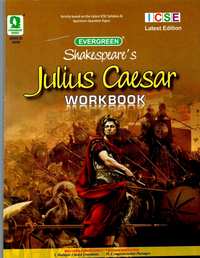
Below listed, you can find solutions for Chapter * of CISCE Shirin Puri Lama for English Shakespeare's Julius Caesar Workbook Class 9 and 10 ICSE.
Shirin Puri Lama solutions for English Shakespeare's Julius Caesar Workbook Class 9 and 10 ICSE * Use of Literary Devices in Acts 3, 4 and 5 - Scene 1 ASSIGNMENTS [Pages 139 - 154]
MULTIPLE CHOICE QUESTIONS Choose the correct answers to the questions from the given options: Analysis, Application and Evaluation:
What does Antony describe as, ‘thou bleeding piece of earth’?
Caesar’s robe that was stained with his blood.
The blood-soaked spot on which Caesar lies.
The bloodied pedestal on which Caesar fell.
Caesar's lifeless body covered in blood.
When Brutus says, ‘ambition’s debt is paid’, he means that ______.
Caesar’s greed for power and possession had resulted in his death.
Caesar had left seventy-five drachmas for every citizen of Rome.
Mark Antony would be permitted to speak at Caesar’s funeral.
The conspirators would be punished for assassinating Caesar.
“O world, thou were the forest to this hart, and this indeed, O world, the heart of theе.”
Which of the following uses the same literary device as given above?
The bees buzzed around the flower-filled garden.
Her eyes are buttons.
She caught the scent of mothballs in the abandoned home.
Broken pencils are pointless.
Caesar's comparing himself with the Pole Star shows his ______.
Bravery and courage
Honesty and determination
Arrogance and overconfidence
Self-respect and boldness
'As fire drives out fire, so pity pity'.
The literary device used in this line is ______.
Metaphor
Simile
Oxymoron
Irony
Which of the following answers is NOT true?
When Artemidorus for the second time insists that Caesar read his letter first since it concerns him personally, Caesar arrogantly says:
What touches us ourself shall be first served.
The Ides of March are come.
What touches us ourself shall be last served.
Give way.
While the unsuspecting Caesar is getting ready to start the business of the day, what are the conspirators getting ready for?
Not getting ready to do anything
Hatching a plot to stab Antony
Getting ready to stab him to death
Getting very excited
Although the real Julius Caesar was a thorough gentleman, Shakespeare presents Caesar to be arrogant due to ______.
His strong dislike for Caesar
His intention to create fun to keep the audience entertained
Dramatic needs to keep the audience's interest and show that his murder is justified
His wish to distort history and mislead his audience
Why does Caesar compare himself to the Pole Star?
It keeps its place firm and never changes, just like him.
It shines the brightest of all the stars, just like him.
It helps sailors and navigators.
He likes to imagine himself as a star.
How did the expression 'stab in the back' come about?
Due to Casca stabbing the unsuspecting Caesar in the neck from behind, which is a cowardly act
Due to Brutus pleading for Metellus Cimber's brother
Because all the conspirators stabbed Caesar together
By Casca being stabbed in the neck by the other conspirators
Maybe, Caesar's assassination would have been prevented had ______.
- he not acted so arrogantly and read the warning letter of Artemidorus.
- the conspirators got scared of committing such a ghastly act.
- Brutus' conscience worried him before the stabbing began.
- he listened to Calpurnia and stayed at home.
1 and 4
2 and 3
1 and 2
2 and 4
What is the significance of Antony's servant coming to the conspirators?
It is the turning point of the entire play and marks the entry of the shrewd and cunning Antony to seek revenge.
It introduces Mark Antony to the audience.
It introduces him to the audience so that they get to know what is to transpire.
He introduces himself to the conspirators in order to stay in their good books.
One proof that Cassius is a better politician than Brutus is when he ______.
Also welcomes the idea of allowing Antony to come and become their friend.
Tells Brutus that he fears Antony and that his doubts generally come true.
Goes and personally escorts Antony to Brutus.
Begins to trust Antony as a friend, just like the idealistic Brutus.
What is Cassius referring to by 'lofty scene'?
The act of killing Caesar, which Cassius regards as a noble deed in order to save democracy.
The ceremony of waving their daggers in the air
The scene where Caesar had referred to Mt. Olympus
When Casca had struck Caesar
The act of washing their hands in Caesar's blood seems to be a fulfilment of ______.
What Shakespeare wanted to portray
Calpurnia's terrible dream in the previous act
The audience watching the play
The rituals that prevailed at that time
When is the idealistic Brutus touched and impressed by the cunning Antony?
When he openly displays his sorrow over the dead body of Caesar in full view of all the conspirators
When he requests each of the conspirators to let him be a part of them
When Antony sends his servant to speak with the conspirators in a polite manner
When Antony demands that he be allowed to speak at Caesar's funeral
Whom does the mighty Caesar arrive with?
Mark Antony
Cassius
Casca and Cassius
Antony, Lepidus and all the conspirators
Among the crowd in the street leading to the Capitol are ______.
Artemidorus and the soothsayer
Artemidorus and Caesar
Brutus and Caesar
The soothsayer and Antony
Upon seeing the soothsayer, Caesar tauntingly remarks that the 'Ides of March are come'. What does the soothsayer replies:
Ay Caesar; that is true
Ay Caesar; but not gone
Ay Caesar; and will soon be over
Ay Caesar; and you will soon be murdered
Recalling and Understanding:
Why does Caesar tell Metellus Cimber to stop his dog-like flattery and fawning?
His brother does not want to come back to Rome
His brother has been banished by a legal decision which cannot be changed
Metellus is looking foolish in his eyes
Caesar wants to get on with other important matters
Why is Cassius against allowing Mark Antony to give a funeral speech?
He does not know what Antony will say and how it may influence the people.
He is not a good orator and may not get the attention of the people.
He is too soft-hearted and may break down.
He may not speak the truth.
Through his servant, Antony asks Brutus to grant him ______.
The assurance that Caesar would be given a state funeral.
The assurance that Caesar's will be given to him.
Permission to leave Rome safely so that his life is spared.
Assurance that he would not be harmed and an explanation for Caesar's assassination.
One of the conditions on which Antony is allowed to speak at Caesar's funeral is that ______.
He will only speak badly of the dead Caesar.
He will only speak after Brutus has spoken.
He will blame Caesar.
He will give full support to the conspirators.
One proof of Mark Antony's deep devotion and loyalty towards Julius Caesar is that ______.
He makes sure to avenge Caesar's horrible murder and bring about the doom of the conspirators.
He sees to it that each of the conspirators is murdered.
He burns down each of their houses.
He gets them arrested and thrown into prison.
Once all the conspirators leave and he is left alone, what does Mark Antony do?
quickly leaves the scene in order to plan his course of action
grieves over the body of the slain Caesar and asks him to forgive him for extending his hand of friendship towards them
silently weeps over the dead body of his dear Caesar
he is in a daze for he is still in shock over Caesar's ghastly murder
CONTEXT QUESTIONS
Read the following extract from Julius Caesar [Act III Scene 1] and answer the questions that follow:
|
Antony: Post back with speed, and tell him what hath chanc'd Here is a mourning Rome, a dangerous Rome, No Rome of safety for Octavius yet; Hie hence and tell him so. Yet, stay awhile; Thou shalt not back till I have borne this corpse Into the marketplace: there shall I try. In my oration, how the people take The cruel issue of these bloody men; According to which, thou shalt discourse To young Octavius of the state of things. Lend me your hand. |
- What instructions does Antony give the servant? (Recall)
- Why does Antony say 'Rome is dangerous'? Whom is it not safe for? Why? (Understanding, Recall and Analysis)
- Mention any three predictions that Antony makes when he is left alone with Julius Caesar's dead body. (Recall)
- What was Brutus' and Cassius' opinion of Antony? Whose assessment about Antony was correct? Justify your answer. (Recall, Analysis and Evaluation)
- What aspects of Antony's character are revealed in Act III and Act IV? (Evaluate)
Read the following extract from Julius Caesar [Act III Scene 1] and answer the questions that follow:
|
CAESAR (to the soothsayer) The Ides of March are come Soothsayer – Ay Caesar, but not gone ARTEMIDORUS – Hail Caesar! Read this schedule. DECIUS – Trebonius doth desire you to o'er read, |
- Why does Artemidorus want Caesar to read the letter? (Understanding)
- What does Popilus say to Cassius? Why does Cassius get tensed up? What does he instruct Casca to do? (Recalling & Understanding)
- What makes Brutus tell Cassius to be calm? (Understanding & Analysis)
- Who takes Antony out of the way? Why? What is Metellus Cimber's suit to Caesar? (Recalling & Analysis)
- State three instances to show Caesar's high-handedness in not granting Metellus Cimber's suit. (Application)
Read the following extract from Julius Caesar [Act III Scene 1] and answer the questions that follow:
|
METALLUS - Is there no voice more worthy than my own To sound more sweetly in great Caesar's ear For _____________? |
- Who is Metallus pleading for? What is his request to Caesar? Is he really sincere about this request? Why? (Recalling & Evaluation)
- Why does Caesar not permit Metallus to kneel before him? What four things according to Caesar melt foolish people? Why is he not like these fools? (Understanding & Analysis)
- What reason does Caesar give Metallus that tells us that he will go by the law of the land? What does Caesar threaten Metallus with if he keeps on kneeling and begging? (Recalling)
- Complete the last line of the speech given above. (Recalling)
- Who responds to Metallus' request? What does he tell Caesar? (Recalling)
Read the following extract from Julius Caesar [Act III Scene 1] and answer the questions that follow:
|
CAESAR - What, Brutus! CASSIUS - Pardon, Caesar; Caesar, pardon; as low as thy foot doth Cassius fall, To beg enfranchisement for Publius Cimber. CAESAR - I could be well moved, if I were as you; If I could pray to move, prayers would move me: But I am constant as the _______ |
- What request has Brutus made to make Caesar exclaim 'What, Brutus!? Why is Caesar shocked at Brutus' request? (Recalling & Analysis)
- What appeal does Cassius make after Brutus? How is his behaviour here unlike him? (Recalling and Analysis)
- What reply does Caesar give Cassius? Between Brutus and Cassius, who does Caesar like better? (Recalling & Analysis)
- What does Caesar compare himself to in the blanks in the extract? Mention two qualities of this object. How does he compare himself to the object? (Application)
- What is the purpose of Caesar comparing himself with this object? (Analysis)
Read the following extract from Julius Caesar [Act III Scene 1] and answer the questions that follow:
| CASCA - Speak hands for me! |
- Who is Casca? What duty has he been given? By whom? (Recalling)
- What does Casca do to make his 'hands speak'? Why do you think it is a cowardly act? (Understanding & Analysis)
- Who strikes Caesar last? What is his relationship with Caesar? What does Caesar cry out? What is the significance of his last words? (Recalling, Understanding & Analysis)
- Where does Caesar fall? Explain the irony of where he lay dead. How does Caesar's assassination affect the story line of the play? (Recalling, Understanding & Analysis)
- How do Cinna and Cassius react immediately after they have stabbed Caesar to death? How does Brutus try to appease the people? How does he show that he has performed an honourable act? What does it tell us about Brutus? (Recalling & Analysis)
Read the following extract from Julius Caesar [Act III Scene 1] and answer the questions that follow:
|
BRUTUS - Stoop, Romans, stoор, And let us bathe our hands in Caesar's blood up to the elbows, and besmear our swords: Then walk we forth, even to the market place. |
- How does Brutus justify Caesar's murder before saying these words? Do you agree with him? (Recalling & Analysis)
- How does Brutus feel about this act of washing their hands with Caesar's blood? (Understanding & Analysis)
- What does Brutus say about the way he and his companions are to conduct themselves in the market? Why does he plan to do so? (Recalling & Interpretation)
- What does Cassius have to say about how Caesar's assassination will be viewed in future? How does Brutus support what Cassius has said? Write the answer in your own words. (Recalling & Understanding)
- What does Cassius say that the conspirators will be called? What error of judgement does this group make as it brags about having killed Caesar? (Recalling & Analysis)
Read the following extract from Julius Caesar [Act III Scene 1] and answer the questions that follow:
| Soft! Who comes here? |
- What does the servant tell about Antony after meeting Brutus when Caesar has been killed? (Recalling)
- Who spoke these words? Name any two other persons who were present there. (Recalling)
- What four adjectives does the servant use for the speaker? Do you think that these four adjectives are justified? Why? (Recalling, Analysis & Evaluation)
- What two requests does the person make? What is the behaviour of this person towards the speaker? (Recalling & Analysis)
- What does the speaker assure this person? Why do you think the speaker's assurance is the turning point of the play? What does the person say before leaving? (Recalling, Analysis & Evaluation)
Read the following extract from Julius Caesar [Act III Scene 1] and answer the questions that follow:
|
ANTONY – O mighty Caesar! Dost thou lie so low? Are all thy conquests, glories, triumphs, spoils, Shrunk to this little measure? Fare thee well. |
- After having said those words, what does Antony wish for? Why does he make such a wish? (Recalling & Analysis)
- While responding to Antony's speech what reason does Brutus give for not granting Antony's wish? How does he justify to Antony the reason for murdering Caesar? (Recalling & Understanding)
- How does Brutus try to convince Antony that they have no ill will towards him? What does Antony do to extend his hand of friendship towards the conspirators? What is Antony's ulterior motive in doing so? Is Antony really a 'coward' who stands on such slippery grounds? (Understanding & Analysis)
- What does Antony compare Caesar and the conspirators with? How does Antony win the confidence of the conspirators? (Recalling & Understanding)
- What request does Antony make? Who objects to his request? Was the person who objected sound in his judgement of Antony? How? (Recalling & Evaluation)
Read the following extract from Julius Caesar [Act III Scene 1] and answer the questions that follow:
|
ANTONY – O, pardon me, thou bleeding piece of earth, That I am meek and gentle with these butchers! Thou art the ruins of the noblest man That ever lived in tide of times. |
- Explain the figure of speech used in the extract. (Application)
- When, why and how had Antony been meek and gentle with these butchers? What trait of Antony's character do you assess by this action? (Recalling & Analysis)
- What does Antony prophesize on seeing the wounds of Caesar? Who will roam about to take revenge? Does Antony's prophecy come true? How? (Recalling & Analysis)
- Who enters after Antony's soliloquy? What news does the person bring? (Recalling)
- What does Antony tell the person to convey to the person who has sent him? What two things does Antony request the person to do at the end of the scene? (Recalling)
COMPETENCY - FOCUSED QUESTIONS
Solutions for *: Use of Literary Devices in Acts 3, 4 and 5 - Scene 1
Shirin Puri Lama solutions for English Shakespeare's Julius Caesar Workbook Class 9 and 10 ICSE chapter * - Use of Literary Devices in Acts 3, 4 and 5 - Scene 1
Shaalaa.com has the CISCE Mathematics English Shakespeare's Julius Caesar Workbook Class 9 and 10 ICSE CISCE solutions in a manner that help students grasp basic concepts better and faster. The detailed, step-by-step solutions will help you understand the concepts better and clarify any confusion. Shirin Puri Lama solutions for Mathematics English Shakespeare's Julius Caesar Workbook Class 9 and 10 ICSE CISCE * (Use of Literary Devices in Acts 3, 4 and 5 - Scene 1) include all questions with answers and detailed explanations. This will clear students' doubts about questions and improve their application skills while preparing for board exams.
Further, we at Shaalaa.com provide such solutions so students can prepare for written exams. Shirin Puri Lama textbook solutions can be a core help for self-study and provide excellent self-help guidance for students.
Concepts covered in English Shakespeare's Julius Caesar Workbook Class 9 and 10 ICSE chapter * Use of Literary Devices in Acts 3, 4 and 5 - Scene 1 are .
Using Shirin Puri Lama English Shakespeare's Julius Caesar Workbook Class 9 and 10 ICSE solutions Use of Literary Devices in Acts 3, 4 and 5 - Scene 1 exercise by students is an easy way to prepare for the exams, as they involve solutions arranged chapter-wise and also page-wise. The questions involved in Shirin Puri Lama Solutions are essential questions that can be asked in the final exam. Maximum CISCE English Shakespeare's Julius Caesar Workbook Class 9 and 10 ICSE students prefer Shirin Puri Lama Textbook Solutions to score more in exams.
Get the free view of Chapter *, Use of Literary Devices in Acts 3, 4 and 5 - Scene 1 English Shakespeare's Julius Caesar Workbook Class 9 and 10 ICSE additional questions for Mathematics English Shakespeare's Julius Caesar Workbook Class 9 and 10 ICSE CISCE, and you can use Shaalaa.com to keep it handy for your exam preparation.
