Advertisements
Chapters
*: Use of Literary Devices in Acts-1 and 2 - Scene 1
*: Use of Literary Devices in Acts-1 and 2 - Scene 2
*: Use of Literary Devices in Acts-1 and 2 - Scene 3
Act 2
*: Use of Literary Devices in Acts-1 and 2 - Scene 1
*: Use of Literary Devices in Acts-1 and 2 - Scene 2
*: Use of Literary Devices in Acts-1 and 2 - Scene 3
*: Use of Literary Devices in Acts-1 and 2 - Scene 4
*: Project Work- Acts-1 and 2
Act 3
*: Use of Literary Devices in Acts 3, 4 and 5 - Scene 1
*: Use of Literary Devices in Acts 3, 4 and 5 - Scene 2
*: Use of Literary Devices in Acts 3, 4 and 5 - Scene 3
Act 4
*: Use of Literary Devices in Acts 3, 4 and 5 - Scene 1
*: Use of Literary Devices in Acts 3, 4 and 5 - Scene 2
*: Use of Literary Devices in Acts 3, 4 and 5 - Scene 3
Act 5
▶ *: Use of Literary Devices in Acts 3, 4 and 5 - Scene 1
*: Use of Literary Devices in Acts 3, 4 and 5 - Scene 2
*: Use of Literary Devices in Acts 3, 4 and 5 - Scene 3
*: Use of Literary Devices in Acts 3, 4 and 5 - Scene 4
*: Use of Literary Devices in Acts 3, 4 and 5- Scene 5
*: Project Work- Acts-3, 4 and 5
Advertisements
Solutions for Chapter *: Use of Literary Devices in Acts 3, 4 and 5 - Scene 1
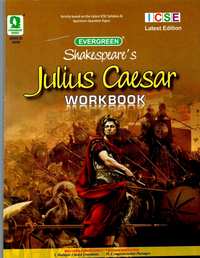
Below listed, you can find solutions for Chapter * of CISCE Shirin Puri Lama for English Shakespeare's Julius Caesar Workbook Class 9 and 10 ICSE.
Shirin Puri Lama solutions for English Shakespeare's Julius Caesar Workbook Class 9 and 10 ICSE * Use of Literary Devices in Acts 3, 4 and 5 - Scene 1 ASSIGNMENTS [Pages 226 - 233]
MULTIPLE CHOICE QUESTIONS Choose the correct answers to the questions from the given options: Analysis, Application and Evaluation:
Which of the following is NOT an example of irony?
Cassius calls Caesar a God while describing how weak he was.
Antony refers to Brutus as an honourable man while disproving his claims.
One of the plebeians suggested crowning Brutus king.
Antony compares the conspirators' killing of Caesar to apes and hounds.
Cassius' reference to ravens, crows and kites taking the place of two mighty eagles that accompanied their armies from Sardis tells us that he is ______.
filled with superstitious dread.
an expert bird watcher.
happier in the company of birds.
not a believer in superstition.
What feeling do Cassius’ words convey when he refers to Octavius as ‘a peevish school boy’ and to Antony as ‘a masker and a reveller’?
fear
disdain
worry
regret
“Witness the hole you made in Caesar’s heart, Crying ‘Long Live! Hail, Caesar! Antony’s tone here is ______.
full of surprise.
joyful.
sarcastic.
ironical.
“But for your words, they rob the Hybla bees.” The expression ‘Hybla bees’ forms an example of ______.
irony
satire
allusion
aside
How does Octavius show his maturity?
by continuing to argue.
by walking away from Brutus and Cassius.
by not wanting to waste time in arguing.
by telling Antony to make Brutus keep quiet.
Which of the following statements is NOT true regarding Antony's sweet words being:
honey made by the Hybla bees.
honey made by the Sybla bees.
bees without stings.
bees without sound.
What does Cassius hope for?
- they may be able to enjoy peace and rest after the battle is over.
- they may not be killed.
- that they live happily till old age.
- that they can return to Rome.
1 and 3
1 and 2
3 and 4
4 and 1
What does Brutus now feel about Cato's philosophy?
that it is the best philosophy.
that suicide is a cowardly act.
that it should be followed by everyone.
that it is a logical philosophy.
Brutus feels that he can never go as a prisoner to Rome because ______.
he has no home to go back to.
Portia is dead.
he has too noble a mind to suffer such disgrace.
he cannot live in Rome with Caesar having gone.
The audience and readers feel a lump in their throats when ______.
Brutus tells Cassius to accept defeat.
Brutus and Cassius take a final farewell from each other.
Brutus says that the battle will end in their favour.
Brutus and Cassius are hoping to return to Rome.
What reason does Mark Antony give Octavius for the enemy forces advancing towards Philippi?
to pretend that they are full of courage and strength.
to pretend that they are united.
to act as if they are not afraid.
to cover up for their disunity.
When will Octavius' sword go back to its sheath?
when the battle is over.
when they go back to Rome.
when the thirty-three wounds of Caesar have been avenged.
when he becomes the ruler of Rome.
Which side of the battlefield does Antony want Octavius to cover?
the left side.
the right side.
the rear end.
the front side.
How does Antony address Brutus and Cassius?
traitors.
villains.
usurpers.
bees.
Which philosophy did Cassius believe in earlier?
Strato.
Epicurus.
Cato.
Pythagoras.
What does the army see while coming from Sardis?
Two mighty lions.
Two mighty eagles.
Three mighty eagles.
Four mighty eagles.
What did the army see in the morning instead?
dogs.
eagles.
ravens, crows and kites.
dead animals.
Which philosophy does Cassius now believe in?
in omens which predict the future.
in soothsayers.
in sick animals of prey.
in Cato's philosophy.
What does Cassius call Octavius?
A traitor.
A coward.
An evil-tempered man.
An immature peevish schoolboy.
Whose birthday is it this day?
Brutus'
Cassius'
Antony's
Messala's
Where is Philippi?
Near Rome
In Rome
In Macedonia
On the upper regions
CONTEXT QUESTIONS
Read the extract given below and answer the questions that follow:
| Cassius: Then, if we lost this battle, You are contented to be led in triumph Through the streets of Rome? Brutus: No, Cassius, no: think not, thou noble Roman, That ever Brutus will go bound to Rome; He bears too great a mind. but this same day Must end that work the Ides of March begun; And whether we shall meet again I know not. Therefore our everlasting farewell, take: Forever, and forever, farewell, Cassius If we do meet again, why, we shall smile; If not, why then, this parting was well made. |
- Why does Brutus say, ‘No, Cassius, no’?
What conditions may force Brutus to go bound to Rome?
Brutus says, ‘And whether we shall meet again I know not’. What do these words imply? - To what does Brutus refer when he says, ‘The work which the Ides of March begun’?
How was ‘that work’ begun?
What political change would take place in Rome if Brutus and Cassius lose this battle? - Earlier in this scene, Cassius had confided to Messala a strange occurrence that he had observed when his army was on its way from Sardis to Philippi. Describe this strange occurrence.
- How does Brutus die?
How does his manner of dying contradict the philosophy by which he had lived his life? - At the end of the play, Antony calls Brutus, ‘the noblest Roman of them all’. Why does he say this? What does this reveal of Antony’s character?
Read the extract given below and answer the questions that follow:
| OCTAVIUS - They mean to warn us at Philippi here, Answering before we do demand of them. ANTONY - Tut! I am in their bosoms, and I know Wherefore they do it. |
- Why does Antony believe that their enemies will be attacking them first? (Understanding)
- What news does a messenger bring after the extract? What does Antony suggest to Octavius? How does Octavius disagree with Antony? Give two instances. (Recalling & Understanding)
- What military strategy was followed? What was Brutus' argument for following the strategy? (Recalling)
- How does Antony taunt Brutus? How does Antony describe the unethical manner in which the conspirators attacked Caesar? Who does he compare them to? (Recalling)
- How does Octavius show better capability and practicality compared to Antony as he stands arguing with the conspirators? (Evaluation)
Read the extract given below and answer the questions that follow:
| CASSIUS - Messala, This is my birthday, as this very day Was Cassius born. Give me thy hand, Messala: |
- After the extract, Cassius narrates two contradicting sights he saw. What were they? What does he feel the sights symbolize? (Recalling & Understanding)
- Give the meanings of the lines that follow the extract' As we were sickly prey their shadows seem/A canopy most fatal (Understanding)
- What character traits of Cassius are seen? How does he appear to have a different bent of mind from what he had earlier in the play? (Understanding & Analysis)
- What philosophy had Cassius followed earlier? Why does he discard this philosophy? What does this show of Cassius? (Recalling, Understanding & Analysis)
- State the reasons for Cassius' downfall. (Analysis)
Read the extract given below and answer the questions that follow:
| CASSIUS - Then, if we lose the battle, You are contented to be led in triumph Through the streets of Rome? BRUTUS - No, Cassius, no: Think not, thou noble Roman, That ever Brutus will go bound to Rome; |
- What has Brutus just said about Cato and the philosophy he applied to make Cassius utter these words? (Recalling & Understanding)
- What Roman practice is referred to by Cassius as a result of losing a battle? (Recalling)
- Explain “That ever Brutus will go bound to Rome?” How do Brutus' words show that he is truly honourable? (Analysis)
- What was the significance of the Ides of March? What was its effect later in the play? (Evaluation)
- Do Brutus and Cassius meet again? If not, why? (Recalling & Understanding)
Read the extract given below and answer the questions that follow:
| He bears too great a mind. But this same day Must end that work the ______ of ______ begun; |
- Fill the blanks in the extract. (Recalling)
- Who is the speaker? Whom is he speaking to? (Recalling)
- What work had begun? What was significant about this day? (Understanding & Analysis)
- State any three repercussions this day had on Brutus and Cassius. (Understanding)
- Who is ‘He’ referred to in the extract? What would he never do? (Recalling)
- Give any two character traits of ‘he’. (Understanding & Analysis)
COMPETENCY - FOCUSED QUESTIONS
Solutions for *: Use of Literary Devices in Acts 3, 4 and 5 - Scene 1
Shirin Puri Lama solutions for English Shakespeare's Julius Caesar Workbook Class 9 and 10 ICSE chapter * - Use of Literary Devices in Acts 3, 4 and 5 - Scene 1
Shaalaa.com has the CISCE Mathematics English Shakespeare's Julius Caesar Workbook Class 9 and 10 ICSE CISCE solutions in a manner that help students grasp basic concepts better and faster. The detailed, step-by-step solutions will help you understand the concepts better and clarify any confusion. Shirin Puri Lama solutions for Mathematics English Shakespeare's Julius Caesar Workbook Class 9 and 10 ICSE CISCE * (Use of Literary Devices in Acts 3, 4 and 5 - Scene 1) include all questions with answers and detailed explanations. This will clear students' doubts about questions and improve their application skills while preparing for board exams.
Further, we at Shaalaa.com provide such solutions so students can prepare for written exams. Shirin Puri Lama textbook solutions can be a core help for self-study and provide excellent self-help guidance for students.
Concepts covered in English Shakespeare's Julius Caesar Workbook Class 9 and 10 ICSE chapter * Use of Literary Devices in Acts 3, 4 and 5 - Scene 1 are .
Using Shirin Puri Lama English Shakespeare's Julius Caesar Workbook Class 9 and 10 ICSE solutions Use of Literary Devices in Acts 3, 4 and 5 - Scene 1 exercise by students is an easy way to prepare for the exams, as they involve solutions arranged chapter-wise and also page-wise. The questions involved in Shirin Puri Lama Solutions are essential questions that can be asked in the final exam. Maximum CISCE English Shakespeare's Julius Caesar Workbook Class 9 and 10 ICSE students prefer Shirin Puri Lama Textbook Solutions to score more in exams.
Get the free view of Chapter *, Use of Literary Devices in Acts 3, 4 and 5 - Scene 1 English Shakespeare's Julius Caesar Workbook Class 9 and 10 ICSE additional questions for Mathematics English Shakespeare's Julius Caesar Workbook Class 9 and 10 ICSE CISCE, and you can use Shaalaa.com to keep it handy for your exam preparation.
