Advertisements
Chapters
▶ *: Use of Literary Devices in Acts-1 and 2 - Scene 1
*: Use of Literary Devices in Acts-1 and 2 - Scene 2
*: Use of Literary Devices in Acts-1 and 2 - Scene 3
Act 2
*: Use of Literary Devices in Acts-1 and 2 - Scene 1
*: Use of Literary Devices in Acts-1 and 2 - Scene 2
*: Use of Literary Devices in Acts-1 and 2 - Scene 3
*: Use of Literary Devices in Acts-1 and 2 - Scene 4
*: Project Work- Acts-1 and 2
Act 3
*: Use of Literary Devices in Acts 3, 4 and 5 - Scene 1
*: Use of Literary Devices in Acts 3, 4 and 5 - Scene 2
*: Use of Literary Devices in Acts 3, 4 and 5 - Scene 3
Act 4
*: Use of Literary Devices in Acts 3, 4 and 5 - Scene 1
*: Use of Literary Devices in Acts 3, 4 and 5 - Scene 2
*: Use of Literary Devices in Acts 3, 4 and 5 - Scene 3
Act 5
*: Use of Literary Devices in Acts 3, 4 and 5 - Scene 1
*: Use of Literary Devices in Acts 3, 4 and 5 - Scene 2
*: Use of Literary Devices in Acts 3, 4 and 5 - Scene 3
*: Use of Literary Devices in Acts 3, 4 and 5 - Scene 4
*: Use of Literary Devices in Acts 3, 4 and 5- Scene 5
*: Project Work- Acts-3, 4 and 5
Advertisements
Solutions for Chapter *: Use of Literary Devices in Acts-1 and 2 - Scene 1
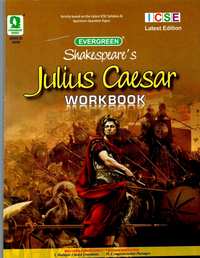
Below listed, you can find solutions for Chapter * of CISCE Shirin Puri Lama for English Shakespeare's Julius Caesar Workbook Class 9 and 10 ICSE.
Shirin Puri Lama solutions for English Shakespeare's Julius Caesar Workbook Class 9 and 10 ICSE * Use of Literary Devices in Acts-1 and 2 - Scene 1 ASSIGNMENTS [Pages 37 - 47]
MULTIPLE CHOICE QUESTIONS Choose the correct answers to the questions from the given options: Analysis, Application and Evaluation:
Why does Marullus ask the citizens to pray to prevent the plague or punishment?
They have gathered to celebrate Caesar’s Victory.
The citizens are religious minded people.
He considers their ingratitude a cause for their punishment.
Marullus believes it will turn them against Caesar.
Flavius says, “Who else would soar above the view of men and keep us all in servile fearfulness,” about Caesar. These words reveal that ______.
Flavius likes Caesar.
He fears Caesar’s rising power.
Hecriticizes Caesar’s soldiers.
Flavius thinks that Caesar will disappear.
An example of the literary device ‘alliteration’ is when Flavius tells the citizens ______.
So you do too, where you perceive them thick.
Hence! Home you idle creatures get you home.
Why dost thou lead these men about the street?
...and keep us in servile fearfulness.
Why are the citizens called ‘idle creatures’?
They are sitting without moving.
They are punning on ‘idol’ and ‘idle’.
They should be working and not wasting time.
They are rejoicing.
One example of punning is when the cobbler tells Marullus ______.
in respect of
I can mend you
why, sir, a carpenter
nay, I beseech you
Why does Marullus scold the citizens?
They are crowding the streets.
He is angry and bitter to see that Pompey has been forgotten.
He fears that they will do no work that day.
He has to keep an eye on them all the time.
What does ‘captive bonds his chariot wheels’ refer to?
the chariot wheels.
people out there rejoicing.
citizens running after the chariot.
the captured princes tied to the chariot wheels of Caesar.
An example of the literary device, ‘hyperbole’ is when Flavius tells the commoners to go to the Tiber and cry tears of repentance till ______.
the lowest stream rises to the top of the bank.
theriver rises with their tears and causes floods.
they have no more tears to shed.
they are exhausted with crying.
What does ‘Caesar’s trophies’ refer to?
flags, garlands and laurel crowns
flags
flowers and bouquets
ribbons and necklaces
What does Shakespeare do through Flavius and Marullus?
Uses them as the two main characters in the play.
Shows their importance for Rome.
Presents the atmosphere of strife and unrest in Rome.
Shows the common people shouting out there and rejoicing on the streets.
Which of the following statement is NOT true of the two tribunes?
They have legal powers.
They believe in the monarchist form of government.
They are accusing the commoners of praising Caesar.
They are speaking with a cobbler and a carpenter.
Read carefully and choose the option that lists the sequence of events in the correct order.
- Flavius and Marullus get angry with the commoners and order them home.
- Flavius and Marullus strip Caesar’s statues of all the decorations hoping to lessen his growing popularity.
- The citizens reply that they have taken a holiday to see Caesar and rejoice in victory.
- Flavius and Marullus enter the stage and question the citizens for not working at that day.
4, 3, 1, 2
1, 2, 3, 4
4, 3, 2, 1
3, 4, 2, 1
Recalling and Understanding:
Who is a tribune?
A nobleman
A leader of people
A magistrate with legal powers
A manual worker
Where does Scene 1 of Act I take placе?
In a street in Rome.
In a garden in Rome.
On the battlefield.
On the banks of the Tiber River.
Who is referred to as ‘idle creatures’?
The ordinary citizens of Rome.
The citizens of Munda.
People of the upper classes of Rome.
The statues of Caesar.
Who is the second citizen?
the carpenter
the cobbler
the soldier
the artist
The Second Citizen tells Flavius that they have taken a holiday to ______.
walk about in the beautiful parks made by Caesar.
meet friends and passers-by.
see Caesar pass by on his chariot and to rejoice at his victory.
stone Caesar when his chariot passes by.
Julius Caesar is returning to Rome after having defeated ______.
a foreign army.
invaders of Rome.
the sons of his old rival, Pompey (Pompey’s blood).
the mutineers.
Marullus addresses the citizens by calling them ______.
towers, windows and chimney tops.
blocks, stone and worse than senseless things.
infants, chariot wheels and senseless things.
blocks, walls and battlements.
For whom had these same people waited for in the years gone by?
Julius Caesar
Flavius and Marullus
Pompеу
The tradesmen
The common citizens are to welcome Caesar by ______.
shouting out his name aloud and throwing their caps up in the air.
taking a holiday, dressing up and scattering flowers before his passing chariot.
going about their work as usual.
taking a stroll along the river Tiber.
In order to intermit the plague, the commoners are instructed to ______.
run back to their homes.
jump into the river.
run back home and pray to the gods.
weep tears of repentance into the river.
After Marullus and Flavius have shouted at the common people, they ______.
ignore the two tribunes.
insist on staying back.
go away without saying anything.
raise slogans against them.
What does Flavius instruct Marullus to do?
Count the statues of Caesar in the city.
Remove all the decorations from Caesar’s statues.
Break Caesar’s statues.
Go and bow before Caesar’s statues.
What was the Capitol?
The main city of Rome.
A busy area in the centre of the city.
The name of the river.
The temple to Jupiter situated on a hill.
What is Caesar compared to?
a lion
a falcon
a raven
a dove
What does ‘growing feathers’ refer to?
The decorated statues of Caesar, his growing popularity and ambition.
That his statues are decorated with feathers of the falcon bird.
The entry of Caesar on his chariot.
The triumphal procession.
What does ‘being mechanical’ mean?
without feelings.
ordinary manual workers.
traders.
citizens belonging to the upper classes.
The two tribunes were followers of ______.
Julius Caesar
Pompey
Calpurnia
the common people
CONTEXT QUESTIONS
Read the extract given below and answer the questions that follow:
| Wherefore rejoice? What conquest brings he home? What tributaries follow him to Rome, To grace in captive bonds his chariot-wheels? |
1. What is the tone of the speaker here? (Analysis)
2. Who is ‘he’ referred to in the first line of the extract? What does the speaker want to convey to the listeners? (Recalling & Understanding)
3. What is the conquest referred to in the extract? Why has the conqueror not brought any territories to Rome by his conquest? (Understanding & Analysis)
4. How does the speaker show his anger towards the listeners after the extract? (Analysis)
5. Explain:
- What tributaries follow him to Rome? (Understanding)
- To grace in captive bonds his chariot-wheels. (Understanding)
Read the extract given below and answer the questions that follow:
| MARULLUS – What trade, thou knave? thou naughty knave, what trade? Second Citizen: Nay, I beseech you, sir, be not out with me: yet, if you be out, sir, I can mend you. |
1. Describe the mood of the speaker talking to the commoner. In what kind of a tone does the commoner reply? (Understanding & Analysis)
2. Why are the citizens out on the streets? (Understanding)
3. What has the second citizen said just before this extract to annoy Marullus? What is his profession? (Recalling)
4. Give the meanings of: (Understanding)
- If you be out -
- I can mend you -
5. How does the second citizen reveal his identity later? (Understanding)
Read the extract given below and answer the questions that follow:
| MARULLUS - And when you saw his chariot but appear, Have you not made an universal shout, That Tiber trembled underneath her banks, To hear the replication of your sounds Made in her concave shores? |
1. The figure of speech used in this passage is hyperbole. Explain. (Application)
2. What do ‘replication’ and ‘concave shore’ mean? Explain the last two lines of the extract. (Understanding & Analysis)
3. What makes Marullus conclude that the citizens are ungrateful and fickle minded? (Understanding & Analysis)
4. How does Marullus make the citizens feel guilty? What does it reveal about his attitude towards Caesar? (Analysis)
5. Flavius and Marullus’s words have an immediate impact on the citizens. Explain. (Evaluation)
Read the extract given below and answer the questions that follow:
| MARULLUS - May we do so? You know it is the feast of Lupercal. FLAVIUS - It is no matter; let no images Be hung with Caesar’s trophies. |
1. What instruction has Flavius given to Marullus before this extract? What does it reveal about his position in relation to Marullus? (Understanding & Analysis)
2. Why is Marullus hesitant to carry out the orders of Flavius? What is the significance of Lupercal? (Understanding)
3. What does Flavius volunteer to do after the extract? (Understanding)
4. ‘This extract shows Flavius’s dissatisfaction against the celebration of Caesar’s victory’. How? (Analysis)
5. How is Flavius more assertive than Marullus? Why do you think so? (Evaluation)
Read the extract given below and answer the questions that follow:
| FLAVIUS - These growing feathers pluck’d from Caesar’s wing Will make him fly an ordinary pitch, |
1. Who is Flavius speaking with? Who is he? What is the profession of this person? What are his professional duties? (Recalling)
2. What does ‘growing feathers’ refer to about Caesar? The literary device used here is ‘metaphor’. Explain. (Understanding & Application)
3. Why does Flavius want Caesar to ‘fly an ordinary pitch’ or height? (Understanding)
4. What are Flavius and the person spoken to afraid of (regarding Caesar)? (Understanding & Analysis)
5. What was the feast of Lupercal? (Understanding)
COMPETENCY - FOCUSED QUESTIONS
Solutions for *: Use of Literary Devices in Acts-1 and 2 - Scene 1
Shirin Puri Lama solutions for English Shakespeare's Julius Caesar Workbook Class 9 and 10 ICSE chapter * - Use of Literary Devices in Acts-1 and 2 - Scene 1
Shaalaa.com has the CISCE Mathematics English Shakespeare's Julius Caesar Workbook Class 9 and 10 ICSE CISCE solutions in a manner that help students grasp basic concepts better and faster. The detailed, step-by-step solutions will help you understand the concepts better and clarify any confusion. Shirin Puri Lama solutions for Mathematics English Shakespeare's Julius Caesar Workbook Class 9 and 10 ICSE CISCE * (Use of Literary Devices in Acts-1 and 2 - Scene 1) include all questions with answers and detailed explanations. This will clear students' doubts about questions and improve their application skills while preparing for board exams.
Further, we at Shaalaa.com provide such solutions so students can prepare for written exams. Shirin Puri Lama textbook solutions can be a core help for self-study and provide excellent self-help guidance for students.
Concepts covered in English Shakespeare's Julius Caesar Workbook Class 9 and 10 ICSE chapter * Use of Literary Devices in Acts-1 and 2 - Scene 1 are .
Using Shirin Puri Lama English Shakespeare's Julius Caesar Workbook Class 9 and 10 ICSE solutions Use of Literary Devices in Acts-1 and 2 - Scene 1 exercise by students is an easy way to prepare for the exams, as they involve solutions arranged chapter-wise and also page-wise. The questions involved in Shirin Puri Lama Solutions are essential questions that can be asked in the final exam. Maximum CISCE English Shakespeare's Julius Caesar Workbook Class 9 and 10 ICSE students prefer Shirin Puri Lama Textbook Solutions to score more in exams.
Get the free view of Chapter *, Use of Literary Devices in Acts-1 and 2 - Scene 1 English Shakespeare's Julius Caesar Workbook Class 9 and 10 ICSE additional questions for Mathematics English Shakespeare's Julius Caesar Workbook Class 9 and 10 ICSE CISCE, and you can use Shaalaa.com to keep it handy for your exam preparation.
