Advertisements
Online Mock Tests
Chapters
1: GST [Goods and Service Tax]
2: Banking (Recurring Deposit Account)
3: Shares and Dividend
Unit 2. Algebra
4: Linear Inequations (In one variable)
5: Quadratic Equations
6: Solving (simple) Problems (Based on Quadratic Equations)
7: Ratio and Proportion (Including Properties and Uses)
8: Factorization of Polynomials (Remainder and Factor Theorems)
9: Matrices
10: Arithmetic Progression
11: Geometric Progression
Unit 3. Co-ordinate Geometry
12: Reflection
13: Section Formula and Mid-Point Formula
14: Equation of a Line
Unit 4. Geometry
15: Similarity (With Applications to Maps and Models)
16: Loci (Locus and Its Constructions)
17: Circles
18: Tangents and Intersecting Chords
19: Constructions (Circles)
Unit 5. Mensuration
20: Cylinder, Cone and Sphere
Unit 6. Trigonometry
21: Trigonometrical Identities
▶ 22: Height and Distances
Unit 7. Statistics
23: Graphical Representation
24: Measure of Central Tendency (Mean, Median, Quartiles and Mode)
25: Probability

Advertisements
Solutions for Chapter 22: Height and Distances
Below listed, you can find solutions for Chapter 22 of CISCE Selina for Concise Mathematics [English] Class 10 ICSE.
Selina solutions for Concise Mathematics [English] Class 10 ICSE 22 Height and Distances EXERCISE 22 (A) [Pages 346 - 347]
Multiple Choice Type: Choose the correct answer from the options given below.
The measure of x is ______.
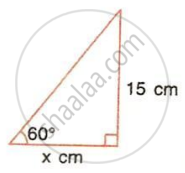
\(15 \sqrt{3} \mathrm{~cm}\)
15 cm
\(5 \sqrt{3} \mathrm{~cm}\)
5 cm
The value of x is ______.
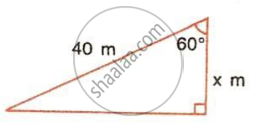
40 m
30 m
20 m
\(40 \sqrt{3} \mathrm{~m}\)
In the given figure, AB = BD, BC = 20 cm and ∠D = 45°, the length of AC is ______.
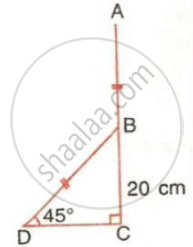
54.64 cm
48.28 cm
40 cm
14.64 cm
The measure of x correct to the nearest metre is ______.
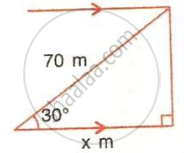
70 m
35 m
61 m
140 m
The length of DC is ______.
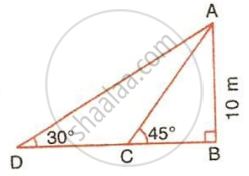
10 m
\(10(\sqrt{3}+1) \mathrm{m}\)
20 m
\(10(\sqrt{3}-1) \mathrm{m}\)
The height of a tree is `sqrt(3)` times the length of its shadow. Find the angle of elevation of the sun.
The angle of elevation of the top of a tower, from a point on the ground and at a distance of 160 m from its foot, is found to be 60°. Find the height of the tower.
A ladder is placed along a wall such that its upper end is resting against a vertical wall. The foot of the ladder is 2.4 m from the wall and the ladder is making an angle of 68° with the ground. Find the height, upto which the ladder reaches.
Two persons are standing on the opposite sides of a tower. They observe the angles of elevation of the top of the tower to be 30° and 38° respectively. Find the distance between them, if the height of the tower is 50 m.
A boy, 1.6 m tall, is 20 m away from a tower and observes the angle of elevation of the top of the tower to be (i) 45°, (ii) 60°. Find the height of the tower in each case.
The upper part of a tree, broken over by the wind, makes an angle of 45° with the ground and the distance from the root to the point where the top of the tree touches the ground is 15 m. What was the height of the tree before it was broken?
The angle of elevation of the top of an unfinished tower from a point at a distance of 80 m from its base is 30°. How much higher must the tower be raised so that its angle of elevation at the same point may be 60°?
At a particular time, when the sun’s altitude is 30°, the length of the shadow of a vertical tower is 45 m. Calculate:
- the height of the tower.
- the length of the shadow of the same tower, when the sun’s altitude is:
- 45°
- 60°
Two vertical poles are on either side of a road. A 30 m long ladder is placed between the two poles. When the ladder rests against one pole, it makes angle 32°24′ with the pole and when it is turned to rest against another pole, it makes angle 32°24′ with the road. Calculate the width of the road.
Two climbers are at points A and B on a vertical cliff face. To an observer C, 40 m from the foot of the cliff, on the level ground, A is at an elevation of 48° and B of 57°. What is the distance between the climbers?
A man stands 9 m away from a flag-pole. He observes that angle of elevation of the top of the pole is 28° and the angle of depression of the bottom of the pole is 13°. Calculate the height of the pole.
From the top of a cliff 92 m high, the angle of depression of a buoy is 20°. Calculate, to the nearest metre, the distance of the buoy from the foot of the cliff.
Selina solutions for Concise Mathematics [English] Class 10 ICSE 22 Height and Distances EXERCISE 22 (B) [Pages 351 - 352]
Multiple Choice Type: Choose the correct answer from the options given below.
According to the information given in the following figure, the length of BC is:
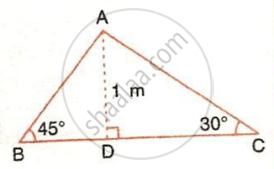
\[\sqrt{3} \mathrm{~m}\]
\[(\sqrt{3}-1) \mathrm{m}\]
\[(\sqrt{3}+1) \mathrm{m}\]
\[2 \sqrt{3} \mathrm{~m}\]
The measurement of h is ______.
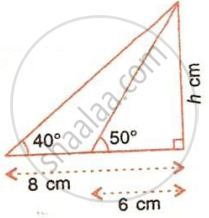
\[\sqrt{8 \times 6} \mathrm{~cm}\]
\[\sqrt{\frac{4}{3}} \mathrm{~cm}\]
\[(8 - 6) \mathrm{cm}\]
\[2 \sqrt{2} \mathrm{~cm}\]
The length of AC is ______.
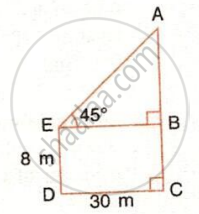
22 m
38 m
23 m
45 m
Using the information given in the following figure, the measure of AE is:
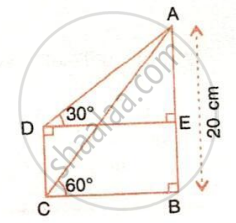
20 cm
10 cm
\[6 \frac{2}{3} \mathrm{~cm}\]
\[20 \sqrt{3} \mathrm{~cm}\]
The length of DC is ______.
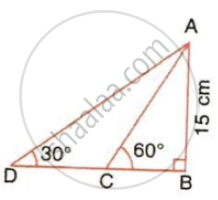
\[15 \sqrt{3} \mathrm{~cm}\]
\[15(\sqrt{3}-1) \mathrm{cm}\]
\[15(\sqrt{3}+1) \mathrm{cm}\]
\[10 \sqrt{3} \mathrm{~cm}\]
In the figure, given below, it is given that AB is perpandiculer to BD and is of length X metres. DC = 30 m, ∠ADB = 30° and ∠ACB = 45°. Without using tables, find X.

Find the height of a tree when it is found that on walking away from it 20 m, in a horizontal line through its base, the elevation of its top changes from 60° to 30°.
From the top of a light house 100 m high, the angles of depression of two ships are observed as 48° and 36° respectively. Find the distance between the two ships (in the nearest metre) if:
- the ships are on the same side of the light house,
- the ships are on the opposite sides of the light house.
Two pillars of equal heights stand on either side of a roadway, which is 150 m wide. At a point in the roadway between the pillars the elevations of the tops of the pillars are 60° and 30°; find the height of the pillars and the position of the point.
From the figure, given below, calculate the length of CD.

The angle of elevation of the top of a tower is observed to be 60°. At a point, 30 m vertically above the first point of observation, the elevation is found to be 45°. Find:
- the height of the tower,
- its horizontal distance from the points of observation.
From the top of a cliff, 60 metres high, the angles of depression of the top and bottom of a tower are observed to be 30° and 60°. Find the height of the tower.
A man on a cliff observes a boat, at an angle of depression 30°, which is sailing towards the shore to the point immediately beneath him. Three minutes later, the angle of depression of the boat is found to be 60°. Assuming that the boat sails at a uniform speed, determine:
- how much more time it will take to reach the shore?
- the speed of the boat in metre per second, if the height of the cliff is 500 m.
A man in a boat rowing away from a lighthouse 150 m high, takes 2 minutes to change the angle of elevation of the top of the lighthouse from 60° to 45°. Find the speed of the boat.
A person standing on the bank of a river observes that the angle of elevation of the top of a tree standing on the opposite bank is 60°. When he moves 40 m away from the bank, he finds the angle of elevation to be 30°. Find:
- the height of the tree, correct to 2 decimal places,
- the width of the river.
The horizontal distance between two towers is 75 m and the angular depression of the top of the first tower as seen from the top of the second, which is 160 m high, is 45°. Find the height of the first tower.
The length of the shadow of a tower standing on level plane is found to be 2y metres longer when the sun’s altitude is 30° than when it was 45°. Prove that the height of the tower is `y(sqrt(3) + 1)` metres.
An aeroplane flying horizontally 1 km above the ground and going away from the observer is observed at an elevation of 60°. After 10 seconds, its elevation is observed to be 30°; find the uniform speed of the aeroplane in km per hour.
From the top of a hill, the angles of depression of two consecutive kilometer stones, due east, are found to be 30° and 45° respectively. Find the distances of the two stones from the foot of the hill.
Selina solutions for Concise Mathematics [English] Class 10 ICSE 22 Height and Distances TEST YOURSELF [Pages 353 - 355]
Multiple Choice Type: Choose the correct answer from the options given below.
If CD = 10 m, the length of AB is ______.
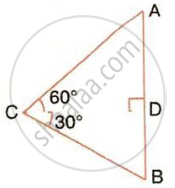
\[\frac{40}{\sqrt{3}} \mathrm{~m}\]
\[\frac{20}{\sqrt{3}} \mathrm{~m}\]
100 m
30 m
If \[\tan x^{\circ}=\frac{5}{2}\], the length of CB is ______.
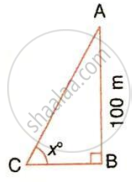
0.4 m
40 m
50 m
80 m
The length of AC is ______.
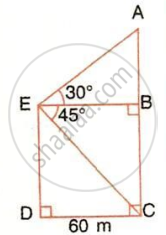
\((60-20 \sqrt{3}) \mathrm{m}\)
\(60 \sqrt{3} \mathrm{~m}\)
\((60+20 \sqrt{3}) \mathrm{m}\)
\(20 \sqrt{3} \mathrm{~m}\)
BCDE is a square with side 90 cm and ∠F = 45°. The length of AF is ______.
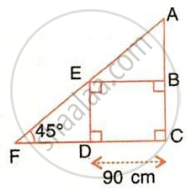
\(60 \sqrt{2} \mathrm{~cm}\)
\(90 \sqrt{2} \mathrm{~cm}\)
\(120 \sqrt{2} \mathrm{~cm}\)
\(180 \sqrt{2} \mathrm{~cm}\)
The length of DC is ______.
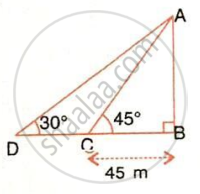
\(45 \sqrt{3} \mathrm{~m}\)
\((45-\sqrt{3}) \mathrm{m}\)
\(45(\sqrt{3}-1) \mathrm{m}\)
\(45(\sqrt{3}+1) \mathrm{m}\)
The ratio of the length of a vertical pole and length of its shadow on the horizontal surface is \(3: \sqrt{3}\).
Assertion (A): The angle of elevation of the sun is 60°.
Reason (R): If angle of elevation of the sun is \[\theta, \tan \theta=\frac{3}{\sqrt{3}}=\sqrt{3}=\tan 60^{\circ}\]
A is true, R is false.
A is false, R is true.
Both A and R are true and R is the correct reason for A.
Both A and R are true and R is the incorrect reason for A.
The length of the ladder placed against a vertical wall is twice the distance between the foot of the ladder and the wall.
Assertion (A): The angle that the ladder makes with the wall is 60°
Reason (R): If ladder makes angle θ with the wall then \[\sin \theta=\frac{\text { perpendicular }}{\text { hypotenuse }}=\frac{x}{2 x}=\frac{1}{2}\]
A is true, R is false.
A is false, R is true.
Both A and R are true and R is the correct reason for A.
Both A and R are true and R is the incorrect reason for A .
For the following figure, \[\tan \mathrm{A}=1 \frac{2}{3}\] and \[\tan \mathrm{B}=\frac{1}{3}\]
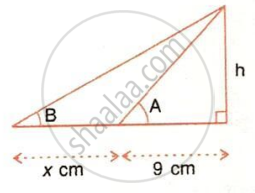
Statement (1): x = 36 cm.
Statement (2): \[\tan \mathrm{A}=\frac{5}{3}=\frac{h}{9} \Rightarrow h=15\] \[\tan \mathrm{B}=\frac{h}{x+9} \Rightarrow \frac{1}{3}=\frac{15}{x+9}\]
Both the statements are true.
Both the statements are false.
Statement 1 is true, and statement 2 is false.
Statement 1 is false, and statement 2 is true.
CD = 100 m, ∠ADB = 15° and ∠BDC = 45°
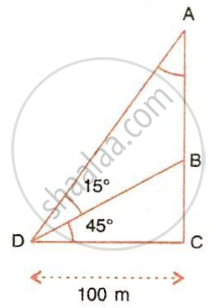
Statement (1): \[\mathrm{AB}=\frac{\tan 60^{\circ}-\tan 45^{\circ}}{100}\]
Statement (2): AB = (100 tan 60° − 100 tan 45°) m.
Both the statements are true.
Both the statements are false.
Statement 1 is true, and statement 2 is false.
Statement 1 is false, and statement 2 is true.
Find AD.

Find AD.

In the following diagram, AB is a floor-board; PQRS is a cubical box with each edge = 1 m and ∠B = 60°. Calculate the length of the board AB.

Calculate BC.

Calculate AB.

The radius of a circle is given as 15 cm and chord AB subtends an angle of 131° at the centre C of the circle. Using trigonometry, calculate:
- the length of AB;
- the distance of AB from the centre C.
At a point on level ground, the angle of elevation of a vertical tower is found to be such that its tangent is `5/12`. On walking 192 metres towards the tower, the tangent of the angle is found to be `3/4`. Find the height of the tower.
A vertical tower stand on horizontel plane and is surmounted by a vertical flagstaff of height h metre. At a point on the plane, the angle of elevation of the bottom of the flagstaff is α and that of the top of flagstaff is β. Prove that the height of the tower is
`(h tan alpha)/(tan beta - tan alpha)`
With reference to the given figure, a man stands on the ground at point A, which is on the same horizontal plane as B, the foot of the vertical pole BC. The height of the pole is 10 m. The man's eye is 2 m above the ground. He observes the angle of elevation of C, the top of the pole, as x°, where tan x° = `2/5`.
Calculate :
- the distance AB in metres;
- angle of elevation of the top of the pole when he is standing 15 metres from the pole. Give your answer to the nearest degree.

From a window A, 10 m above the ground the angle of elevation of the top C of a tower is x°, where tan `x^circ = 5/2` and the angle of depression of the foot D of the tower is y°, where tan `y^circ = 1/4`. Calculate the height CD of the tower in metres.

A vertical tower is 20 m high. A man standing at some distance from the tower knows that the cosine of the angle of elevation of the top of the tower is 0.53. How far is he standing from the foot of the tower?
A vertical pole and a vertical tower are on the same level ground in such a way that from the top of the pole, the angle of elevation of the top of the tower is 60° and the angle of depression of the bottom of the tower is 30°. Find:
- the height of the tower, if the height of the pole is 20 m;
- the height of the pole, if the height of the tower is 75 m.
In the given figure, from the top of a building AB = 60 m hight, the angle of depression of the top and bottom of a vertical lamp post CD are observed to be 30° and 60° respectively. Find:
- the horizontal distance between AB and CD.
- the height of the lamp post.

An aeroplane, at an altitude of 250 m, observes the angles of depression of two boats on the opposite banks of a river to be 45° and 60° respectively. If the boats are on the opposite sides of the aeroplane, find the width of the river. Write the answer correct to the nearest whole number.
The horizontal distance between two towers is 120 m. The angle of elevation of the top and angle of depression of the bottom of the first tower as observed from the top of the second is 30° and 24° respectively. Find the height of the two towers. Give your answers correct to 3 significant figures.

The angles of depression of two ships A and B as observed from the top of a light house 60 m high are 60° and 45° respectively. If the two ships are on the opposite sides of the light house, find the distance between the two ships. Give your answer correct to the nearest whole number.
Two ships are approaching a light-house from opposite directions. The angles of depression of the two ships from the top of the light-house are 30° and 45°. If the distance between the two ships is 100 m, find the height of the light-house. \[[Use \sqrt{3} = 1 . 732]\]
Solutions for 22: Height and Distances
Selina solutions for Concise Mathematics [English] Class 10 ICSE chapter 22 - Height and Distances
Shaalaa.com has the CISCE Mathematics Concise Mathematics [English] Class 10 ICSE CISCE solutions in a manner that help students grasp basic concepts better and faster. The detailed, step-by-step solutions will help you understand the concepts better and clarify any confusion. Selina solutions for Mathematics Concise Mathematics [English] Class 10 ICSE CISCE 22 (Height and Distances) include all questions with answers and detailed explanations. This will clear students' doubts about questions and improve their application skills while preparing for board exams.
Further, we at Shaalaa.com provide such solutions so students can prepare for written exams. Selina textbook solutions can be a core help for self-study and provide excellent self-help guidance for students.
Concepts covered in Concise Mathematics [English] Class 10 ICSE chapter 22 Height and Distances are Angles of Elevation and Depression, Problems based on Elevation and Depression, Angles of Elevation and Depression, Problems based on Elevation and Depression, Angles of Elevation and Depression, Problems based on Elevation and Depression.
Using Selina Concise Mathematics [English] Class 10 ICSE solutions Height and Distances exercise by students is an easy way to prepare for the exams, as they involve solutions arranged chapter-wise and also page-wise. The questions involved in Selina Solutions are essential questions that can be asked in the final exam. Maximum CISCE Concise Mathematics [English] Class 10 ICSE students prefer Selina Textbook Solutions to score more in exams.
Get the free view of Chapter 22, Height and Distances Concise Mathematics [English] Class 10 ICSE additional questions for Mathematics Concise Mathematics [English] Class 10 ICSE CISCE, and you can use Shaalaa.com to keep it handy for your exam preparation.
