Advertisements
Advertisements
Question
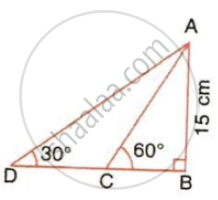
The length of DC is ______.
Options
\[15 \sqrt{3} \mathrm{~cm}\]
\[15(\sqrt{3}-1) \mathrm{cm}\]
\[15(\sqrt{3}+1) \mathrm{cm}\]
\[10 \sqrt{3} \mathrm{~cm}\]
Advertisements
Solution
The length of DC is \[\underline{\boldsymbol 10 \sqrt{3} \mathrm{~cm}}\].
Explanation:
We know that,
\[\tan \theta = \frac{\text{Perpendicular}}{\text{Base}}\]
From figure,
In \[\triangle ABC,\]
\[\Rightarrow \tan 60^\circ = \frac{AB}{BC}\]
\[\Rightarrow \sqrt{3} = \frac{15}{BC}\]
\[\Rightarrow BC = \frac{15}{\sqrt{3}}\]
Rationalizing the denominator,
\[\Rightarrow BC = \frac{15}{\sqrt{3}} \times \frac{\sqrt{3}}{\sqrt{3}}\]
\[\Rightarrow BC = \frac{15\sqrt{3}}{3}\]
\[\Rightarrow BC = 5\sqrt{3}.\]
In \[\triangle ABD,\]
\[\Rightarrow \tan 30^\circ = \frac{AB}{BD}\]
\[\Rightarrow \frac{1}{\sqrt{3}} = \frac{15}{BD}\]
\[\Rightarrow BD = 15\sqrt{3}\ \text{cm}.\]
From figure,
\[DC = BD - BC = 15\sqrt{3} - 5\sqrt{3} = 10\sqrt{3}\ \text{cm}.\]
