Advertisements
Chapters
2: Cell: The Building Block of Life
3: Tissues in Action
4: Describing Motion Around Us
5: Exploring Mixtures and their Separation
6: How Forces Affect Motion
7: Work, Energy, and Simple Machines
8: Journey Inside the Atom
9: Atomic Foundations of Matter
10: Sound Waves: Characteristics and Applications
11: Reproduction: How Life Continues
▶ 12: Patterns in Life: Diversity and Classification
13: Earth as a System: Energy, Matter, and Life

Advertisements
Solutions for Chapter 12: Patterns in Life: Diversity and Classification
Below listed, you can find solutions for Chapter 12 of CBSE NCERT for Science Exploration [English] Class 9.
NCERT solutions for Science Exploration [English] Class 9 12 Patterns in Life: Diversity and Classification Intext Questions [Pages 228 - 247]
Think It Over
What do you understand by biodiversity?
How does the grouping of organisms help us understand diversity?
On what basis are plants and animals put into different categories?
How does classification help address problems in farming?
Fig. shows the diversity of animals in an ecosystem. Observe the image carefully. Can you guess how the organisms are grouped in the image?
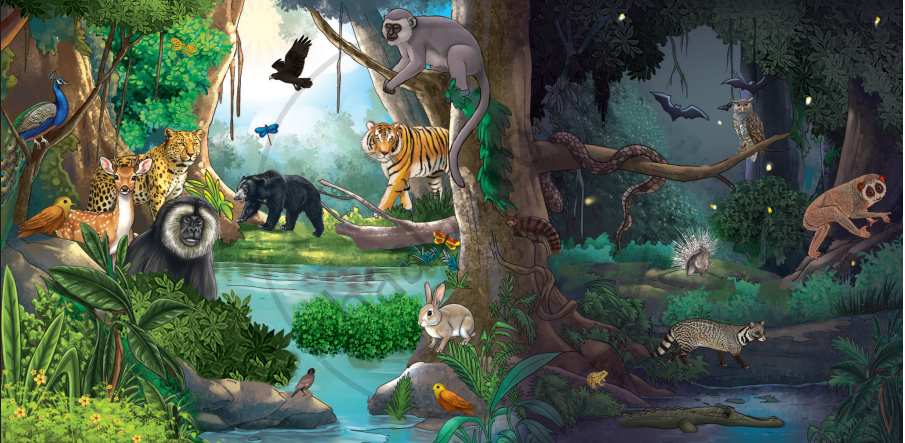
- Ponder on the questions given below:
- Which animals can you identify in the given picture?
- Where are they seen?
- Which animals in the picture seem active:
- during the day?
- during the night?
- both during the day and the night?
- Record your observations in Table:
Observation table for recording the data Organism
(draw or write name)Where do you see it? (flying high in air/flying near the ground/tree/water/forest floor) When does it appear to be active? (day/night/unsure) Any visible feature(s) Owl Tree Night Feathers - Now, try grouping the same organisms in more than one way. Each time change the criterion you are using for grouping (Table 12.2).
Grouping the organisms The grouping criterion Which organisms fit in this group? What feature or pattern helped you decide? Carnivore Eagle, tiger, leopard Eating habits
You may notice that the same organism can fit into different groups depending on the criterion you choose. This leads to an important question: how do scientists decide which features to use while grouping the living organisms? This question leads us to the idea of classification, a systematic way of organising the Earth’s living diversity.
Pause and Ponder
If many organisms share common features, could they also share a common ancestry?
How can a single-celled organism carry out all its life processes when billions of cells are required to perform similar functions in multicellular organisms like us?
Which plant features reduce their dependence on water but still require moist conditions?
Why do taller plants need specialised transport tissues?
How do seeds and fruits affect, where and how plants can survive?
An earthworm (annelida) and a beetle (arthropoda), both have segmented bodies but the beetle has a hard external skeleton. How does the beetle’s external skeleton help it survive?
Does the term ‘biodiversity’ relate only to the variety of organisms, or does it encompass other elements?
If you find a new organism in a pond, what features will you observe to classify it and why?
Why do genetic studies provide deep information about living beings?
How can changes in climate affect the biodiversity?
NCERT solutions for Science Exploration [English] Class 9 12 Patterns in Life: Diversity and Classification Revise, Reflect, Refine [Pages 249 - 250]
Meena and Hari observed an animal in their garden. Hari called it an insect while Meena said it was an earthworm. Choose the character from the following which confirms that it is an insect.
Bilateral symmetrical body
Body with jointed legs
Cylindrical body
Body with little segmentation
Sponges represent one of the simplest animal body plans. Their bodies lack true tissues and organs. Which feature of sponge cells supports its classification under the animal kingdom?
Absence of mitochondria
Ability to photosynthesise
Presence of a cell membrane
Presence of a cell wall
Observe two different animals in your immediate environment. What features help you distinguish between them? How do these features help place them into different groups?
How would a scientist justify choosing cellular organisation as a more fundamental characteristic for the basis of classification rather than the presence of xylem and phloem?
You find an unlabelled slide of a single-celled organism that has a well-defined nucleus and multiple cilia. Which group would it most likely belong to? Give reasons.
How does the diversity of organisms contribute to the balance and stability of an ecosystem?
If all unicellular organisms were grouped into a single kingdom, what problems would arise?
Viruses were studied in earlier classes. Why are they not placed in any of the five kingdoms? Give reasons.
If you were asked to revise the five kingdom classification, would you create a separate category for viruses or keep them outside the system? Justify your answer and explain what this indicates about the evolving nature of scientific classification.
Viruses contain genetic material like living organisms but lack cellular organisation. Which features prevent them from fitting into the five kingdom system? What does this tell us about the limitations of classification systems?
Both pteridophytes and bryophytes lack flowers and seeds, yet they are placed in different groups. Explain this classification using their key features.
In the classification hierarchy, which group—class or genus—has fewer members but more features in common? Explain your answer.
A scientist discovers a new organism with the characteristic features of locomotion and autotrophic nutrition. Which character(s) would help the scientist identify the organism belonging to Protista according to the five kingdom classification?
A researcher identified a unicellular eukaryotic organism as fungi. What identification key would you suggest according to the five kingdom classification to keep a unicellular organism in the Kingdom Fungi?
During a long-term ecological study, students examined organisms collected from three different environments—a freshwater pond, damp soil near decaying logs and the digestive tract of animals. Instead of naming organisms directly, scientists recorded only structural, cellular and nutritional features as given in the table below.
| Organisms | Key Observations |
|---|---|
| P | Microscopic; no true nucleus; rigid cell covering; survives high salinity and temperature |
| Q | Multicellular; filamentous body; cell wall present; no chlorophyll; grows on dead organic matter |
| R | Unicellular; true nucleus; contractile vacuole present; moves using flagella; shows photosynthesis in light but heterotrophic in the absence of light |
| S | Multicellular; well-differentiated tissues; backbone present; aquatic respiration during early life stage |
| T | Acellular; contains genetic material; remains inactive outside a host cell |
The students realised that some organisms fit neatly into Whittaker's five kingdom classification, while others challenged the very basis of this classification.
Based on the case study, answer the following questions—
- Identify one organism that clearly belongs to the Kingdom Fungi. State one observation that supports your answer.
- Which organism would be placed in the Kingdom Monera? Mention one characteristic that justifies this placement.
- Organisms R and Q are both eukaryotic, yet they are placed in different kingdoms. Analyse the criteria that separate them.
- Explain why organism S cannot be classified using the mode of nutrition alone.
- Organism T does not fit into any of the five kingdoms. Which fundamental characteristic used in classification does it lack and what does this reveal about the limitations of classification systems?
- If classification were based only on habitat, which organisms might be incorrectly grouped together? Explain the scientific consequences of such a classification.
- Imagine scientists discover a new organism that is multicellular, eukaryotic, lacks chlorophyll and absorbs nutrients from a host externally. Should it be placed under fungi or animalia? Justify your reasoning using classification criteria.
NCERT solutions for Science Exploration [English] Class 9 12 Patterns in Life: Diversity and Classification The Journey Beyond [Page 251]
Visit a nearby park or a water body. Observe the water body and its surroundings. Identify ten organisms and classify them into kingdoms.
Interview a gardener or a forest worker. Ask them how they identify species. Compare the traditional scientific methods of identification.
If you were studying the Pakke Tiger Reserve or any other bird sanctuary of your choice, how would you organise the information about the bird species?
Conduct a survey in a forest area near a village, identify edible and poisonous mushrooms with the help of indigenous knowledge of community resource person(s).
Collect and study the postal stamps of India and the world released over time on diversified flora and fauna. Based on your learning, make your own criteria and classify them. Organise a philately (collection of postage stamps) exhibition in your school and showcase your work in this exhibition.
Investigate an extinct species and analyse how its disappearance impacted the organisms that depend on it, and how this affected the ecological balance of the ecosystem.
Study the diversity of farm animals used in different types of farming practices in various parts of the country
The Quest Continues…
What knowledge do you think scientists would come up with further and how would it affect the classification system?
Solutions for 12: Patterns in Life: Diversity and Classification
NCERT solutions for Science Exploration [English] Class 9 chapter 12 - Patterns in Life: Diversity and Classification
Shaalaa.com has the CBSE Mathematics Science Exploration [English] Class 9 CBSE solutions in a manner that help students grasp basic concepts better and faster. The detailed, step-by-step solutions will help you understand the concepts better and clarify any confusion. NCERT solutions for Mathematics Science Exploration [English] Class 9 CBSE 12 (Patterns in Life: Diversity and Classification) include all questions with answers and detailed explanations. This will clear students' doubts about questions and improve their application skills while preparing for board exams.
Further, we at Shaalaa.com provide such solutions so students can prepare for written exams. NCERT textbook solutions can be a core help for self-study and provide excellent self-help guidance for students.
Concepts covered in Science Exploration [English] Class 9 chapter 12 Patterns in Life: Diversity and Classification are .
Using NCERT Science Exploration [English] Class 9 solutions Patterns in Life: Diversity and Classification exercise by students is an easy way to prepare for the exams, as they involve solutions arranged chapter-wise and also page-wise. The questions involved in NCERT Solutions are essential questions that can be asked in the final exam. Maximum CBSE Science Exploration [English] Class 9 students prefer NCERT Textbook Solutions to score more in exams.
Get the free view of Chapter 12, Patterns in Life: Diversity and Classification Science Exploration [English] Class 9 additional questions for Mathematics Science Exploration [English] Class 9 CBSE, and you can use Shaalaa.com to keep it handy for your exam preparation.
