Advertisements
Chapters
1: Interpretation of Topographical Maps
2: Contours
3: Scales and Direction
4: Map Reading and Interpretation
5: Map of India
PART II - GEOGRAPHY OF INDIA
6: Location, Extent and Physical Features
7: Climate
8: Soil Resources
9: Natural Vegetation
10: Water Resources
11: Mineral Resources
12: Conventional Sources of Energy
13: Non-Conventional Sources of Energy
14: Agriculture - I
15: Agriculture - II: Food Crops
16: Agriculture - III: Cash Crops (1)
▶ 17: Agriculture - IV: Cash Crops (2)
18: Manufacturing Industries (Agro-Based)
19: Mineral Based Industry
20: Transport
Chapter 21: Waste Management - I: Impact of Waste Accumulation
Chapter 22: Waste Management - II: Safe Disposal of Waste
![Morning Star solutions for Total Geography [English] Class 10 ICSE chapter 17 - Agriculture - IV: Cash Crops (2) - Shaalaa.com](/images/total-geography-english-class-10-icse_6:9033996325ef4d37a61a084b4444e2b2.jpg "Morning Star solutions for Total Geography [English] Class 10 ICSE chapter 17 - Agriculture - IV: Cash Crops (2)")
Advertisements
Solutions for Chapter 17: Agriculture - IV: Cash Crops (2)
Below listed, you can find solutions for Chapter 17 of CISCE Morning Star for Total Geography [English] Class 10 ICSE.
Morning Star solutions for Total Geography [English] Class 10 ICSE 17 Agriculture - IV: Cash Crops (2) EXERCISES [Pages 206 - 209]
Choose the correct option:
Cotton plant is extremely sensitive to ______ which can kill the plant and destroy the crop.
temperature
rainfall
frost
humidity
The clear October skies are beneficial to the cotton plant.
Sunny skies and no rainfall help in the flowering.
Sunny skies help in ripening and bursting of cotton bolls.
Sunny skies make harvesting expensive.
All of the above.
Which soils are ideal for cotton cultivation?
Deltaic alluvial soils of West Bengal.
Black soils of the Deccan and Malwa Plateaus
Alluvial Soils of the Coastal regions.
All of the above.
Assertion (A): The cotton crop is harvested in three to four pickings as the bolls mature.
Reason (R): Yield of cotton decreases with successive pickings.
Both A and R are true and R is the correct explanation of A.
Both A and R are true but R does not explain A.
A is true but R is false.
A is false but R is true.
Tejas has a farm in Gujarat. He uses terminology such as lint, ginning and sliver. What do you think he cultivates?
Jute
Cotton
Silk
Coffee
More than 50% of the area under cultivation is in which of the following states?
Gujarat and Maharashtra
Telangana and Andhra Pradesh
Karnataka
All of them
Name the process by which cotton fibre is separated from the seeds ______.
ginning
spinning
pruning
deseeding
Assertion (A): Cotton crops exhaust the fertility of soils rapidly.
Reason (R): Regular application of manures and fertilisers to the soils is necessary.
Both A and R are true and R is the correct explanation of A.
Both A and R are true but R does not explain A.
A is true but R is false.
A is false but R is true.
Why are cotton farmers opting for other crops?
Reduced global demand for cotton.
Increased cost of cultivation.
Erratic rainfall due to climate change.
All of the above.
Name the inferior substitute for jute which can withstand drought conditions and be cultivated in non-traditional areas.
Testa
Mesta
Cesta
Jesta
The ______ soil gives the heaviest yield of Jute.
clayey
loamy
siety
sandy
dry
Which process softens the outer bark of jute facilitating the easy extraction of the fibre?
Jetting
Retting
Metting
Netting
Assertion (A): Loamy soils are most suitable for jute production.
Reason (R): The clay particles of loam help to hold the plant nutrients preventing them from getting washed away by water.
Both A and R are true and R is the correct explanation of A.
Both A and R are true but R does not explain A.
A is true but R is false.
A is false but R is true.
Tea develops most vigorously under ______ and no ______.
sunshine, rains
light shade, dry spells
moisture, high temperature
clear sky, no rains
The tea shrub continues to be productive for about ______ years.
20
25
50
70
Complete the following with respect to tea production.
World : China : : India : ______.
Tamil Nadu
Kerala
West Bengal
Assam
Name two crops that are cultivated on slopes as they cannot stand stagnant water.
Cotton and Jute
Tea and Coffee
Cotton and Coffee
Tea and Jute
Tea-picking is a skilful job involving fine plucking which is ______.
Plucking the tender leaves
Plucking two tender leaves and a bud
Plucking a bud with its stalk
Plucking the bud only.
Jassu loves drinking tea and has a refined palate. She intends to become a tea-taster. Which state will provide her the best opportunity to become a master in her craft?
Tamil Nadu
A West Bengal
Assam
Kerala
Which of the following are non-traditional coffee producing areas?
Andhra Pradesh and Odisha
Kerala and Karnataka
Manipur and Tripura
Bihar and Punjab
Chandra wants to set up a coffee shop that caters to coffee connoisseurs. Which variety of coffee would he serve?
Robusta
Liberica
Arabica
All of them
Answer the following questions:
What are fibre crops?
Give two examples of plant fibre crops.
What conditions of soil favour the growth of cotton? Why?
Name the two chief cotton-growing areas in India.
Which climatic conditions favour the cultivation of cotton?
How is frost harmful for the growth of cotton plant?
Why is dry weather necessary at the time of harvesting cotton?
Why is the net sown area of the cotton crop declining?
What advantages does Long Staple Cotton have?
Why Gujarat and Maharashtra are the leading producers of cotton?
Given on the right is a sketch of the processes involved in ginning. Describe them in your own words.
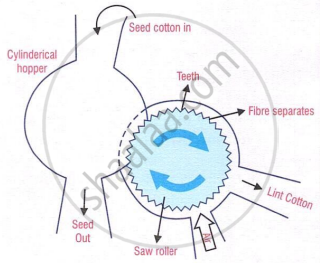
Akola is known as the ‘Cotton City of India’ due to its high cotton production. Shyamlal a cotton farmer from the district does not want his son to follow his vocation. Instead he wants his son to find employment in Pune. What are the problems associated with the growing of cotton that is influencing Shyamlal?
State the soil conditions that favour the growth of jute.
In what way is Ganga-Brahmaputra Delta suitable for jute cultivation?
Why is jute retted?
How is retting done?
Describe briefly the processing of jute.
Why is mesta an inferior substitute for jute?
Where is mesta grown?
By what other name is jute referred to? Why?
Why are floods beneficial for the growth of jute?
Mention one advantage of delay in jute harvest.
Mention one disadvantage of delay in jute harvest.
Mention some uses of jute.
State any two conditions that favour the growth of tea in the Nilgiris.
State the advantages of growing tea plants on hill slopes.
Name the different varieties of tea grown in India.
Why is blending necessary for tea?
Name the leading producer of tea in India. State two factors that have helped it to become the leading state in tea production.
Define the following term:
Clonal Planting
Define the following term:
Pruning
Give two climatic factors that favour the cultivation of coffee.
Name the three varieties of coffee plants grown on commercial scale in India.
Name one state where coffee is grown extensively.
Give a geographical reason for the following:
Coffee is grown on the slopes of the hills in Peninsular India.
Why are coffee estates inter-planted with orange trees, cardamom and pepper vines?
Tea bushes are pruned at regular intervals.
Describe briefly the dry parchment method of processing of coffee.
Thinking Skills
Cotton and Jute are the two crops which can provide employment to a large number of people and enhance the foreign exchange of the country. Give your opinion on the statement.
Tea and Coffee plantations should be developed as tourist spots to promote agri-tourism and provide an alternative source of income to the farmers. What do you think about this proposal?
Solutions for 17: Agriculture - IV: Cash Crops (2)
Morning Star solutions for Total Geography [English] Class 10 ICSE chapter 17 - Agriculture - IV: Cash Crops (2)
Shaalaa.com has the CISCE Mathematics Total Geography [English] Class 10 ICSE CISCE solutions in a manner that help students grasp basic concepts better and faster. The detailed, step-by-step solutions will help you understand the concepts better and clarify any confusion. Morning Star solutions for Mathematics Total Geography [English] Class 10 ICSE CISCE 17 (Agriculture - IV: Cash Crops (2)) include all questions with answers and detailed explanations. This will clear students' doubts about questions and improve their application skills while preparing for board exams.
Further, we at Shaalaa.com provide such solutions so students can prepare for written exams. Morning Star textbook solutions can be a core help for self-study and provide excellent self-help guidance for students.
Concepts covered in Total Geography [English] Class 10 ICSE chapter 17 Agriculture - IV: Cash Crops (2) are Cash Crops, Sugarcane, Oilseeds, Cotton, Jute, Tea, Coffee, Major Crops: Food Crops, Overview of Agriculture in India Part III - Cash Crops, Cash Crops, Sugarcane, Oilseeds, Cotton, Jute, Tea, Coffee, Major Crops: Food Crops, Overview of Agriculture in India Part III - Cash Crops.
Using Morning Star Total Geography [English] Class 10 ICSE solutions Agriculture - IV: Cash Crops (2) exercise by students is an easy way to prepare for the exams, as they involve solutions arranged chapter-wise and also page-wise. The questions involved in Morning Star Solutions are essential questions that can be asked in the final exam. Maximum CISCE Total Geography [English] Class 10 ICSE students prefer Morning Star Textbook Solutions to score more in exams.
Get the free view of Chapter 17, Agriculture - IV: Cash Crops (2) Total Geography [English] Class 10 ICSE additional questions for Mathematics Total Geography [English] Class 10 ICSE CISCE, and you can use Shaalaa.com to keep it handy for your exam preparation.
