Advertisements
Chapters
1: Interpretation of Topographical Maps
2: Contours
3: Scales and Direction
4: Map Reading and Interpretation
5: Map of India
PART II - GEOGRAPHY OF INDIA
6: Location, Extent and Physical Features
7: Climate
8: Soil Resources
9: Natural Vegetation
10: Water Resources
11: Mineral Resources
12: Conventional Sources of Energy
13: Non-Conventional Sources of Energy
▶ 14: Agriculture - I
15: Agriculture - II: Food Crops
16: Agriculture - III: Cash Crops (1)
17: Agriculture - IV: Cash Crops (2)
18: Manufacturing Industries (Agro-Based)
19: Mineral Based Industry
20: Transport
Chapter 21: Waste Management - I: Impact of Waste Accumulation
Chapter 22: Waste Management - II: Safe Disposal of Waste
![Morning Star solutions for Total Geography [English] Class 10 ICSE chapter 14 - Agriculture - I - Shaalaa.com](/images/total-geography-english-class-10-icse_6:9033996325ef4d37a61a084b4444e2b2.jpg "Morning Star solutions for Total Geography [English] Class 10 ICSE chapter 14 - Agriculture - I")
Advertisements
Solutions for Chapter 14: Agriculture - I
Below listed, you can find solutions for Chapter 14 of CISCE Morning Star for Total Geography [English] Class 10 ICSE.
Morning Star solutions for Total Geography [English] Class 10 ICSE 14 Agriculture - I EXERCISES [Pages 171 - 174]
Choose the correct option:
What are the crops grown in commercial farms called?
Beverage crops
Cash crops
Fibre crops
Plantation crops
Your uncle has a large farm. He rears animals along with farming. He is practising ______.
Intensive farming
Extensive farming
Commercial farming
Plantation farming
Assertion (A): Agriculture is the mainstay and the backbone of India’s economy.
Reason (R): It provides employment to millions of people.
Both A and R are true and R is the correct explanation of A.
Both A and R are true but R does not explain A.
A is true but R is false.
A is false but R is true.
Commercial farming is prevalent in areas where landholdings are ______ and market economy is well developed.
large
small
consolidated
poor in fertility
‘Slash and burn method’ refers to ______ agriculture.
Subsistence
Shifting
Intensive
Extensive
Which of the following crops are associated with shifting agriculture?
Rice and wheat
Tea and coffee
Yams and tapioca
Jute and cotton
Which of the following is practised in many areas as an alternative to shifting cultivation?
Rotation of crops
Intercropping
Nitrogen fixation
Dry farming
Assertion (A): The agricultural output depends on monsoon.
Reason (R): Nearly 55 per cent of the area sown is dependent on irrigation.
Both A and R are true and R is the correct explanation of A.
Both A and R are true but R does not explain A.
A is true but R is false.
A is false but R is true.
Intercropping involves growing of two or more crops next to each other at the same ______.
time
space
height
distance
______ plantation is being promoted to check the practice of shifting cultivation.
Mango
Orange
Apple
Timber
______ type of farming involves cultivation of small farms using large inputs of labour, manures and fertilizers.
Extensive
Shifting
Intensive
Commercial
Which type of agriculture is mainly practised in the irrigated areas of the plains of northern India and the coastal area of south India?
Plantation
Shifting
Extensive
Intensive
______ farming is an eco-friendly method as it excludes the use of chemical fertilizers.
Subsistence
Commercial
Intensive
Organic
The farming which involves cultivation of single agricultural crop over large tracts of land or estates is ______.
Subsistence agriculture
Commercial agriculture
Plantation farming
Mixed farming
Assertion (A): India has the largest irrigated area of cultivated land.
Reason (R): The failure of monsoon or too much rainfall leads to crop failure.
Both A and R are true and R is the correct explanation of A.
Both A and R are true but R does not explain A.
A is true but R is false.
A is false but R is true.
Tea, coffee, rubber or spices are ______ crops.
Plantation farming
Intensive farming
Extensive farming
Commercial farming
Farmers narrate the story of what years of intensive commercial cultivation and over-extraction of nutrients by unsuitable crops has done to their natural resource base. Around 25 years ago, their farm soil was teeming with life - from earthworms to beetles. Now there are no signs of life. farmers belong to which state?
Bihar
Uttar Pradesh
Punjab
Rajasthan
Around 2014-15, a farmer got yields of 95 quintals and 70 quintals per ha in paddy and wheat respectively. Today, with the same quantity of chemical fertilisers, the average yield of paddy and wheat from one ha is 85 quintals and 65 quintals respectively. What has led to the decline in yield?
Soil depletion
Government policies
Irrigation facilities
Seed quality
Increasing rural-urban migration by men has led to rise of women-headed rural households and the resultant increased incomes had led to growth in the production of cash crops which are labour intensive in nature. This is referred to as feminisation of agriculture. Which type of farming would be carried out?
Subsistence
Plantation
Cooperative
Shifting
Answer the following questions:
What is meant by the term agriculture?
Why is agriculture said to be the backbone of the Indian economy?
While agriculture in India has achieved grain self-sufficiency but the production is, resource intensive, cereal centric and regionally biased. Mention any three problems of agriculture in India.
State three advantages of cooperative farming.
What is the Green Revolution?
State any two negative results of the Green Revolution.
What was the impact of Green Revolution on Indian agriculture?
With reference to the given image, answer the following questions:
- What are the inputs of the above-mentioned project in transforming Indian agriculture?
- Which crop was experimented with its inputs?
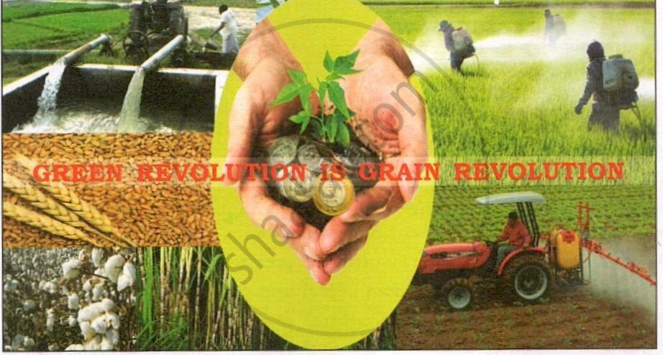
Differentiate between intensive farming and extensive farming.
State any two advantages of commercial farming.
Give a reason for the following:
Plantations are managed by large multinational companies.
Give a reason for the following:
Fields are rotated instead of crops in shifting cultivation.
Give a reason for the following:
In extensive agriculture, yield per hectare is low but total yield is large.
What type of farming is practised in areas where population is sparse and land is in plenty? Name two areas in India where such type of farming is practised.
Give two points of difference between plantation and mixed farming.
Give any two effects of globalisation on Indian agriculture.
Mention any three measures taken by the government to boost agricultural production.
Agriculture in India is a gamble on the monsoon. Explain.
How is shifting cultivation carried out?
Where is shifting cultivation practised in India?
State any one disadvantage of shifting cultivation.
State any two steps being taken by the government to discourage shifting cultivation.
What is subsistence farming?
Mention two features of subsistence farming.
What is organic farming?
What is Cooperative farming?
With reference to organic farming, state the following:
Main characteristics of organic farming.
State why is organic farming gaining popularity in recent times.
Thinking Skills
Your penfriend, who lives in Australia, has read that India is an agricultural country. He wants to know the details about the nature of agriculture practised in India and the problems faced by the farmers. Write to your friend replying to his queries.
Your grandfather, a farmer, was a young boy when the Green Revolution began. What does he tell you about the pros and cons of the Green Revolution.
Your uncle, who lives in Punjab, is a farmer involved in the cultivation of crops and livestock rearing. He sells the crops and dairy products in the market. Name the type of agriculture practised by him, the crops he grows and the main features of the agriculture practised by him. Why is this type of agriculture not popular throughout the country?
If you are given a choice, which type of agriculture you would like to practise and why?
The concept of organic food is fast catching up in metro cities. What are your views on this? Give reasons to support your answer. Are you ready to pay more for organic products?
Punjab is known as the food granary of India growing most of the cereal and cash crops but is facing declining crop yields and poor soil conditions. It is one of the biggest exporter of rice and cotton crops.
- What climatic conditions favour rice growth in the above-mentioned area?
- What is the difference between cereal and cash crops? Can a cereal be a cash crop?
- Suggest the sustainable agricultural practices to improve soil fertility.
During my visit to the flood plains of Uttar Pradesh, I witnessed immense agricultural development. Mention the soil type found here and the characteristic features of it.
Solutions for 14: Agriculture - I
Morning Star solutions for Total Geography [English] Class 10 ICSE chapter 14 - Agriculture - I
Shaalaa.com has the CISCE Mathematics Total Geography [English] Class 10 ICSE CISCE solutions in a manner that help students grasp basic concepts better and faster. The detailed, step-by-step solutions will help you understand the concepts better and clarify any confusion. Morning Star solutions for Mathematics Total Geography [English] Class 10 ICSE CISCE 14 (Agriculture - I) include all questions with answers and detailed explanations. This will clear students' doubts about questions and improve their application skills while preparing for board exams.
Further, we at Shaalaa.com provide such solutions so students can prepare for written exams. Morning Star textbook solutions can be a core help for self-study and provide excellent self-help guidance for students.
Concepts covered in Total Geography [English] Class 10 ICSE chapter 14 Agriculture - I are Importance and Features of Indian Agriculture, Problems Faced by the Agricultural Sector in India > Economic Problems, Problems Faced by the Agricultural Sector in India > Environmental Problems, Problems Faced by the Agricultural Sector in India > Technological Problems, Problems Faced by the Agricultural Sector in India > Institutional Problems, Agricultural Reforms and the Green Revolution in India, Types of Farming in India > Intensive Farming, Minimum Support Price (MSP), Types of Farming in India > Subsistence Farming, Types of Farming in India > Commercial Farming, Types of Farming in India > Shifting Agriculture, Types of Farming in India > Extensive Farming, Types of Farming in India > Plantation Farming, Types of Farming in India > Mixed Farming, Types of Farming in India > Organic Farming, Types of Farming in India > Cooperative Farming, Agricultural Seasons in India, Importance and Features of Indian Agriculture, Problems Faced by the Agricultural Sector in India > Economic Problems, Problems Faced by the Agricultural Sector in India > Environmental Problems, Problems Faced by the Agricultural Sector in India > Technological Problems, Problems Faced by the Agricultural Sector in India > Institutional Problems, Agricultural Reforms and the Green Revolution in India, Types of Farming in India > Intensive Farming, Minimum Support Price (MSP), Types of Farming in India > Subsistence Farming, Types of Farming in India > Commercial Farming, Types of Farming in India > Shifting Agriculture, Types of Farming in India > Extensive Farming, Types of Farming in India > Plantation Farming, Types of Farming in India > Mixed Farming, Types of Farming in India > Organic Farming, Types of Farming in India > Cooperative Farming, Agricultural Seasons in India.
Using Morning Star Total Geography [English] Class 10 ICSE solutions Agriculture - I exercise by students is an easy way to prepare for the exams, as they involve solutions arranged chapter-wise and also page-wise. The questions involved in Morning Star Solutions are essential questions that can be asked in the final exam. Maximum CISCE Total Geography [English] Class 10 ICSE students prefer Morning Star Textbook Solutions to score more in exams.
Get the free view of Chapter 14, Agriculture - I Total Geography [English] Class 10 ICSE additional questions for Mathematics Total Geography [English] Class 10 ICSE CISCE, and you can use Shaalaa.com to keep it handy for your exam preparation.
