Advertisements
Chapters
1: Interpretation of Topographical Maps
2: Contours
3: Scales and Direction
4: Map Reading and Interpretation
5: Map of India
PART II - GEOGRAPHY OF INDIA
6: Location, Extent and Physical Features
7: Climate
8: Soil Resources
9: Natural Vegetation
▶ 10: Water Resources
11: Mineral Resources
12: Conventional Sources of Energy
13: Non-Conventional Sources of Energy
14: Agriculture - I
15: Agriculture - II: Food Crops
16: Agriculture - III: Cash Crops (1)
17: Agriculture - IV: Cash Crops (2)
18: Manufacturing Industries (Agro-Based)
19: Mineral Based Industry
20: Transport
Chapter 21: Waste Management - I: Impact of Waste Accumulation
Chapter 22: Waste Management - II: Safe Disposal of Waste
![Morning Star solutions for Total Geography [English] Class 10 ICSE chapter 10 - Water Resources - Shaalaa.com](/images/total-geography-english-class-10-icse_6:9033996325ef4d37a61a084b4444e2b2.jpg "Morning Star solutions for Total Geography [English] Class 10 ICSE chapter 10 - Water Resources")
Advertisements
Solutions for Chapter 10: Water Resources
Below listed, you can find solutions for Chapter 10 of CISCE Morning Star for Total Geography [English] Class 10 ICSE.
Morning Star solutions for Total Geography [English] Class 10 ICSE 10 Water Resources EXERCISES [Pages 131 - 134]
Choose the correct option:
What is an aquifer?
An underground well that readily gives out water on digging the land.
An underground pond that was once a source of water and is now buried under rocks.
An underground stream saturated with water that is transmitted readily on to the surface.
None of the above.
Which of the following measures are not used to conserve water?
Rainwater harvesting
Using bottled drinking water only
Water recycling
Preventing water pollution
Drip irrigation
Assertion (A): Many states have recorded a sharp fall in the groundwater levels, ranging from 70 to 80 per cent.
Reason (R): With the increase in population the demand for water has risen.
Both A and R are true and R is the correct explanation of A.
Both A and R are true but R does not explain A.
A is true but R is false.
A is false but R is true.
Which of the following is a cause for the decline in groundwater levels?
Irregular and erratic rainfall
Urbanisation
Loss of vegetative cover
All of the above
Sprinkler irrigation is also known as ______.
Seepage irrigation
Overhead irrigation
Protected irrigation
Nozzle irrigation
Tanks form the main source of irrigation in ______.
Punjab and Haryana
the Deccan Plateau
Madhya Pradesh and Gujarat
All of the above
Assertion (A): Cherrapunji, which receives about 11,000 mm of rainfall annually, suffers from acute shortage of drinking water.
Reason (R): Most of the rain falling on the surface tends to flow away rapidly, leaving very little for the recharge of groundwater.
Both A and R are true and R is the correct explanation of A.
Both A and R are true but R does not explain A.
A is true but R is false.
A is false but R is true.
______ is not a conventional means of irrigation.
Furrow irrigation
Wells
Tanks
Inundation canals
Rahul is constructing a house in Mathura. Of the following methods select those that he can use to ensure rainwater harvesting.
- A garden
- Porous tiles in his driveway
- Rooftop rainwater harvesting
- Borewell
(i), (ii), (iii), (iv)
(i), (ii), (iii)
(i), (ii), (iv)
None of them
Assertion (A): Runoff from only paved surfaces is used for storing rainwater.
Reason (R): It is relatively free of bacteriological contamination.
Both A and R are true and R is the correct explanation of A.
Both A and R are true but R does not explain A.
A is true but R is false.
A is false but R is true.
Most of the canals in India belong to which category?
Perennial canals
Inundation canals
Navigation canals
None of the above
Which of the following least irrigated state of India is solely dependent on canals?
Assam
Mizoram
Tripura
Arunachal Pradesh
Assertion (A): For farmers rainfall is still the most important source of water.
Reason (R): Irrigation canals and tanks have been constructed by rulers since ancient times.
Both A and R are true and R is the correct explanation of A.
Both A and R are true but R does not explain A.
A is true but R is false.
A is false but R is true.
You have to maintain one public park in your colony. Which method of irrigation would you prefer?
Furrow irrigation
Spray irrigation
Drip irrigation
Sprinkler irrigation
Answer the following questions:
What do you understand by the term ‘water resource’?
Give two points of difference between ‘surface water’ and ‘groundwater’.
Give a geographical reason for the following:
Need to adopt different means of irrigation.
Give a geographical reason for the following:
Need for conserving water.
Give a geographical reason for the following:
Man is responsible for water crisis in India.
| Rajasthan faces water scarcity, particularly in dry areas. The government has initiated water harvesting projects to enhance water availability. |
- What is meant by water harvesting?
- State the objectives of water harvesting schemes.
What is meant by the term irrigation?
What is meant by the term ‘water scarcity’?
What has caused water scarcity in India?
Give a geographical reason for the following:
Inundation canals are being converted to perennial canals.
Give a geographical reason for the following:
Tank irrigation is preferred over other means of irrigation in Peninsular India.
Give a geographical reason for the following:
Groundwater reserves are depleting at a fast rate.
What is meant by traditional or conventional methods of irrigation?
Name any two conventional methods of irrigation.
State any two drawbacks of conventional methods of irrigation.
Mention any three advantages of well irrigation in India.
Describe the disadvantages of well irrigation.
Give a geographical reason for the following:
Well irrigation is confined mainly to the alluvial plains.
Give a geographical reason for the following:
In Tamil Nadu, nearly one-third of the net irrigated area is under canal irrigation.
Give a geographical reason for the following:
Drip irrigation reduces loss of water through evaporation.
Name any two states where well irrigation is practised.
Give one advantage of tubewell irrigation.
Give one disadvantage of tube-well irrigation.
What are the two types of canals?
Name two states where perennial canals are widely used.
How are the fields irrigated using the Persian wheel method?
Give a geographical reason for the following:
Canals make the soil infertile.
Give a geographical reason for the following:
Tubewell irrigation is quite expensive.
Give a geographical reason for the following:
Excessive accumulation of salts make the soils unsuitable for cultivation.
| Canals are a channel for supply of water from rivers to the farm fields. The perennial canals are not only an advantage but can be disadvantageous too. The perennial canals are functional in the state of Punjab due to the favourable situations available there. |
- What conditions favour the development of canal irrigation in the mentioned area?
- State two disadvantages of it.
Briefly explain why groundwater levels are dropping rapidly in India.
How can groundwater be recharged?
Name a method to recharge groundwater.
Give a geographical reason for the following:
Many farmers in India still use wells.
Give a geographical reason for the following:
There is very little recharge of groundwater.
Give a geographical reason for the following:
Tubewells are important in Punjab.
What is watershed management?
How is watershed management beneficial for farmers in the long run?
What is ‘drip irrigation’?
How is drip irrigation useful?
Explain briefly the need to conserve water.
“The modern means of irrigation are gaining popularity.” Give two reasons to justify this statement.
Give a geographical reason for the following:
Sprinkler irrigation helps in conserving water.
Give a geographical reason for the following:
Spray irrigation is quite expensive.
What is meant by furrow irrigation?
What is the advantage of furrow irrigation?
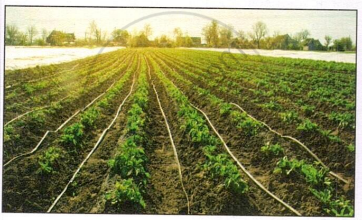
Picture shows drip irrigation in a field. List its advantages.
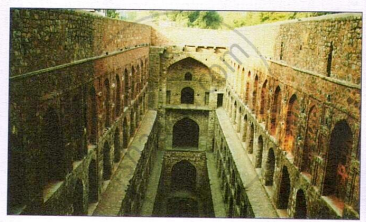
Picture is Agrasen ki Baoli (New Delhi) - a step-well whose current form is believed to be constructed in the 14th century. The water level varies seasonally. It is designed to ensure water availability throughout the year with all fluctuations. Write a short note on any traditional irrigation method.
Give a geographical reason for the following:
Loss of water due to evaporation is highest in tanks.
Give a geographical reason for the following:
Many cities have banned construction of tubewells.
Give a geographical reason for the following:
Rabi crops are grown in areas with irrigation facilities.
Given a choice which modern method of irrigation would you use to irrigate your farm? Give reasons to support your answer.
Practical Work
With the help of a suitable sketch show the various methods of rainwater harvesting.
Enlist the ways in which water can be reused and recycled in various activities.
Make a Power Point Presentation showing the various methods used for rainwater harvesting from ancient times to the present.
Thinking Skills
Nature has endowed India with plentiful water resources. Despite this, acute shortage of water is noticed in some states. What could be the reasons for this shortage?
In your city, critical shortage of water has been reported due to a sharp fall in the groundwater level. What steps you will take to check this scarcity of water?
| Our country has a long history of water conservation techniques like (i) Surangam (Kerela): A horizontal well dug in laterite rock until a significant amount of water is struck. This water seeps out of the hard rock. Outside of the Surangam, the water is gathered in an open pit. (ii) Bawaris/Baolis (Rajasthan): A system of layered steps was created around the reservoirs to narrow and deepen the wells, reducing water loss through evaporation harvesting the scanty rainfall received by the region. (iii) Eri/Ooranis (Tamil Nadu): A tank system that manages floods, minimises soil erosion and runoff during heavy rains. Thus recharging groundwater. (iv) Ahar Pynes (Bihar) are reservoirs with three-sided embankments (Ahar) constructed at the end of man-made diversion channels (Pynes). (v) Zing (Ladakh): Tank used to harvest water from glaciers. As the glacier melts during the day, a network of channels fill up with water. By the afternoon the water in the channels turns into a flowing stream which collects in the tank by evening and is used the next day. |
Which one would be suitable for your city? Have you observed any of these traditional systems? If you have, briefly describe it.
Solutions for 10: Water Resources
Morning Star solutions for Total Geography [English] Class 10 ICSE chapter 10 - Water Resources
Shaalaa.com has the CISCE Mathematics Total Geography [English] Class 10 ICSE CISCE solutions in a manner that help students grasp basic concepts better and faster. The detailed, step-by-step solutions will help you understand the concepts better and clarify any confusion. Morning Star solutions for Mathematics Total Geography [English] Class 10 ICSE CISCE 10 (Water Resources) include all questions with answers and detailed explanations. This will clear students' doubts about questions and improve their application skills while preparing for board exams.
Further, we at Shaalaa.com provide such solutions so students can prepare for written exams. Morning Star textbook solutions can be a core help for self-study and provide excellent self-help guidance for students.
Concepts covered in Total Geography [English] Class 10 ICSE chapter 10 Water Resources are Need for Irrigation, India: A Land of Rivers Yet Water Scarce, Sources of Water, Need to Conserve Water, Irrigation, Means of Irrigation, Well Irrigation, Canal Irrigation, Tank Irrigation, Modern Irrigation Methods, Water Conservation Practices > Rainwater Harvesting, Water Conservation Practices > Watershed Management, Water Conservation Practices > Rooftop Rainwater Harvesting, Water Conservation Practices > Recharging Groundwater Aquifers, Need for Irrigation, India: A Land of Rivers Yet Water Scarce, Sources of Water, Need to Conserve Water, Irrigation, Means of Irrigation, Well Irrigation, Canal Irrigation, Tank Irrigation, Modern Irrigation Methods, Water Conservation Practices > Rainwater Harvesting, Water Conservation Practices > Watershed Management, Water Conservation Practices > Rooftop Rainwater Harvesting, Water Conservation Practices > Recharging Groundwater Aquifers.
Using Morning Star Total Geography [English] Class 10 ICSE solutions Water Resources exercise by students is an easy way to prepare for the exams, as they involve solutions arranged chapter-wise and also page-wise. The questions involved in Morning Star Solutions are essential questions that can be asked in the final exam. Maximum CISCE Total Geography [English] Class 10 ICSE students prefer Morning Star Textbook Solutions to score more in exams.
Get the free view of Chapter 10, Water Resources Total Geography [English] Class 10 ICSE additional questions for Mathematics Total Geography [English] Class 10 ICSE CISCE, and you can use Shaalaa.com to keep it handy for your exam preparation.
