Advertisements
Chapters
1: Interpretation of Topographical Maps
2: Contours
3: Scales and Direction
4: Map Reading and Interpretation
5: Map of India
PART II - GEOGRAPHY OF INDIA
6: Location, Extent and Physical Features
7: Climate
8: Soil Resources
9: Natural Vegetation
10: Water Resources
11: Mineral Resources
12: Conventional Sources of Energy
13: Non-Conventional Sources of Energy
14: Agriculture - I
▶ 15: Agriculture - II: Food Crops
16: Agriculture - III: Cash Crops (1)
17: Agriculture - IV: Cash Crops (2)
18: Manufacturing Industries (Agro-Based)
19: Mineral Based Industry
20: Transport
Chapter 21: Waste Management - I: Impact of Waste Accumulation
Chapter 22: Waste Management - II: Safe Disposal of Waste
![Morning Star solutions for Total Geography [English] Class 10 ICSE chapter 15 - Agriculture - II: Food Crops - Shaalaa.com](/images/total-geography-english-class-10-icse_6:9033996325ef4d37a61a084b4444e2b2.jpg "Morning Star solutions for Total Geography [English] Class 10 ICSE chapter 15 - Agriculture - II: Food Crops")
Advertisements
Solutions for Chapter 15: Agriculture - II: Food Crops
Below listed, you can find solutions for Chapter 15 of CISCE Morning Star for Total Geography [English] Class 10 ICSE.
Morning Star solutions for Total Geography [English] Class 10 ICSE 15 Agriculture - II: Food Crops EXERCISES [Pages 185 - 188]
Choose the correct option:
______ crops are associated with the south-west monsoon.
Rabi
Kharif
Zayad
None of the above
Identify a non-kharif crop?
Sugarcane
Cotton
Rice
Wheat
Assertion (A): Categorisation of the cropping season does not exist in southern India.
Reason (R): The temperatures are sufficiently high to grow tropical crops during any period in the year provided the soil moisture is available.
Both A and R are true and R is the correct explanation of A.
Both A and R are true but R does not explain A.
A is true but R is false.
A is false but R is true.
The kharif crops are sown in June and July and harvested in ______ and ______.
September and October
October and November
March and April
August and September
Wheat and barley are associated with which agricultural season?
Kharif
Zaid
Rabi
None of the above
The crops which are raised throughout the year are known as ______.
Kharif
Rabi
Zaid
Baid
Assertion (A): India is by and large self-sufficient in food grains.
Reason (R): Indian agriculture is largely dominated by food crops.
Both A and R are true and R is the correct explanation of A.
Both A and R are true but R does not explain А.
A is true but R is false.
A is false but R is true.
Name the grass-like plants, which have starchy edible seeds that are a warehouse of nutrients.
Cereals
Spices
Beverages
Oilseeds
Assertion (A): Rice, an indigenous crop, is grown all over the country.
Reason (R): Rice is a kharif crop in north India. In the south, it can be grown throughout the year if irrigation is available.
Both A and R are true and R is the correct explanation of A.
Both A and R are true but R does not explain A.
A is true but R is false.
A is false but R is true.
Rice grows best in ______ and ______ areas.
warm, humid
cold, dry
hot, rainy
hot, dry
Rice thrives in the ______ soils grown along the river banks.
laterite
red
black
alluvial
A farmer is using the dry method of rice cultivation, seeds are sown in rows with drills. As a student of geography what can you say about the rainfall in the area?
low rainfall
heavy rainfall
moderate rainfall
scanty rainfall
Assertion (A): Millets serve as food grains for the poorer sections of the society.
Reason (R): They are highly nutritious easily digestible food that grows in harsh conditions.
Both A and R are true and R is the correct explanation of A.
Both A and R are true but R does not explain A.
A is true but R is false.
A is false but R is true.
Pulses are important crops because they ______.
compliment the India starch-rich diet.
are rich source of protein.
fix atmospheric nitrogen.
All of the above.
Answer the following questions:
Name the three cropping seasons in India.
Which is the most important method of rice cultivation in India? Why?
Name the two states where rice is grown as a cash crop. Why?
Give three points of difference between upland and lowland rice.
Why are cereals referred to as ‘staff of life’?
State two geographical conditions suitable for the cultivation of rice?
Give a geographical reason for the following:
Cultivation of wheat is confined to the northern part of India.
Give a geographical reason for the following:
Punjab is the leading producer of wheat in India.
Give a geographical reason for the following:
Government of India is encouraging cultivation of pulses.
Name the state that produces the highest quantity of rice in India.
State two advantages of growing rice on lowlands.
Which type of soils are suitable for wheat cultivation?
What geographical conditions are necessary for the growth of wheat?
Name two states that grow wheat extensively. What climatic features have helped these states in this respect?
Mention three differences in the geographical conditions and cultivation of rice and wheat.
What is meant by “transplantation”?
State two advantages of “transplantation”.
How does the cultivation of pulses usually help in restoration of fertility of the soil?
Why are pulses grown as rotational crops?
Explain why India is the largest consumer of pulses.
State three methods of growing rice.
What do you understand by the term ‘millets’?
Why are millets referred to as ‘foodgrains of the poor’?
Give the geographical reason for the following:
Millets are known as dry crops.
In what way are the millets different from rice?
In which region is ragi grown in India? Why?
In which part of the year is wheat grown in India? Why?
Why is wheat not grown in the eastern and in the extreme southern parts of India?
With reference to wheat cultivation, answer the following:
Name the state that is the largest producer of this crop in India.
In the year 2023-24 the government has imposed restrictions on rice exports, according to news reports. As a student of geography give reasons to support government’s decision.
[Hint: low rainfall in August 2023]
Study the picture given below and answer the following questions:
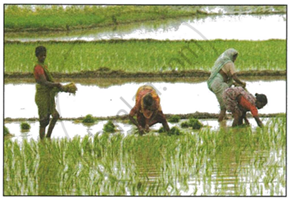 |
- Name the crop which is being planted. Give one benefit of this method of planting this crop.
- Name the other method of planting the crop. In which area is this method practised?
- Give a geographical reason for each of the following:
- Rice is not the main crop in the Deccan Plateau.
- Punjab is the largest producer of rice despite deficient rainfall.
- Wheat grows well in loamy soil.
- Mention the climatic conditions which favour the cultivation of the crop being planted.
What is dry farming?
Name one crop that can be grown by dry farming.
Name the soil which enables dry farming.
Give a geographical reason for the following:
The soil should be able to retain standing water in the field.
Give a geographical reason for the following:
Rice is the leading crop of West Bengal.
Give a geographical reason for the following:
In north India wheat is a rabi crop.
In the state of West Bengal, three crops of rice are grown annually. It is the leading rice growing state of India and has favourable conditions for its growth. Write the climatic factors which favour its growth in the mentioned region of India.
The United Nations declared 2023 as International Year of Millets to encourage the cultivation and increase awareness of the nutritional benefits and the sustainability of millets. How can cultivation of millets promote sustainability?
State the advantages of cultivation of pulses.
Sapan is a farmer who has purchased seeds called Japonica.
- Which crop is he cultivating?
- Briefly describe two practices that he would need to follow.
The government of Punjab is encouraging its farmers to shift away from rice cultivation.
- What has prompted this action?
- Which alternate crops are encouraged?
Map Work
On an outline map of India, shade and mark:
- The highest wheat producing state in India.
- Any two rice producing states in South India.
- One ragi producing region.
- Two major areas for cultivation of pulses.
Thinking Skills
Indian agriculture is largely dominated by food crops. What is the reason for it? Give examples to support your answer.
You live in a state which has a number of rivers, deltas and estuaries, good rainfall and heavy soils. Which cereal crop is ideal for growth in your state? During which season would this crop be sown and which method of cultivation would be used?
Though India is an agricultural country, the cost of food is rising sharply. Give reasons to explain the causes of this rise in prices of food.
Solutions for 15: Agriculture - II: Food Crops
Morning Star solutions for Total Geography [English] Class 10 ICSE chapter 15 - Agriculture - II: Food Crops
Shaalaa.com has the CISCE Mathematics Total Geography [English] Class 10 ICSE CISCE solutions in a manner that help students grasp basic concepts better and faster. The detailed, step-by-step solutions will help you understand the concepts better and clarify any confusion. Morning Star solutions for Mathematics Total Geography [English] Class 10 ICSE CISCE 15 (Agriculture - II: Food Crops) include all questions with answers and detailed explanations. This will clear students' doubts about questions and improve their application skills while preparing for board exams.
Further, we at Shaalaa.com provide such solutions so students can prepare for written exams. Morning Star textbook solutions can be a core help for self-study and provide excellent self-help guidance for students.
Concepts covered in Total Geography [English] Class 10 ICSE chapter 15 Agriculture - II: Food Crops are Classification of Crops, Major Crops: Food Crops, Rice, Wheat, Millets, Pulses, Classification of Crops, Major Crops: Food Crops, Rice, Wheat, Millets, Pulses.
Using Morning Star Total Geography [English] Class 10 ICSE solutions Agriculture - II: Food Crops exercise by students is an easy way to prepare for the exams, as they involve solutions arranged chapter-wise and also page-wise. The questions involved in Morning Star Solutions are essential questions that can be asked in the final exam. Maximum CISCE Total Geography [English] Class 10 ICSE students prefer Morning Star Textbook Solutions to score more in exams.
Get the free view of Chapter 15, Agriculture - II: Food Crops Total Geography [English] Class 10 ICSE additional questions for Mathematics Total Geography [English] Class 10 ICSE CISCE, and you can use Shaalaa.com to keep it handy for your exam preparation.
