Advertisements
Online Mock Tests
Chapters
2: Physics and Mathematics
3: Rest and Motion: Kinematics
4: The Forces
5: Newton's Laws of Motion
6: Friction
7: Circular Motion
8: Work and Energy
9: Centre of Mass, Linear Momentum, Collision
10: Rotational Mechanics
11: Gravitation
12: Simple Harmonics Motion
13: Fluid Mechanics
14: Some Mechanical Properties of Matter
15: Wave Motion and Waves on a String
16: Sound Waves
17: Light Waves
18: Geometrical Optics
19: Optical Instruments
20: Dispersion and Spectra
21: Speed of Light
▶ 22: Photometry
23: Heat and Temperature
24: Kinetic Theory of Gases
25: Calorimetry
26: Laws of Thermodynamics
27: Specific Heat Capacities of Gases
28: Heat Transfer
29: Electric Field and Potential
30: Gauss’s Law
31: Capacitors
32: Electric Current in Conductors
33: Thermal and Chemical Effects of Current
34: Magnetic Field
35: Magnetic Field due to a Current
36: Permanent Magnets
37: Magnetic Properties of Matter
38: Electromagnetic Induction
39: Alternating Current
40: Electromagnetic Waves
41: Electric Current through Gases
42: Photoelectric Effect and Wave-Particle Duality
43: Bohr’s Model and Physics of Atom
44: X-rays
45: Semiconductors and Semiconductor Devices
46: The Nucleus
47: The Special Theory of Relativity
![HC Verma solutions for Concepts of Physics Volume 1 and 2 [English] chapter 22 - Photometry - Shaalaa.com](/images/concepts-of-physics-volume-1-and-2-english_6:9bad16cab2dd4ae1a1a6bac3add1eb27.jpg "HC Verma solutions for Concepts of Physics Volume 1 and 2 [English] chapter 22 - Photometry")
Advertisements
Solutions for Chapter 22: Photometry
Below listed, you can find solutions for Chapter 22 of CBSE, Karnataka Board PUC HC Verma for Concepts of Physics Volume 1 and 2 [English].
HC Verma solutions for Concepts of Physics Volume 1 and 2 [English] 22 Photometry Short Answers [Page 453]
What is the luminous flux of a source emitting radio waves?
The luminous flux of a 1 W sodium vapour lamp is more than that of a 10 kW source of ultraviolet radiation. Comment.
Light is incident normally on a small plane surface. If the surface is rotated by an angle of 30° about the incident light, does the illuminance of the surface increase, decreases or remain same? Does your answer change if the light did not fall normally on the surface?
A bulb is hanging over a table. At which portion of the table is the illuminance maximum? If a plane mirror is placed above the bulb facing the table, will the illuminance on the table increase?
The sun is less bright at morning and evening as compared to at noon although its distance from the observer is almost the same Why?
Why is the luminous efficiency small for a filament bulb as compared to a mercury vapour lamp?
The yellow colour has a greater luminous efficiency as compared to the other colours. Can we increase the illuminating power of a white light source by putting a yellow plastic paper around this source?
HC Verma solutions for Concepts of Physics Volume 1 and 2 [English] 22 Photometry MCQ [Page 454]
The one parameter that determines the brightness of a light source sensed by an eye is ____________ .
energy of light entering the eye per second
wavelength of the light
total radiant flux entering the eye
total luminous flux entering the eye
Three light sources A, B and C emit equal amount of radiant energy per unit time. The wavelengths emitted by the three source are 450 nm, 555 nm and 700 nm respectively. The brightness sensed by an eye for the sources are XA, XB and XC respectively. Then, ________ .
XA > XB, XC > XB
XA > XB, XB > XC
XB > XA, XB > XC
XB > XA, XC > XB
As the wavelength is increased from violet to red, the luminosity ____________ .
continuously increases
continuously decreases
increases then decreases
decreases then increases
An electric bulb is hanging over a table at a height of 1 m above it. The illuminance on the table directly below the bulb is 40 lux. The illuminance at a point on the table 1 m away from the first point will be about ___________ .
10 lux
14 lux
20 lux
28 lux
Light from a point source falls on a screen. If the separation between the source and the screen is increased by 1%, the illuminance will decrease (nearly) by ____________ .
0.5%
1%
2%
4%
A battery-operated torch is adjusted to send an almost parallel beam of light. It produces an illuminancle of 40 lux when the light falls on a wall 2 m away. The illuminance produced when it falls on a wall 4 m away is close to _________ .
40 lux
20 lux
10 lux
5 lux
The intensity produced by a long cylindrical light source at a small distance r from the source is proportional to _________ .
\[\frac{1}{r^2}\]
\[\frac{1}{r^3}\]
\[\frac{1}{r}\]
None of these
A photographic plate placed a distance of 5 cm from a weak point source is exposed for 3 s. If the plate is kept at a distance of 10 cm from the source, the time needed for the same exposure is _____________ .
3s
12s
24s
48s
A photographic plate is placed directly in front of a small diffused source in the shape of a circular disc. It takes 12s to get a good exposure. If the source is rotated by 60° about one of its diameter, the time needed to get the same exposure will be ___________ .
6s
12s
24s
48s
A point source of light moves in a straight line parallel to a plane table. Consider a small portion of the table directly below the line of movement of the source. The illuminance at this portion varies with its distance r from the source as ___________ .
\[1 \propto \frac{1}{r}\]
\[1 \propto \frac{1}{r^2}\]
\[1 \propto \frac{1}{r^3}\]
\[1 \propto \frac{1}{r^4}\]
Figure shows a glowing mercury tube. The intensities at point A, B and C are related as __________ .

B > C > A
A > C > B
B = C > A
B = C < A
HC Verma solutions for Concepts of Physics Volume 1 and 2 [English] 22 Photometry MCQ [Page 454]
The brightness-producing capacity of a source
(a) does not depend on its power
(b) does not depend on the wavelength emitted
(c) depends on its power
(d) depends on the wavelength emitted
A room is illuminated by an extended source. The illuminance at a particular portion of a wall can be increased by
(a) moving the source
(b) rotating the source
(c) bringing some mirrors in proper positions
(d) changing the colour of the source.
Mark the correct options.
(a) The luminous efficiency of a monochromatic source is always greater than that of a white light source of same power.
(b) The luminous efficiency of a monochromatic source of wavelength 555 nm is always greater than that of a white light source of same power.
(c) The illuminating power of a monochromatic source of wavelength 555 nm is always greater than that of a white light source of same power.
(d) The illuminating power of a monochromatic source is always greater than that of a white light source of same power.
Mark out the correct options.
(a) Luminous flux and radiant flux have same dimensions.
(b) Luminous flux and luminous intensity have same dimensions.
(c) Radiant flux and power have same dimensions.
(d) Relative luminosity is a dimensionless quantity.
HC Verma solutions for Concepts of Physics Volume 1 and 2 [English] 22 Photometry Exercise [Page 455]
A source emits 45 joules of energy in 15 s. What is the radiant flux of the source?
A photographic plate records sufficiently intense lines when it is exposed for 12 s to a source of 10 W. How long should it be exposed to a 12 W source radiating the light of same colour to get equally intense lines?
Using figure, find the relative luminosity of wavelength (a) 480 nm, (b) 520 nm (c) 580 nm and (d) 600 nm.
The relative luminosity of wavelength 600 nm is 0.6. Find the radiant flux of 600 nm needed to produce the same brightness sensation as produced by 120 W of radiant flux at 555 nm.
The luminous flux of a monochromatic source of 1 W is 450 lumen watt−1. Find the relative luminosity at the wavelength emitted.
A source emits light of wavelengths 555 nm and 600 nm. The radiant flux of the 555 nm part is 40 W and of the 600 nm part is 30 W. The relative luminosity at 600 nm is 0.6. Find (a) the total radiant flux, (b) the total luminous flux, (c) the luminous efficiency.
A light source emits monochromatic light of 555 nwavelengthm. The source consumes 100 W of electric power and emits 35 W of radiant flux. Calculate the overall luminous efficiency.
A source emits 31.4 W of radiant flux distributed uniformly in all directions. The luminous efficiency is 60 lumen watt−1. What is the luminous intensity of the source?
A point source emitting 628 lumen of luminous flux uniformly in all directions is placed at the origin. Calculate the illuminance on a small area placed at (1.0 m, 0, 0) in such a way that the normal to the area makes an angle of 37° with the X-axis.
The illuminance of a small area changes from 900 lumen m−2 to 400 lumen m−2 when it is shifted along its normal by 10 cm. Assuming that it is illuminated by a point source placed on the normal, find the distance between the source and the area in the original position.
A point source emitting light uniformly in all directions is placed 60 cm above a table-top. The illuminance at a point on the table-top, directly below the source, is 15 lux. Find the illuminance at a point on the table-top 80 cm away from the first point.
Light from a point source falls on a small area placed perpendicular to the incident light. If the area is rotated about the incident light by an angle of 60°, by what fraction will the illuminance change?
A student is studying a book placed near the edge of a circular table of radius R. A point source of light is suspended directly above the centre of the table. What should be the height of the source above the table so as to produce maximum illuminance at the position of the book?
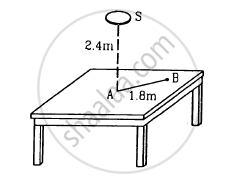
Figure shows a small diffused plane source S placed over a horizontal table-top at a distance of 2.4 m with its plane parallel to the table-top. The illuminance at the point Adirectly below the source is 25 lux. Find the illuminance at a point B of the table at a distance of 1.8 m from A.
An electric lamp and a candle produce equal illuminance at a photometer screen when they are placed at 80 cm and 20 cm from the screen respectively. The lamp is now covered with a thin paper which transmits 49% of the luminous flux. By what distance should the lamp be moved to balance the intensities at the screen again?
Two light sources of intensities 8 cd and 12 cd are placed on the same side of a photometer screen at a distance of 40 cm from it. Where should a 80 cd source be placed to balance the illuminance?
Solutions for 22: Photometry
HC Verma solutions for Concepts of Physics Volume 1 and 2 [English] chapter 22 - Photometry
Shaalaa.com has the CBSE, Karnataka Board PUC Mathematics Concepts of Physics Volume 1 and 2 [English] CBSE, Karnataka Board PUC solutions in a manner that help students grasp basic concepts better and faster. The detailed, step-by-step solutions will help you understand the concepts better and clarify any confusion. HC Verma solutions for Mathematics Concepts of Physics Volume 1 and 2 [English] CBSE, Karnataka Board PUC 22 (Photometry) include all questions with answers and detailed explanations. This will clear students' doubts about questions and improve their application skills while preparing for board exams.
Further, we at Shaalaa.com provide such solutions so students can prepare for written exams. HC Verma textbook solutions can be a core help for self-study and provide excellent self-help guidance for students.
Concepts covered in Concepts of Physics Volume 1 and 2 [English] chapter 22 Photometry are .
Using HC Verma Concepts of Physics Volume 1 and 2 [English] solutions Photometry exercise by students is an easy way to prepare for the exams, as they involve solutions arranged chapter-wise and also page-wise. The questions involved in HC Verma Solutions are essential questions that can be asked in the final exam. Maximum CBSE, Karnataka Board PUC Concepts of Physics Volume 1 and 2 [English] students prefer HC Verma Textbook Solutions to score more in exams.
Get the free view of Chapter 22, Photometry Concepts of Physics Volume 1 and 2 [English] additional questions for Mathematics Concepts of Physics Volume 1 and 2 [English] CBSE, Karnataka Board PUC, and you can use Shaalaa.com to keep it handy for your exam preparation.
