English
Karnataka Board PUCPUC Science Class 11

A Point Source Emitting Light Uniformly in All Directions is Placed 60 Cm Above a Table-top. the Illuminance at a Point on the Table-top, Directly Below the Source, is 15 Lux. - Physics

Advertisements
Advertisements

Question

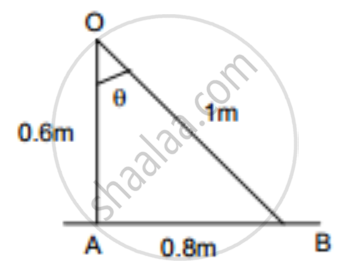
A point source emitting light uniformly in all directions is placed 60 cm above a table-top. The illuminance at a point on the table-top, directly below the source, is 15 lux. Find the illuminance at a point on the table-top 80 cm away from the first point.

Sum
Advertisements

Solution

Given,

Distance of the source from the table-top (r) = 60 cm or 0.6 m

Let Io be the intensity of illumination.

Illuminance directly below the source (EA) is given by,

`E_A=I_0/(0.6)^2`

 I0 = 15 × (0.6)2
       = 5.4 candela

Let EB be the illuminance at a point 80 cm away from the initial point.

So, `E_B=(I_0 costheta)/(OB)^2`

From the figure, we get

`cos theta=0.6/1`

OB = 1 m

Substituting the respective values in the above formula, we get

` E_B= 5.4(0.6/1)`

= 3.24 lux

So, the illuminance at a point on the table-top 80 cm away from the first point is 3.24 lux.

shaalaa.com
Light Process and Photometry
  Is there an error in this question or solution?
Chapter 22: Photometry - Exercise [Page 455]

APPEARS IN

HC Verma Concepts of Physics Vol. 1 [English] Class 11 and 12
Chapter 22 Photometry
Exercise | Q 11 | Page 455

RELATED QUESTIONS

What is the luminous flux of a source emitting radio waves?


The sun is less bright at morning and evening as compared to at noon although its distance from the observer is almost the same Why?


Why is the luminous efficiency small for a filament bulb as compared to a mercury vapour lamp?


The yellow colour has a greater luminous efficiency as compared to the other colours. Can we increase the illuminating power of a white light source by putting a yellow plastic paper around this source?


A battery-operated torch is adjusted to send an almost parallel beam of light. It produces an illuminancle of 40 lux when the light falls on a wall 2 m away. The illuminance produced when it falls on a wall 4 m away is close to _________ .


A photographic plate placed a distance of 5 cm from a weak point source is exposed for 3 s. If the plate is kept at a distance of 10 cm from the source, the time needed for the same exposure is _____________ .


A point source of light moves in a straight line parallel to a plane table. Consider a small portion of the table directly below the line of movement of the source. The illuminance at this portion varies with its distance r from the source as ___________ .


The brightness-producing capacity of a source

(a) does not depend on its power

(b) does not depend on the wavelength emitted

(c) depends on its power

(d) depends on the wavelength emitted


A room is illuminated by an extended source. The illuminance at a particular portion of a wall can be increased by

(a) moving the source

(b) rotating the source

(c) bringing some mirrors in proper positions

(d) changing the colour of the source.


Mark the correct options.

(a) The luminous efficiency of a monochromatic source is always greater than that of a white light source of same power.

(b) The luminous efficiency of a monochromatic source of wavelength 555 nm is always greater than that of a white light source of same power.

(c) The illuminating power of a monochromatic source of wavelength 555 nm is always greater than that of a white light source of same power.

(d) The illuminating power of a monochromatic source is always greater than that of a white light source of same power.


Mark out the correct options.

(a) Luminous flux and radiant flux have same dimensions.

(b) Luminous flux and luminous intensity have same dimensions.

(c) Radiant flux and power have same dimensions.

(d) Relative luminosity is a dimensionless quantity.


The luminous flux of a monochromatic source of 1 W is 450 lumen watt−1. Find the relative luminosity at the wavelength emitted.


A source emits light of wavelengths 555 nm and 600 nm. The radiant flux of the 555 nm part is 40 W and of the 600 nm part is 30 W. The relative luminosity at 600 nm is 0.6. Find (a) the total radiant flux, (b) the total luminous flux, (c) the luminous efficiency.


A source emits 31.4 W of radiant flux distributed uniformly in all directions. The luminous efficiency is 60 lumen watt−1. What is the luminous intensity of the source?


The illuminance of  a small area changes from 900 lumen m−2 to 400 lumen m−2 when it is shifted along its normal by 10 cm. Assuming that it is illuminated by a point source placed on the normal, find the distance between the source and the area in the original position.


An electric lamp and a candle produce equal illuminance at a photometer screen when they are placed at 80 cm and 20 cm from the screen respectively. The lamp is now covered with a thin paper which transmits 49% of the luminous flux. By what distance should the lamp be moved to balance the intensities at the screen again?


Photo diodes are used to detect ______.


Light rays from a point object ______.


Light travels through a glass plate of thickness t and having a refractive index μ. If c is the velocity of light in vacuum, the time taken by the light to travel this thickness of glass is ______.


Share
Notifications

Englishहिंदीमराठी


      Forgot password?
Use app×