Advertisements
Advertisements
प्रश्न
A point source emitting light uniformly in all directions is placed 60 cm above a table-top. The illuminance at a point on the table-top, directly below the source, is 15 lux. Find the illuminance at a point on the table-top 80 cm away from the first point.
Advertisements
उत्तर
Given,
Distance of the source from the table-top (r) = 60 cm or 0.6 m
Let Io be the intensity of illumination.
Illuminance directly below the source (EA) is given by,
`E_A=I_0/(0.6)^2`
⇒ I0 = 15 × (0.6)2
= 5.4 candela
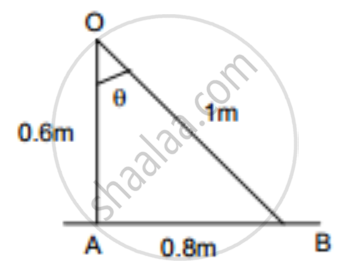
Let EB be the illuminance at a point 80 cm away from the initial point.
So, `E_B=(I_0 costheta)/(OB)^2`
From the figure, we get
`cos theta=0.6/1`
OB = 1 m
Substituting the respective values in the above formula, we get
` E_B= 5.4(0.6/1)`
= 3.24 lux
So, the illuminance at a point on the table-top 80 cm away from the first point is 3.24 lux.
APPEARS IN
संबंधित प्रश्न
What is the luminous flux of a source emitting radio waves?
Light is incident normally on a small plane surface. If the surface is rotated by an angle of 30° about the incident light, does the illuminance of the surface increase, decreases or remain same? Does your answer change if the light did not fall normally on the surface?
A bulb is hanging over a table. At which portion of the table is the illuminance maximum? If a plane mirror is placed above the bulb facing the table, will the illuminance on the table increase?
The sun is less bright at morning and evening as compared to at noon although its distance from the observer is almost the same Why?
The one parameter that determines the brightness of a light source sensed by an eye is ____________ .
An electric bulb is hanging over a table at a height of 1 m above it. The illuminance on the table directly below the bulb is 40 lux. The illuminance at a point on the table 1 m away from the first point will be about ___________ .
Light from a point source falls on a screen. If the separation between the source and the screen is increased by 1%, the illuminance will decrease (nearly) by ____________ .
A photographic plate placed a distance of 5 cm from a weak point source is exposed for 3 s. If the plate is kept at a distance of 10 cm from the source, the time needed for the same exposure is _____________ .
The brightness-producing capacity of a source
(a) does not depend on its power
(b) does not depend on the wavelength emitted
(c) depends on its power
(d) depends on the wavelength emitted
A room is illuminated by an extended source. The illuminance at a particular portion of a wall can be increased by
(a) moving the source
(b) rotating the source
(c) bringing some mirrors in proper positions
(d) changing the colour of the source.
Mark out the correct options.
(a) Luminous flux and radiant flux have same dimensions.
(b) Luminous flux and luminous intensity have same dimensions.
(c) Radiant flux and power have same dimensions.
(d) Relative luminosity is a dimensionless quantity.
A source emits 45 joules of energy in 15 s. What is the radiant flux of the source?
A photographic plate records sufficiently intense lines when it is exposed for 12 s to a source of 10 W. How long should it be exposed to a 12 W source radiating the light of same colour to get equally intense lines?
A source emits light of wavelengths 555 nm and 600 nm. The radiant flux of the 555 nm part is 40 W and of the 600 nm part is 30 W. The relative luminosity at 600 nm is 0.6. Find (a) the total radiant flux, (b) the total luminous flux, (c) the luminous efficiency.
A point source emitting 628 lumen of luminous flux uniformly in all directions is placed at the origin. Calculate the illuminance on a small area placed at (1.0 m, 0, 0) in such a way that the normal to the area makes an angle of 37° with the X-axis.
The illuminance of a small area changes from 900 lumen m−2 to 400 lumen m−2 when it is shifted along its normal by 10 cm. Assuming that it is illuminated by a point source placed on the normal, find the distance between the source and the area in the original position.
Light from a point source falls on a small area placed perpendicular to the incident light. If the area is rotated about the incident light by an angle of 60°, by what fraction will the illuminance change?
