English
Karnataka Board PUCPUC Science Class 11

A Student is Studying a Book Placed Near the Edge of a Circular Table of Radius R. a Point Source of Light is Suspended Directly Above the Centre of the Table. - Physics

Advertisements
Advertisements

Question

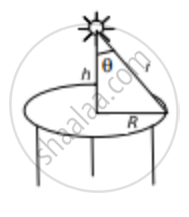
A student is studying a book placed near the edge of a circular table of radius R. A point source of light is suspended directly above the centre of the table. What should be the height of the source above the table so as to produce maximum illuminance at the position of the book?

Sum
Advertisements

Solution

Let the height of the source be h and the luminous intensity in the normal direction be I0.

So, illuminance on the book (E) is given by,

\[E = \frac{I_0 \cos\theta}{r^2}\]

From the figure we get

Cosθ = \[\frac{h}{r}\]

On substituting the value of Cosθ, we get

\[E = \frac{I_0 h}{r^3}\]

But r = \[\sqrt{R^2 + h^2}\]

\[\therefore E=\frac{I_0 h}{\left( r^2 + h^2 \right)^\frac{3}{2}}\]

For maximum illuminance,

\[\frac{dE}{dH} = 0\]

\[\frac{dE}{dH} = \frac{I_0 \left[ \left( R^2 + h^2 \right)^\frac{3}{2} - \frac{3}{2}h \times \left( R^2 + h^2 \right)^\frac{1}{2} \times 2h \right]}{\left( R^2 + h^2 \right)^3} = 0\]

\[\Rightarrow  \left( R^2 + h^2 \right)^\frac{1}{2} \left[ R^2 + h^2 - 3 h^2 \right] = 0\]

\[ \Rightarrow  R^2  - 2 h^2  = 0\]

\[ \Rightarrow h = \frac{R}{\sqrt{2}}\]

shaalaa.com
Light Process and Photometry
  Is there an error in this question or solution?
Chapter 22: Photometry - Exercise [Page 455]

APPEARS IN

HC Verma Concepts of Physics Vol. 1 [English] Class 11 and 12
Chapter 22 Photometry
Exercise | Q 13 | Page 455

RELATED QUESTIONS

The luminous flux of a 1 W sodium vapour lamp is more than that of a 10 kW source of ultraviolet radiation. Comment.


A bulb is hanging over a table. At which portion of the table is the illuminance maximum? If a plane mirror is placed above the bulb facing the table, will the illuminance on the table increase?


The one parameter that determines the brightness of a light source sensed by an eye is ____________ .


A battery-operated torch is adjusted to send an almost parallel beam of light. It produces an illuminancle of 40 lux when the light falls on a wall 2 m away. The illuminance produced when it falls on a wall 4 m away is close to _________ .


The intensity produced by a long cylindrical light source at a small distance r from the source is proportional to _________ .


A photographic plate placed a distance of 5 cm from a weak point source is exposed for 3 s. If the plate is kept at a distance of 10 cm from the source, the time needed for the same exposure is _____________ .


Figure shows a glowing mercury tube. The intensities at point A, B and C are related as __________ .


The brightness-producing capacity of a source

(a) does not depend on its power

(b) does not depend on the wavelength emitted

(c) depends on its power

(d) depends on the wavelength emitted


A source emits 45 joules of energy in 15 s. What is the radiant flux of the source?


A photographic plate records sufficiently intense lines when it is exposed for 12 s to a source of 10 W. How long should it be exposed to a 12 W source radiating the light of same colour to get equally intense lines?


A source emits light of wavelengths 555 nm and 600 nm. The radiant flux of the 555 nm part is 40 W and of the 600 nm part is 30 W. The relative luminosity at 600 nm is 0.6. Find (a) the total radiant flux, (b) the total luminous flux, (c) the luminous efficiency.


A light source emits monochromatic light of  555 nwavelengthm. The source consumes 100 W of electric power and emits 35 W of radiant flux. Calculate the overall luminous efficiency.


A source emits 31.4 W of radiant flux distributed uniformly in all directions. The luminous efficiency is 60 lumen watt−1. What is the luminous intensity of the source?


A point source emitting light uniformly in all directions is placed 60 cm above a table-top. The illuminance at a point on the table-top, directly below the source, is 15 lux. Find the illuminance at a point on the table-top 80 cm away from the first point.


Light from a point source falls on a small area placed perpendicular to the incident light. If the area is rotated about the incident light by an angle of 60°, by what fraction will the illuminance change?


Figure shows a small diffused plane source S placed over a horizontal table-top at a distance of 2.4 m with its plane parallel to the table-top. The illuminance at the point Adirectly below the source is 25 lux. Find the illuminance at a point B of the table at a distance of 1.8 m from A.


Two light sources of intensities 8 cd and 12 cd are placed on the same side of a photometer screen at a distance of 40 cm from it. Where should a 80 cd source be placed to balance the illuminance?


Light rays from a point object ______.


Light travels through a glass plate of thickness t and having a refractive index μ. If c is the velocity of light in vacuum, the time taken by the light to travel this thickness of glass is ______.


Share
Notifications

Englishहिंदीमराठी


      Forgot password?
Use app×