Advertisements
Advertisements
Explain concept with example/explain with the help of a balanced equation.
Roasting
Concept: undefined >> undefined
Explain concept with example/explain with the help of a balanced equation.
Calcination
Concept: undefined >> undefined
Advertisements
Complete flow chart given below.
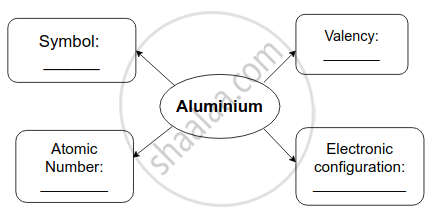
Concept: undefined >> undefined
An object is placed vertically at a distance of 20 cm from a convex lens. If the height of the object is 5 cm and the focal length of the lens is 10 cm, what will be the position, size and nature of the image? How much bigger as compared to the object?
Concept: undefined >> undefined
Observe the given below the figure, correct it and explain and write about the concept depicted in this figure.
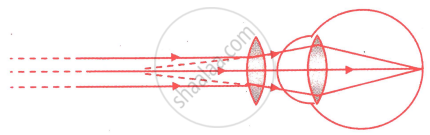
Concept: undefined >> undefined
Given below is a diagram showing a defect of vision. Name the defect of vision and draw an accurately labelled diagram to correct this defect.
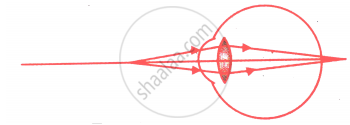
Concept: undefined >> undefined
Observe the following diagram and write answers.
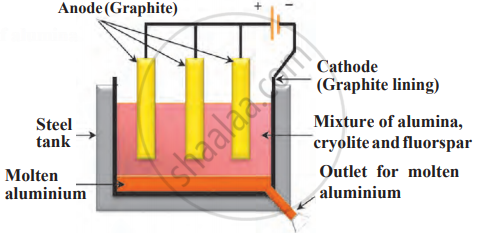
- Name the method.
- Write anode reaction and cathode reaction.
- Why fluorspar and cryolite are added in the mixture?
Concept: undefined >> undefined
Read the following passage and answer the questions.
According to the reactivity series, zinc is more reactive than iron, iron is more reactive than silver. During study of this, a student dipped the iron nails in silver nitrate solution.
- What is reactivity series?
- What will happen when iron nails are dipped in silver nitrate solution?
- Which type of reaction happens when iron metal reacts with silver nitrate solution?
- What will happen if a zinc rod is used instead of iron nail?
Concept: undefined >> undefined
Explain in brief types of extraction of highly reactive metals according to their reactivity.
Concept: undefined >> undefined
Explain in brief types of extraction of moderately reactive metals according to their reactivity.
Concept: undefined >> undefined
Explain in brief types of extraction of less reactive metals according to their reactivity.
Concept: undefined >> undefined
Explain Bayer’s process of concentration of bauxite with a chemical equation.
Concept: undefined >> undefined
Explain in brief electrolytic reduction of alumina with a neat labelled diagram.
Concept: undefined >> undefined
Observe the figure and answer the following.
- Write the name of the method.
- What is used as anode and cathode in this method?
- Write the molecular formula and use of cryolite.
- Write anode reaction.
- Write cathode reaction.
Concept: undefined >> undefined
Answer the questions on the following passage.
The minerals from which the metal can be separated economically are called ores. Ores contain many types of impurities such as soil, sand and rocky substances along with metal compounds. These impurities are called gangue.
Metals can be extracted from their ores by means of various methods of separation. The process of extraction of metal in a pure state from the ores is also a part of metallurgy.
Ores are taken out from the mines and the gangue is usually separated from the ore at the site itself by various methods. Then the ores are carried out to the place where metals are produced. Here metals are extracted in pure form. Then metals are further purified by different methods of purification. This entire process is called metallurgy. Most metals being reactive do not occur in nature in the free state but are found in combined state as their salts such as oxides, carbonates, sulphides, and nitrates. however, the most unreactive metals that are not affected by air, water and other natural factors like silver, gold, platinum, generally occur in a free state. The compounds of metals that occur in nature along with the impurities are called minerals.
- What are ores?
- Which processes are involved in the branch of metallurgy? What is metallurgy?
- Which metals are found in a free state?
- In what forms are metals found in combined state?
- What is gangue?
Concept: undefined >> undefined
Explain the difference between Bayer’s process and Hall’s process by explaining the Bayer’s process.
Concept: undefined >> undefined
Read the following paragraphs and write the answers.
Next to the moon, the astronomical object nearest to the earth is Mars. Many nations sent spacecrafts to Mars. Mars mission is difficult and almost half the missions were unsuccessful. However, ISRO’s performance in this mission is remarkable and we all must be proud of it. The spacecraft ‘Mangalyaan’ made by ISRO using minimum expenses was launched in November, 2013 and was placed into orbit around Mars in September, 2014. It obtained very useful information about the surface of Mars and the atmosphere around it.
- Next to the moon, which is the nearest celestial object to the earth?
- When did Mangalyaan placed into orbit around Mars by ISRO?
- What important information did ISRO's Mangalyaan obtain?
- Explain that critical velocity does not depend on the mass of the satellite.
Concept: undefined >> undefined
Identify the type of chemical reaction given below:
\[\ce{2KClO3 -> 2KCl + 3O2 ^}\]
Concept: undefined >> undefined
Correlate the given sequence:
Hypermetropia : Convex lens : ______ : Concave lens
Concept: undefined >> undefined
Observe the figure whether it is correct or not and explain the phenomenon.

Concept: undefined >> undefined
