Advertisements
Advertisements
Question
Explain in brief electrolytic reduction of alumina with a neat labelled diagram.
Advertisements
Solution
- The pure alumina obtained from bauxite ore by Bayer’s process or Hall’s process is electrolysed to obtain metallic aluminium.
- Alumina has a very high melting point (>2000 °C).
- Electrolysis of alumina is carried out in an electrolytic cell at a much lower temperature by dissolving it in molten cryolite (Na3AlF6) and fluorspar (CaF2). Addition of cryolite and fluorspar reduces the melting point to about 1000 °C.
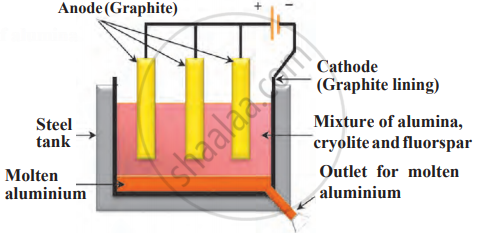
- The electrolytic cell is a large steel tank having a lining of carbon (graphite) on the inner side. The carbon lining acts as a cathode. A set of carbon (graphite) rods dipped in the molten electrolyte acts as an anode.
- On passing electric current, electrolysis of alumina takes place.
- Aluminium is formed at the cathode and oxygen gas is liberated at the anode.
- The electrode reactions are as follows:
Cathode: \[\ce{Al^3+ + 3e^- -> Al_{(l)}}\]
(Reduction)
Anode:
\[\ce{2O2- -> O2 + 4e^-}\] (Oxidation) - The molten aluminium is heavier than the electrolyte used and hence, it sinks to the bottom of the tank from where it is removed periodically.
- The oxygen gas liberated at the anode reacts with the carbon anode and forms carbon dioxide gas.
\[\ce{C_{(s)} + O_{2(g)} -> CO_2(g)}\] - As the anode gets oxidized during the electrolysis of alumina, it has to be replaced from time to time.
APPEARS IN
RELATED QUESTIONS
In the extraction of aluminium: Why is it necessary to replace anodes time to time?
Bronze is an alloy of copper and ______.
Define the term mineral.
Explain giving equation, what happens when:
A mixture of Cu2O and Cu2S is heated.
Name two metals which are always found in combined state.
Name two ores of zinc. Write the names of the chemical compounds present in them and give their chemical formulae.
An ore of manganese metal is ______.
The major ore of aluminium is known as ______.
The articles made of silver metal become dark on prolonged exposure to air. This is due to the formation of a layer of its ______.
An element A which is a part of common salt and kept under kerosene reacts with another element B of atomic number 17 to give a product C. When an aqueous solution of product C is electrolysed then a compound D is formed and two gases are liberated.
- What are A and B?
- Identify C and D.
- What will be the action of C on litmus solution? Why?
- State whether element B is a solid, liquid or gas at room temperature.
- Write formula of the compound formed when element B reacts with an element E having atomic number 5.
Give the principles of the froth floatation process.
Identify the process given in following passage and draw neat labelled diagram showing the process.
Electrolysis of molten mixture of alumina (melting point > 20000C) is done in a steel tank. The tank has a graphite lining on the inner side. This lining does the work of a cathode. A set of graphite rods dipped in the molten electrolyte works as anode. Cryolite (Na3AlF6) and fluorspar (CaF2) are added in the mixture to lower its melting point upto 10000C.
Name the following:
The process of heating a substance very strongly in such a way that it does not combine with oxygen.
Complete the incomplete statement with missing words:
Metals are ______ while non-metals are ______ conductors of heat.
Zinc blende is converted to oxide by ______ process.
Mercury, silver, gold are highly reactive metals.
Explain concept with example/explain with the help of a balanced equation.
Ionic bond and ionic compounds
In extraction of copper, the flux used is ____________.
2 mL each of concentrated HCl, HNO3 and a mixture of concentrated HCl and concentrated HNO3 in the ratio of 3 : 1 were taken in test tubes labelled as A, B and C. A small piece of metal was put in each test tube. No change occurred in test tubes A and B but the metal got dissolved in test tube C respectively. The metal could be
The given reaction shows one of the processes to extract the metals like Iron and Manganese.
\[\ce{MnO2(s) + Al(s) -> Mn(l) + Al2O3(s) + Heat}\]
Give the reason why the above reaction is known as a thermite reaction.
