Advertisements
Advertisements
प्रश्न
Explain in brief electrolytic reduction of alumina with a neat labelled diagram.
Advertisements
उत्तर
- The pure alumina obtained from bauxite ore by Bayer’s process or Hall’s process is electrolysed to obtain metallic aluminium.
- Alumina has a very high melting point (>2000 °C).
- Electrolysis of alumina is carried out in an electrolytic cell at a much lower temperature by dissolving it in molten cryolite (Na3AlF6) and fluorspar (CaF2). Addition of cryolite and fluorspar reduces the melting point to about 1000 °C.
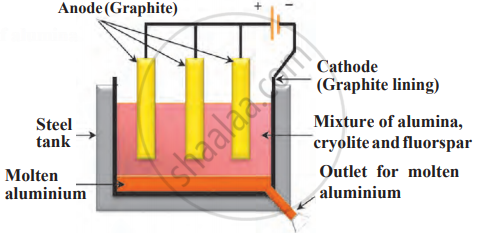
- The electrolytic cell is a large steel tank having a lining of carbon (graphite) on the inner side. The carbon lining acts as a cathode. A set of carbon (graphite) rods dipped in the molten electrolyte acts as an anode.
- On passing electric current, electrolysis of alumina takes place.
- Aluminium is formed at the cathode and oxygen gas is liberated at the anode.
- The electrode reactions are as follows:
Cathode: \[\ce{Al^3+ + 3e^- -> Al_{(l)}}\]
(Reduction)
Anode:
\[\ce{2O2- -> O2 + 4e^-}\] (Oxidation) - The molten aluminium is heavier than the electrolyte used and hence, it sinks to the bottom of the tank from where it is removed periodically.
- The oxygen gas liberated at the anode reacts with the carbon anode and forms carbon dioxide gas.
\[\ce{C_{(s)} + O_{2(g)} -> CO_2(g)}\] - As the anode gets oxidized during the electrolysis of alumina, it has to be replaced from time to time.
APPEARS IN
संबंधित प्रश्न
Why do gold ornaments look new even after several years of use?
Which one of the methods given in column I is applied for the extraction of each of the metals given in column II:
| Column I | Column II |
| Electrolytic reduction | Aluminium |
| Reduction with Carbon | Zinc |
| Reduction with Aluminium | Sodium |
| Iron | |
| Manganese | |
| Tin |
Why does aluminium not corrode right through?
Describe with one example, how moderately reactive metals (which are in the middle of reactivity series) are extracted.
Name the gas produced when calamine ore is calcined.
Zinc blende ore can be converted into zinc oxide by the process of ______.
State three objectives achieved during the roasting of ores.
Identify the process given in following passage and draw neat labelled diagram showing the process.
Electrolysis of molten mixture of alumina (melting point > 20000C) is done in a steel tank. The tank has a graphite lining on the inner side. This lining does the work of a cathode. A set of graphite rods dipped in the molten electrolyte works as anode. Cryolite (Na3AlF6) and fluorspar (CaF2) are added in the mixture to lower its melting point upto 10000C.
What is galvanized iron.
Write equations for each of the above metal which reacts with water.
Which one of the following is not true of metal :
Metals are good conductors of electricity.
Name the methods by which concentrated ore is converted to metallic oxide.
Carbon cannot reduce the oxides of sodium, magnesium, and aluminum to their respective metals. Why? Where are these metals placed in the reactivity series? How are these metals obtained from their ores? Take an example to explain the process of extraction along with chemical equations.
_______ is the least reactive metal.
Explain the following reaction with the balanced equation.
Chlorine dissolved in water
Observe the following diagram and write answers.
- Name the method.
- Write anode reaction and cathode reaction.
- Why fluorspar and cryolite are added in the mixture?
Explain in brief types of extraction of less reactive metals according to their reactivity.
In thermite welding a mixture of ____________ is ignited with a burning magnesium ribbon which produces molten iron metal as a large amount of heat is evolved.
Iqbal treated a lustrous, divalent element M with sodium hydroxide. He observed the formation of bubbles in reaction mixture. He made the same observations when this element was treated with hydrochloric acid. Suggest how can he identify the produced gas. Write chemical equations for both the reactions.
Two ores A and B were taken. On heating ore A gives CO2 whereas, ore B gives SO2. What steps will you take to convert them into metals?
