Advertisements
Advertisements
प्रश्न
Write the molecular formulae of the following compound.
Cryolite
Advertisements
उत्तर
Cryolite- Na3AlF6
APPEARS IN
संबंधित प्रश्न
In the extraction of aluminium Write the cathode reaction in electrolytic reduction of alumina.
A zinc ore gave CO2 on treatment with a dilute acid. Identify the ore and write its chemical formula.
Why does a new aluminium vessel lose shine so soon after use?
Why do gold ornaments look new even after several years of use?
Name one metal which is extracted by:
Reduction with carbon.
Name the chemical compound which is electrolysed in molten state to obtain sodium metal. Which gas is produced in this process?
Name the gas evolved when cinnabar ore is roasted.
How is sodium metal extracted? Explain with the help of equation of the reaction involved.
Describe the extraction of zinc metal from its sulphide ore (zinc blende). Write equations of the reactions involved.
Manganese metal is extracted from manganese dioxide by a reduction process by making use of ______.
The metal which can be extracted simply by heating the cinnabar ore in air is ______.
Give the chemical formula of :
Sodium aluminate
Define the term:
Slag
What is galvanized iron.
Compare the properties of a typical metal and a non- metal on the basis of the following:
(a) electronic configuration
(b) nature of oxides
(c) oxidizing or reducing action
(d) conductivity of heat and electricity
Name the following :
The Process of heating an ore to a high temperature in the presence of air.
In the electrolytic method, a layer of highly active metal is applied to a less active metal.
Observe the following diagram and write answers.
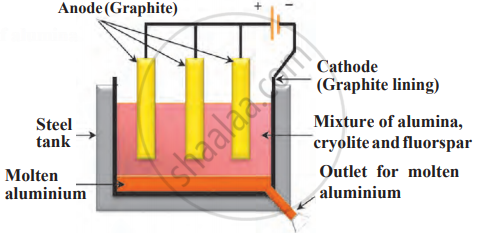
- Name the method.
- Write anode reaction and cathode reaction.
- Why fluorspar and cryolite are added in the mixture?
Explain in brief types of extraction of highly reactive metals according to their reactivity.
On the basis of reactivity metals are grouped into three categories:
- Metals of low reactivity
- Metals of medium reactivity
- Metals of high reactivity
Therefore metals are extracted in pure form from their ores on the basis of their chemical properties.
Metals of high reactivity are extracted from their ores by electrolysis of the molten ore.
Metals of low reactivity are extracted from their sulphide ores, which are converted into their oxides. The oxides of these metals are reduced to metals by simple heating.
(a) Name the process of reduction used for a metal that gives vigorous reaction with air and water both.
(b) Carbon cannot be used as a reducing agent to obtain aluminium from its oxide? Why?
(c) Describe briefly the method to obtain mercury from cinnabar. Write the chemical equation for the reactions involved in the process.
OR
(c) Differentiate between roasting and calcination giving chemical equation for each.
