Advertisements
Advertisements
प्रश्न
Explain in brief types of extraction of highly reactive metals according to their reactivity.
Advertisements
उत्तर
Extraction of highly reactive metals:
- Highly reactive metals such as sodium, magnesium and calcium are obtained by electrolytic reduction.
- The metals are deposited at the cathode (negatively charged electrode), whereas chlorine gas is liberated at the anode (positively charged electrode).
E.g. For extraction of sodium metal, cathode and anode reactions are as follows:
At cathode: \[\ce{Na+ + e^- -> Na}\] (Reduction)
At anode: \[\ce{2Cl- -> Cl2 + 2e^-}\] (Oxidation)
APPEARS IN
संबंधित प्रश्न
Which of the following pairs will give displacement reactions?
A man went door to door posing as a goldsmith. He promised to bring back the glitter of old and dull gold ornaments. An unsuspecting lady gave a set of gold bangles to him which he dipped in a particular solution. The bangles sparkled like new but their weight was reduced drastically. The lady was upset, but after a futile argument, the man beat a hasty retreat. Can you play the detective to find out the nature of the solution he had used?
In the extraction of aluminium: Why is it necessary to replace anodes time to time?
A zinc ore gave CO2 on treatment with a dilute acid. Identify the ore and write its chemical formula.
The major ore of aluminium is known as ______.
Some metallic oxides can be reduced by hydrogen, carbon and carbon monoxide and some cannot. Explain.
Answer the following questions based on the extraction of aluminium from alumina by Hall - Heroult’s Process :
Name the electrode, from which aluminium collected.
Name the following:
Two metals which are found in the free or native state.
Compare the properties of a typical metal and a non- metal on the basis of the following:
(a) electronic configuration
(b) nature of oxides
(c) oxidizing or reducing action
(d) conductivity of heat and electricity
To protect iron from rusting, it is coated with a thin layer of zinc. Name the process.
Which one of the following is not true of metal :
Metals form non-polar covalent compounds
Observe the given figure of reactivity series of metals and answer the following questions:
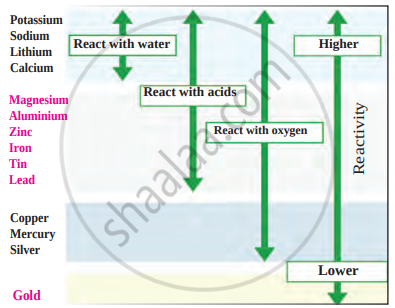
Reactivity series of metals
- Name two metals which react with water.
- Name two moderately reactive metals.
- Name the most highly reactive metal and the most less reactive metal.
In Electrolytic reduction of alumina, Anode : _______ : : Cathode : Graphite lining
Zinc sulphide : Roasting : : zinc carbonate : _______
Write the molecular formulae of the following compound.
Sodium aluminate
Explain the following reaction with the balanced equation.
Chlorine dissolved in water
Complete flow chart given below.
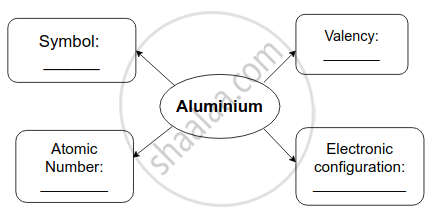
The poorest conductor of heat among metals is ____________.
Which of the following metals exist in their native state in nature?
- Cu
- Au
- Zn
- Ag
The given reaction shows one of the processes to extract the metals like Iron and Manganese.
\[\ce{MnO2(s) + Al(s) -> Mn(l) + Al2O3(s) + Heat}\]
Give a reason why Aluminium is preferably used in thermite reactions.
