Advertisements
Advertisements
प्रश्न
Observe the figure and answer the following.
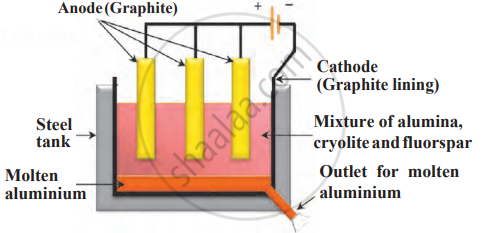
- Write the name of the method.
- What is used as anode and cathode in this method?
- Write the molecular formula and use of cryolite.
- Write anode reaction.
- Write cathode reaction.
Advertisements
उत्तर
- The method shown is an electrolytic reduction of alumina.
- A set of graphite rods dipped in the molten electrolyte acts as the anode. and the graphite lining acts as a cathode.
- Molecular formula of cryolite: Na3AlF6
Use of cryolite: Addition of cryolite reduces the melting point of alumina to about 1000 °C. - Anode reaction: \[\ce{2O^2+ -> O2 + 4e^-}\]
- Cathode reaction: \[\ce{Al^3+ + 3e^- -> Al_{(l)}}\]
APPEARS IN
संबंधित प्रश्न
Define the Ore.
What chemical process is used for obtaining a metal from its oxide?
Give one word or a phrase:
The process by which sulphide ore is concentrated.
Silver metal does not combine easily with oxygen but silver jewellery tarnishes after some time. How?
Name the chemical compound which is electrolysed in molten state to obtain aluminium metal. Which gas is evolved during this process?
Describe the extraction of zinc metal from its sulphide ore (zinc blende). Write equations of the reactions involved.
The major ore of aluminium is known as ______.
Which metal can be extracted from the following ore?
Haematite
Give the principles of the hydrolytic method.
Answer the following questions based on the extraction of aluminium from alumina by Hall - Heroult’s Process :
What is the function of cryolite used along with alumina as the electrolyte?
Explain the following:
Galvanization protects iron from rusting.
What is passive iron?
The following question relate to the extraction of aluminium by electrolysis.
Give the equation for the reaction which takes place at the cathode.
Name : The metal which is liquid at room temperature.
Which one of the following is not true of metal :
Metals are good conductors of electricity.
Explain in brief types of extraction of less reactive metals according to their reactivity.
Explain in brief electrolytic reduction of alumina with a neat labelled diagram.
Answer the questions on the following passage.
The minerals from which the metal can be separated economically are called ores. Ores contain many types of impurities such as soil, sand and rocky substances along with metal compounds. These impurities are called gangue.
Metals can be extracted from their ores by means of various methods of separation. The process of extraction of metal in a pure state from the ores is also a part of metallurgy.
Ores are taken out from the mines and the gangue is usually separated from the ore at the site itself by various methods. Then the ores are carried out to the place where metals are produced. Here metals are extracted in pure form. Then metals are further purified by different methods of purification. This entire process is called metallurgy. Most metals being reactive do not occur in nature in the free state but are found in combined state as their salts such as oxides, carbonates, sulphides, and nitrates. however, the most unreactive metals that are not affected by air, water and other natural factors like silver, gold, platinum, generally occur in a free state. The compounds of metals that occur in nature along with the impurities are called minerals.
- What are ores?
- Which processes are involved in the branch of metallurgy? What is metallurgy?
- Which metals are found in a free state?
- In what forms are metals found in combined state?
- What is gangue?
Which of the following metals exist in their native state in nature?
- Cu
- Au
- Zn
- Ag
Assertion (A): The extraction of metals from their sulphide ores cannot take place without roasting the ore.
Reason (R): Roasting converts sulphide ores directly into metals.
