Advertisements
Advertisements
प्रश्न
Explain in brief electrolytic reduction of alumina with a neat labelled diagram.
Advertisements
उत्तर
- The pure alumina obtained from bauxite ore by Bayer’s process or Hall’s process is electrolysed to obtain metallic aluminium.
- Alumina has a very high melting point (>2000 °C).
- Electrolysis of alumina is carried out in an electrolytic cell at a much lower temperature by dissolving it in molten cryolite (Na3AlF6) and fluorspar (CaF2). Addition of cryolite and fluorspar reduces the melting point to about 1000 °C.
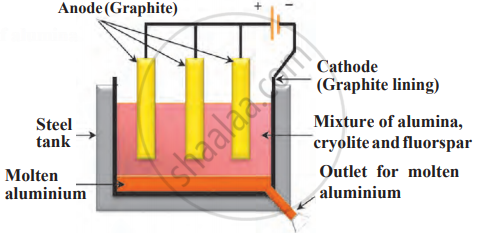
- The electrolytic cell is a large steel tank having a lining of carbon (graphite) on the inner side. The carbon lining acts as a cathode. A set of carbon (graphite) rods dipped in the molten electrolyte acts as an anode.
- On passing electric current, electrolysis of alumina takes place.
- Aluminium is formed at the cathode and oxygen gas is liberated at the anode.
- The electrode reactions are as follows:
Cathode: \[\ce{Al^3+ + 3e^- -> Al_{(l)}}\]
(Reduction)
Anode:
\[\ce{2O2- -> O2 + 4e^-}\] (Oxidation) - The molten aluminium is heavier than the electrolyte used and hence, it sinks to the bottom of the tank from where it is removed periodically.
- The oxygen gas liberated at the anode reacts with the carbon anode and forms carbon dioxide gas.
\[\ce{C_{(s)} + O_{2(g)} -> CO_2(g)}\] - As the anode gets oxidized during the electrolysis of alumina, it has to be replaced from time to time.
APPEARS IN
संबंधित प्रश्न
Bronze is an alloy of copper and ______.
Define the term ore.
Explain giving equation, what happens when:
ZnCO3 is heated in the absence of air?
Name the gas produced when calamine ore is calcined.
Which metal is extracted from calamine ore?
How is copper extracted from its sulphide ore (copper glance), Cu2S? Explain with equations of the reactions involved.
Calamine ore can be converted into zinc oxide by the process of ______.
When an object made of metal A is kept in air for a considerable time, it loses its shine and becomes almost black due to the formation of a layer of substance B. When an object made of another metal C is kept in damp air for a considerable time, it gets covered with a green layer of substance D. Metal A is the best conductor of electricity whereas metal C is the next best conductor of electricity.
- What is metal А?
- What is metal C?
- Name the substance B.
- Name the substance D.
- What type of chemical can be used to remove the green layer from metal C and clean it? Why?
Which metal can be extracted from the following ore?
bauxite
Give reasons, why aluminum is used in:
In making ships
How are metals refined by the electrolytic methods?
What is galvanized iron.
What is passive iron?
State three objectives achieved during the roasting of ores.
Name the following :
The Process of heating an ore to a high temperature in the presence of air.
Sulphide ores : Roasting : : Carbonate ores : _______
Zinc sulphide : Roasting : : zinc carbonate : _______
Write the molecular formulae of the following compound.
Fluorspar
Explain the following reaction with the balanced equation.
Chlorine dissolved in water
The given reaction shows one of the processes to extract the metals like Iron and Manganese.
\[\ce{MnO2(s) + Al(s) -> Mn(l) + Al2O3(s) + Heat}\]
Identify the substance oxidised and reduced in the above reaction.
