Advertisements
Advertisements
प्रश्न
Explain Bayer’s process of concentration of bauxite with a chemical equation.
Advertisements
उत्तर
- Bauxite is the main ore of aluminium with silica (SiO2), ferric oxide (Fe2O3) and titanium oxide (TiO2) as impurities in it.
- In this process, the bauxite ore is first crushed and then it is leached by heating with hot concentrated caustic soda (NaOH) solution under high pressure for 2 to 8 hrs at 140 to 150 °C in a tank called a digester.
- Aluminium oxide, being amphoteric in nature, dissolves in an aqueous NaOH solution, forming water-soluble sodium aluminate.
\[\ce{\underset{\text{oxide}}{\underset{\text{Aluminium}}{Al2O3.2H2O_{(s)}}} + \underset{\text{hydroxide}}{\underset{\text{Sodium}}{2NaOH_{(aq)}}} -> \underset{\text{aluminate}}{\underset{\text{Sodium}}{2NaAlO_{2(aq)}}} + \underset{\text{Water}}{3H2O_{(l)}}}\] - The iron oxide present in the gangue does not dissolve in an aqueous NaOH solution and is separated by filtration.
- However, silica from the gangue dissolves in an aqueous NaOH solution forming water-soluble sodium silicate.
- The solution of sodium aluminate is diluted with water and then cooled to 50 °C. This gives aluminium hydroxide as a precipitate.
\[\ce{\underset{\text{aluminate}}{\underset{\text{Sodium}}{NaAlO_{2(aq)}}} + \underset{\text{Water}}{2H2O_{(l)}} -> \underset{\text{hydroxide}}{\underset{\text{Sodium}}{NaOH_{(aq)}}} + \underset{\text{hydroxide}}{\underset{\text{Aluminium}}{Al(OH)3\downarrow}}}\] - The aluminium hydroxide is then filtered, washed, dried and calcined by heating at 1000 °C to get pure aluminium oxide, called alumina.
\[\ce{\underset{\text{hydroxide}}{\underset{\text{Aluminium}}{2Al(OH)_{3(s)}}} ->[heat][1000°C] \underset{\text{oxide}}{\underset{\text{Aluminium}}{Al2O_{3(s)}}} + \underset{\text{Water vapour}}{3H2O_{(g)}}}\]
APPEARS IN
संबंधित प्रश्न
Metallic oxides of zinc, magnesium and copper were heated with the following metals.
| Metal | Zinc | Magnesium | Copper |
| Zinc oxide | – | – | – |
| Magnesium oxide | – | – | – |
| Copper oxide | – | – | – |
In which cases will you find displacement reactions taking place?
A man went door to door posing as a goldsmith. He promised to bring back the glitter of old and dull gold ornaments. An unsuspecting lady gave a set of gold bangles to him which he dipped in a particular solution. The bangles sparkled like new but their weight was reduced drastically. The lady was upset, but after a futile argument, the man beat a hasty retreat. Can you play the detective to find out the nature of the solution he had used?
Name the chemical compound which is electrolysed in molten state to obtain sodium metal. Which gas is produced in this process?
What is the difference between a mineral and an ore?
Which gas is produced during the extraction of aluminium? At which electrode is this gas produced?
Describe the extraction of zinc metal from its sulphide ore (zinc blende). Write equations of the reactions involved.
Name the metal which is extracted from the ore called ‘rock salt’.
Which of the following metals can be obtained from haematite ore?
The metal which is always present in an amalgam is ______.
During galvanisation, iron metal is given a thin coating of one of the following metals. This metal is:
Some metallic oxides can be reduced by hydrogen, carbon and carbon monoxide and some cannot. Explain.
Identify the process given in following passage and draw neat labelled diagram showing the process.
Electrolysis of molten mixture of alumina (melting point > 20000C) is done in a steel tank. The tank has a graphite lining on the inner side. This lining does the work of a cathode. A set of graphite rods dipped in the molten electrolyte works as anode. Cryolite (Na3AlF6) and fluorspar (CaF2) are added in the mixture to lower its melting point upto 10000C.
State one observation for each of the following :
Copper sulphate solution is electrolysed using copper electrodes.
Answer the following questions based on the extraction of aluminium from alumina by Hall - Heroult’s Process :
What is the function of cryolite used along with alumina as the electrolyte?
Name:
The allotrope of the non-metal carbon which conducts electricity.
Name the following:
The process of heating an ore to a high temperature in the presence of air.
Usually ______ ores are subjected to ______ which is done in the absence of air.
Observe the given figure of reactivity series of metals and answer the following questions:
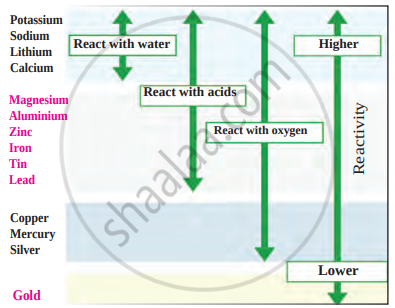
Reactivity series of metals
- Name two metals which react with water.
- Name two moderately reactive metals.
- Name the most highly reactive metal and the most less reactive metal.
Explain the reactions of nonmetals with water with the help of examples.
Explain the following reaction with the balanced equation.
Zinc sulphide is heated strongly in excess of air
