Advertisements
Advertisements
Question
Explain concept with example/explain with the help of a balanced equation.
Calcination
Advertisements
Solution
- The process of heating carbonate ores in limited air to convert it into respective oxide is called calcination.
- For example, zinc carbonate is heated strongly in a limited supply of air to convert it to zinc oxide.
\[\ce{\underset{\text{Zinc carbonate}}{ZnCO_{3(s)}} ->[Heat] \underset{\text{Zinc oxide}}{ZnO_{(s)}} + \underset{\text{Carbon dioxide}}{CO_2\uparrow}}\]
APPEARS IN
RELATED QUESTIONS
Write the composition of the alloy called bronze.
Define the term mineral.
Explain how, mercury is extracted from its sulphide ore (cinnabar). Give equations of the reactions involved.
A metal which exists as a liquid at room temperature is obtained by heating its sulphide ore in the presence of air.
- Name the metal and write its chemical symbol.
- Write the name and formula of the sulphide ore.
- Give the equations of chemical reactions involved in the production of metal from its sulphide ore.
- Name a common device in which this metal is used.
- Can this metal displace copper from copper sulphate solution? Why?
A black metal oxide XO2 is used as a catalyst in the preparation of oxygen gas from potassium chlorate. The oxide XO2 is also used in ordinary dry cells. The metal oxide XO2 cannot be reduced satisfactorily with carbon to form metal X.
- Name the metal X.
- Name the metal oxide XO2.
- Which reducing agent can be used to reduce XO2 to obtain metal X?
- Name another metal which can also be extracted by the reduction of its oxide with the above reducing agent.
Which metal can be extracted from the following ore?
bauxite
Which metal can be extracted from the following ore?
Calamine
Which metal can be extracted from the following ore?
Haematite
Give reasons, why aluminum is used in:
making alloys
An element has its electron configuration as 2,8,8,2. Now answer the following questions.
a) What is the atomic number of this element?
b) What is the group of this element?
c) To which period does this element belong?
Give the chemical formula of :
Sodium aluminate
Answer the following questions based on the extraction of aluminium from alumina by Hall - Heroult’s Process :
Why is powdered coke sprinkled on top of the electrolyte?
Name the following:
A compound which is added to lower the fusion temperature of the electrolytic bath in the extraction of aluminium.
Define roasting.
Observe the following diagram and write answers.
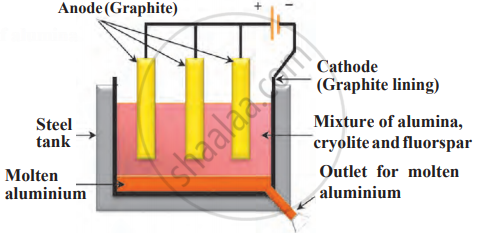
- Name the method.
- Write anode reaction and cathode reaction.
- Why fluorspar and cryolite are added in the mixture?
The highly reactive metals like Sodium, Potassium, Magnesium, etc. are extracted by the ____________.
Which of the statements about the reaction, \[\ce{ZnO + CO -> Zn + CO2}\] is correct?
In extraction of copper, the flux used is ____________.
The given reaction shows one of the processes to extract the metals like Iron and Manganese.
\[\ce{MnO2(s) + Al(s) -> Mn(l) + Al2O3(s) + Heat}\]
Give a reason why Aluminium is preferably used in thermite reactions.
