Advertisements
Advertisements
Question
In the extraction of aluminium Write the cathode reaction in electrolytic reduction of alumina.
Advertisements
Solution
In the electrolytic reduction of alumina, the reaction at the cathode is as follows:
Al3+ + 3e- → Al
APPEARS IN
RELATED QUESTIONS
Name the most abundant metal in the earth’s crust.
Why does a new aluminium vessel lose shine so soon after use?
Give the name and chemical formula of one ore of copper.
Name two metals which occur in nature in free state as well as in combined state.
Define the term ore.
Explain giving equation, what happens when:
A mixture of Cu2O and Cu2S is heated.
What is the difference between a mineral and an ore?
Name the electrode at which aluminium metal is produced.
Which metal is extracted from bauxite ore?
Explain how, mercury is extracted from its sulphide ore (cinnabar). Give equations of the reactions involved.
State three objectives achieved during the roasting of ores.
Give reasons, why aluminum is used in:
In aluminiothermy
Aluminum is used in thermite welding:
what is thermit?
Complete the incomplete statement with missing word:
Metals form positive ions while non- metals ______.
Name a non- metal that has a metallic luster and sublimes on heating.
State three objectives achieved during the roasting of ores.
Aluminium oxide is _______ oxide.
In the electrolytic method, a layer of highly active metal is applied to a less active metal.
Explain concept with example/explain with the help of a balanced equation.
Calcination
Observe the figure and answer the following.
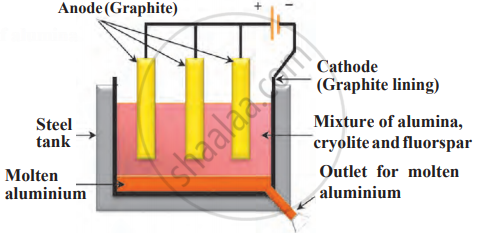
- Write the name of the method.
- What is used as anode and cathode in this method?
- Write the molecular formula and use of cryolite.
- Write anode reaction.
- Write cathode reaction.
