Advertisements
Advertisements
Question
Iron is _______.
Options
more reactive than zinc
more reactive than aluminium
less reactive than copper
less reactive than aluminium
Advertisements
Solution
Iron is less reactive than aluminium.
APPEARS IN
RELATED QUESTIONS
What chemical process is used for obtaining a metal from its oxide?
Name a reducing agent that may be used to obtain manganese from manganese dioxide.
Write the composition of the alloy called bronze.
Name one metal which is extracted by:
Reduction with aluminium.
The rocky material found with ores is called ______.
Calamine ore can be used to extract one of the following metals. This metal is:
The articles made of silver metal become dark on prolonged exposure to air. This is due to the formation of a layer of its ______.
A black metal oxide XO2 is used as a catalyst in the preparation of oxygen gas from potassium chlorate. The oxide XO2 is also used in ordinary dry cells. The metal oxide XO2 cannot be reduced satisfactorily with carbon to form metal X.
- Name the metal X.
- Name the metal oxide XO2.
- Which reducing agent can be used to reduce XO2 to obtain metal X?
- Name another metal which can also be extracted by the reduction of its oxide with the above reducing agent.
Give the principles of electromagnetic separation.
Give reasons, why aluminum is used in:
making alloys
Give reasons, why aluminum is used in:
In making ships
Define the following term.
Gangue
Answer the following questions based on the extraction of aluminium from alumina by Hall - Heroult’s Process :
Why is powdered coke sprinkled on top of the electrolyte?
Name the following:
The substance added to get rid of gangue in the extraction of metal.
Explain the following:
Galvanization protects iron from rusting.
What is the difference between calcination and roasting?
Write the molecular formulae of the following compound.
Fluorspar
Explain the concept of Calcination.
Explain in brief types of extraction of less reactive metals according to their reactivity.
Observe the figure and answer the following.
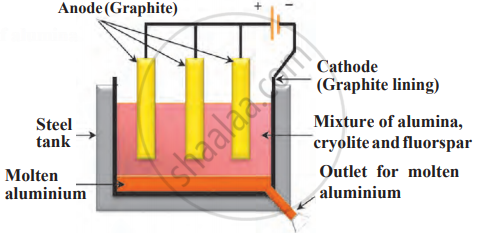
- Write the name of the method.
- What is used as anode and cathode in this method?
- Write the molecular formula and use of cryolite.
- Write anode reaction.
- Write cathode reaction.
