Advertisements
Advertisements
Question
In electrolytic reduction of alumina _______ is used as a cathode.
Options
sulphur
graphite
platinum
aluminium
Advertisements
Solution
In electrolytic reduction of alumina graphite is used as a cathode.
APPEARS IN
RELATED QUESTIONS
Which of the following pairs will give displacement reactions?
Name the most abundant metal in the earth’s crust.
Name a reducing agent that may be used to obtain manganese from manganese dioxide.
Give the name and chemical formula of one ore of copper.
Define the term mineral.
How is sodium metal extracted? Explain with the help of equation of the reaction involved.
Which gas is produced during the extraction of aluminium? At which electrode is this gas produced?
A black metal oxide XO2 is used as a catalyst in the preparation of oxygen gas from potassium chlorate. The oxide XO2 is also used in ordinary dry cells. The metal oxide XO2 cannot be reduced satisfactorily with carbon to form metal X.
- Name the metal X.
- Name the metal oxide XO2.
- Which reducing agent can be used to reduce XO2 to obtain metal X?
- Name another metal which can also be extracted by the reduction of its oxide with the above reducing agent.
State three objectives achieved during the roasting of ores.
Give the principles of electromagnetic separation.
Some metallic oxides can be reduced by hydrogen, carbon and carbon monoxide and some cannot. Explain.
Aluminum is used in thermite welding:
what is thermit?
Name the following:
The mixture of materials fed into a furnace to extract a metal.
Name the following:
The process in which an ore is heated in air so that oxygen gets added to it to form the oxides.
State the property of the metal being utilized in the following :
| Use of metal | Property |
| Zinc in Galvanization | |
| Aluminium in Thermite welding |
Heating an ore in a limited supply of air or in the absence of air at a temperature just below its melting point is known as ______.
Name the following:
A steel grey coloured solid non-metal.
In Electrolytic reduction of alumina, Anode : _______ : : Cathode : Graphite lining
Observe the following diagram and write answers.
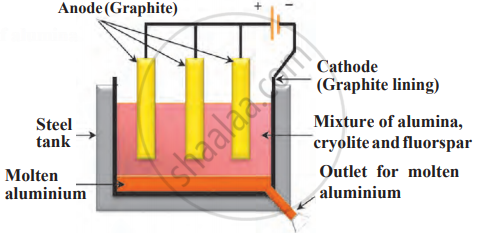
- Name the method.
- Write anode reaction and cathode reaction.
- Why fluorspar and cryolite are added in the mixture?
Explain in brief types of extraction of highly reactive metals according to their reactivity.
