Advertisements
Advertisements
Question
Explain the difference between Bayer’s process and Hall’s process by explaining the Bayer’s process.
Advertisements
Solution
- Difference between Bayer’s process and Hall’s process:
In Bayer’s process, aluminium ore is heated with concentrated caustic soda while in Hall’s process, it is heated with aqueous sodium carbonate to obtain water-soluble sodium aluminate. In Bayer’s process, the solution of sodium aluminate is diluted with water to obtain aluminium hydroxide while in Hall’s process, sodium aluminate is converted to aluminium hydroxide by reaction with CO2. - Bayer’s process:
- In this process, the bauxite ore is first crushed and then it is leached by heating with hot concentrated caustic soda (NaOH) solution under high pressure for 2 to 8 hrs at 140 to 150 °C in a tank called a digester.
- Aluminium oxide, being amphoteric in nature, dissolves in an aqueous NaOH solution, forming water-soluble sodium aluminate.
\[\ce{\underset{\text{oxide}}{\underset{\text{Aluminium}}{Al2O3.2H2O_{(s)}}} + \underset{\text{hydroxide}}{\underset{\text{Sodium}}{2NaOH_{(aq)}}} -> \underset{\text{aluminate}}{\underset{\text{Sodium}}{2NaAlO_{2(aq)}}} + \underset{\text{Water}}{3H2O_{(l)}}}\] - The iron oxide present in the gangue does not dissolve in an aqueous NaOH solution and is separated by filtration. However, silica from the gangue dissolves in an aqueous NaOH solution forming water-soluble sodium silicate.
- The solution of sodium aluminate is diluted with water and then cooled to 50 °C. This gives aluminium hydroxide as a precipitate.
\[\ce{\underset{\text{aluminate}}{\underset{\text{Sodium}}{NaAlO_{2(aq)}}} + \underset{\text{Water}}{2H2O_{(l)}} -> \underset{\text{hydroxide}}{\underset{\text{Sodium}}{NaOH_{(aq)}}} + \underset{\text{hydroxide}}{\underset{\text{Aluminium}}{Al(OH)_3}\downarrow}}\] - The aluminium hydroxide is then filtered, washed, dried and calcined by heating at 1000 °C to get pure aluminium oxide, called alumina.
\[\ce{\underset{\text{hydroxide}}{\underset{\text{Aluminium}}{2Al(OH)_{3(s)}}} ->[heat][1000 °C] \underset{\text{oxide}}{\underset{\text{Aluminium}}{Al2O_{3(s)}}} + \underset{\text{vapour}}{\underset{\text{Water}}{3H2O_{(g)}}}}\]
APPEARS IN
RELATED QUESTIONS
Define the Ore.
In the extraction of aluminium: Write the function and formula of cryolite in the extraction of aluminium.
Why are the metals like Na, K, Ca and Mg never found in their free state in nature?
Name two metals which are always found in combined state.
How is sodium metal extracted? Explain with the help of equation of the reaction involved.
Name the electrode at which aluminium metal is produced.
The two metals which can be extracted just by heating their sulphides in air are ______.
Manganese metal is extracted from manganese dioxide by a reduction process by making use of ______.
Which metal can be extracted from the following ore?
bauxite
Define the following term.
Mineral
Name the following:
Name two metals always find in combined state.
Which one of the following is not true of metal :
Metal will have 1 or 2 or 3 electrons in their valence shell.
Observe the given figure of reactivity series of metals and answer the following questions:
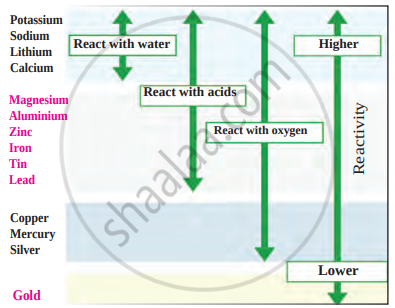
Reactivity series of metals
- Name two metals which react with water.
- Name two moderately reactive metals.
- Name the most highly reactive metal and the most less reactive metal.
Right or wrong sentence?
The electrolysis of alumina combines fluorite and cryolite to increase the solubility in the precipitation method.
The poorest conductor of heat among metals is ____________.
Which of the following metals exist in their native state in nature?
- Cu
- Au
- Zn
- Ag
- Given below are the steps for extraction of copper from its ore. Write the reaction involved.
- Roasting of copper (I) sulphide
- Reduction of copper (I) oxide with copper (I) sulphide.
- Electrolytic refining
- Draw a neat and well labelled diagram for electrolytic refining of copper
The given reaction shows one of the processes to extract the metals like Iron and Manganese.
\[\ce{MnO2(s) + Al(s) -> Mn(l) + Al2O3(s) + Heat}\]
Give a reason why Aluminium is preferably used in thermite reactions.
Assertion (A): The extraction of metals from their sulphide ores cannot take place without roasting the ore.
Reason (R): Roasting converts sulphide ores directly into metals.
