Advertisements
Advertisements
प्रश्न
Explain the difference between Bayer’s process and Hall’s process by explaining the Bayer’s process.
Advertisements
उत्तर
- Difference between Bayer’s process and Hall’s process:
In Bayer’s process, aluminium ore is heated with concentrated caustic soda while in Hall’s process, it is heated with aqueous sodium carbonate to obtain water-soluble sodium aluminate. In Bayer’s process, the solution of sodium aluminate is diluted with water to obtain aluminium hydroxide while in Hall’s process, sodium aluminate is converted to aluminium hydroxide by reaction with CO2. - Bayer’s process:
- In this process, the bauxite ore is first crushed and then it is leached by heating with hot concentrated caustic soda (NaOH) solution under high pressure for 2 to 8 hrs at 140 to 150 °C in a tank called a digester.
- Aluminium oxide, being amphoteric in nature, dissolves in an aqueous NaOH solution, forming water-soluble sodium aluminate.
\[\ce{\underset{\text{oxide}}{\underset{\text{Aluminium}}{Al2O3.2H2O_{(s)}}} + \underset{\text{hydroxide}}{\underset{\text{Sodium}}{2NaOH_{(aq)}}} -> \underset{\text{aluminate}}{\underset{\text{Sodium}}{2NaAlO_{2(aq)}}} + \underset{\text{Water}}{3H2O_{(l)}}}\] - The iron oxide present in the gangue does not dissolve in an aqueous NaOH solution and is separated by filtration. However, silica from the gangue dissolves in an aqueous NaOH solution forming water-soluble sodium silicate.
- The solution of sodium aluminate is diluted with water and then cooled to 50 °C. This gives aluminium hydroxide as a precipitate.
\[\ce{\underset{\text{aluminate}}{\underset{\text{Sodium}}{NaAlO_{2(aq)}}} + \underset{\text{Water}}{2H2O_{(l)}} -> \underset{\text{hydroxide}}{\underset{\text{Sodium}}{NaOH_{(aq)}}} + \underset{\text{hydroxide}}{\underset{\text{Aluminium}}{Al(OH)_3}\downarrow}}\] - The aluminium hydroxide is then filtered, washed, dried and calcined by heating at 1000 °C to get pure aluminium oxide, called alumina.
\[\ce{\underset{\text{hydroxide}}{\underset{\text{Aluminium}}{2Al(OH)_{3(s)}}} ->[heat][1000 °C] \underset{\text{oxide}}{\underset{\text{Aluminium}}{Al2O_{3(s)}}} + \underset{\text{vapour}}{\underset{\text{Water}}{3H2O_{(g)}}}}\]
APPEARS IN
संबंधित प्रश्न
In the extraction of aluminium Write the cathode reaction in electrolytic reduction of alumina.
Bronze is an alloy of copper and ______.
A zinc ore on heating in air forms sulphur dioxide. Describe briefly any two stages involved in the conversion of this concentrated ore into zinc metal.
Name the gas produced when calamine ore is calcined.
Which metal is extracted from calamine ore?
How is copper extracted from its sulphide ore (copper glance), Cu2S? Explain with equations of the reactions involved.
During galvanisation, iron metal is given a thin coating of one of the following metals. This metal is:
Which of the following metals are extracted by the electrolysis of their molten chlorides?
Give the principles of the hydrolytic method.
Give reasons, why aluminum is used in:
making alloys
Correct the following statement :
Copper reacts with nitric acid to produce nitrogen dioxide.
Name the following:
A steel grey coloured solid non-metal.
Write the name.
Metals which are amphoteric in nature.
Explain the characteristics of ionic compounds.
Observe the following diagram and write answers.
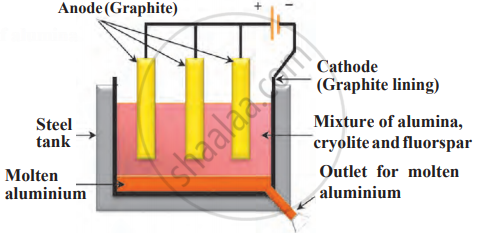
- Name the method.
- Write anode reaction and cathode reaction.
- Why fluorspar and cryolite are added in the mixture?
Which of the following metals exist in their native state in nature?
- Cu
- Au
- Zn
- Ag
Why should the metal sulphides and carbonates be converted to metal oxides in the process of extraction of metal from them?
The given reaction shows one of the processes to extract the metals like Iron and Manganese.
\[\ce{MnO2(s) + Al(s) -> Mn(l) + Al2O3(s) + Heat}\]
Give the reason why the above reaction is known as a thermite reaction.
