Advertisements
Advertisements
Concept: undefined >> undefined
Concept: undefined >> undefined
Advertisements
Which of the following measurement is most accurate?
Concept: undefined >> undefined
Is there any difference in the following measurements?
(a) 51.7 cm
(b) 51.70 cm
(c) 51.700 cm.
Explain your answer.
Which measurement is most accurate?
Concept: undefined >> undefined
Define speed of a body.
Concept: undefined >> undefined
How many variables are present in each equation of motion?
Concept: undefined >> undefined
What are the uses of equations of motion?
Concept: undefined >> undefined
Give two examples of uniform circular motion from your daily life.
Concept: undefined >> undefined
Derive th e equation of motion.
S = ut+ `1/2` at2,
Where the symbols have their usual meanings
Concept: undefined >> undefined
Concept: undefined >> undefined
Distinguish between speed and velocity.
Concept: undefined >> undefined
Define velocity. State its unit.
Concept: undefined >> undefined
Differentiate between uniform acceleration and variable acceleration.
Concept: undefined >> undefined
Give one example of following motion :
Variable acceleration
Concept: undefined >> undefined
If a stone and a pencil are dropped simultaneously in vacuum from the top of a tower, then which of the two will reach the ground first? Give reason.
Concept: undefined >> undefined
A body starts from rest and acquires a velocity 10 m s-1 in 2 s. Find the acceleration.
Concept: undefined >> undefined
A car starting from rest acquires a velocity 180m s-1 in 0.05 h. Find the acceleration.
Concept: undefined >> undefined
A bicycle initially moving with a velocity 5.0 m s-1 accelerates for 5 s at a rate of 2 m s-2. What will be its final velocity?
Concept: undefined >> undefined
State how the velocity-time graph can be used to find
The acceleration of a body
Concept: undefined >> undefined
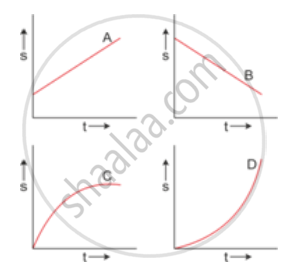
The figure shows the displacement - time graph for four bodies A, B C and D. In each case state what information do you get about the acceleration (zero, positive or negative).
Concept: undefined >> undefined
