Please select a subject first
Advertisements
Advertisements
Describe the locus of points at distances greater than or equal to 35 mm from a given point.
Concept: undefined >> undefined
Sketch and describe the locus of the vertices of all triangles with a given base and a given altitude.
Concept: undefined >> undefined
Advertisements
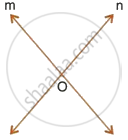
In the given figure, obtain all the points equidistant from lines m and n; and 2.5 cm from O.
Concept: undefined >> undefined
By actual drawing obtain the points equidistant from lines m and n; and 6 cm from a point P, where P is 2 cm above m, m is parallel to n and m is 6 cm above n.
Concept: undefined >> undefined
A straight line AB is 8 cm long. Draw and describe the locus of a point which is:
- always 4 cm from the line AB.
- equidistant from A and B.
Mark the two points X and Y, which are 4 cm from AB and equidistant from A and B. Describe the figure AXBY.
Concept: undefined >> undefined
Draw a triangle ABC in which AB = 6 cm, BC = 4.5 cm and AC = 5 cm. Draw and label:
- the locus of the centres of all circles which touch AB and AC,
- the locus of the centres of all the circles of radius 2 cm which touch AB.
Hence, construct the circle of radius 2 cm which touches AB and AC .
Concept: undefined >> undefined
The surface area of a sphere is 2464 cm2, find its volume.
Concept: undefined >> undefined
The volume of a sphere is 38808 cm3; find its diameter and the surface area.
Concept: undefined >> undefined
A spherical ball of lead has been melted and made into identical smaller balls with radius equal to half the radius of the original one. How many such balls can be made?
Concept: undefined >> undefined
How many balls each of radius 1 cm can be made by melting a bigger ball whose diameter is 8 cm?
Concept: undefined >> undefined
Eight metallic spheres; each of radius 2 mm, are melted and cast into a single sphere. Calculate the radius of the new sphere.
Concept: undefined >> undefined
The volume of one sphere is 27 times that of another sphere. Calculate the ratio of their :
- radii,
- surface areas.
Concept: undefined >> undefined
If the number of square centimeters on the surface of a sphere is equal to the number of cubic centimeters in its volume, what is the diameter of the sphere?
Concept: undefined >> undefined
Metallic spheres of radii 6 cm, 8 cm and 10 cm respectively are melted and recasted into a single solid sphere. Taking π = 3.1, find the surface area of the solid sphere formed.
Concept: undefined >> undefined
The surface area of a solid sphere is increased by 12% without changing its shape. Find the percentage increase in its:
- radius
- volume
Concept: undefined >> undefined
A solid sphere of radius 15 cm is melted and recast into solid right circular cones of radius 2.5 cm and height 8 cm. Calculate the number of cones recast.
Concept: undefined >> undefined
A hollow sphere of internal and external diameter 4 cm and 8 cm respectively is melted into a cone of base diameter 8 cm. Find the height of the cone.
Concept: undefined >> undefined
Total volume of three identical cones is the same as that of a bigger cone whose height is 9 cm and diameter 40 cm. Find the radius of the base of each smaller cone, if height of each is 108 cm.
Concept: undefined >> undefined
A solid rectangular block of metal 49 cm by 44 cm by 18 cm is melted and formed into a solid sphere. Calculate the radius of the sphere.
Concept: undefined >> undefined
The total area of a solid metallic sphere is 1256 cm2. It is melted and recast into solid right circular cones of radius 2.5 cm and height 8 cm. Calculate :
- the radius of the solid sphere.
- the number of cones recast. [Take π = 3.14]
Concept: undefined >> undefined
