Advertisements
Advertisements
Question
Total volume of three identical cones is the same as that of a bigger cone whose height is 9 cm and diameter 40 cm. Find the radius of the base of each smaller cone, if height of each is 108 cm.
Advertisements
Solution
Let the radius of the smaller cone be 'r' cm.
Volume of larger cone
= `1/3pi xx 20^2 xx 9`
Volume of smaller cone
= `1/3pi xx r^2 xx 108`
Volume of larger cone = 3 × Volume of smaller cone
`1/3pi xx 20^2 xx 9 = 1/3pi xx r^2 xx 108 xx 3`
`=> r^2 = (20^2 xx 9)/(108 xx 3)`
`=> r = 20/6 = 10/3`
APPEARS IN
RELATED QUESTIONS
Find the surface area of a sphere of radius 14 cm.
`["Assume "pi=22/7]`
A hollow sphere of internal and external radii 6 cm and 8 cm respectively is melted and recast into small cones of base radius 2 cm and height 8 cm. Find the number of cones.
A solid cone of radius 5 cm and height 8 cm is melted and made into small spheres of radius 0.5 cm. Find the number of spheres formed.
Spherical marbles of diameter 1.4 cm are dropped into beaker containing some water and are fully submerged. The diameter of the beaker is 7 cm. Find how many marbles have been dropped in it if the water rises by 5.6 cm.
The ratio of the total surface area of a sphere and a hemisphere of same radius is
The largest sphere is cut off from a cube of side 6 cm. The volume of the sphere will be
If the ratio of volumes of two spheres is 1 : 8, then the ratio of their surface areas is
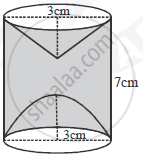
A hemispherical and a conical hole is scooped out of a.solid wooden cylinder. Find the volume of the remaining solid where the measurements are as follows:
The height of the solid cylinder is 7 cm, radius of each of hemisphere, cone and cylinder is 3 cm. Height of cone is 3 cm.
Give your answer correct to the nearest whole number.Taken`pi = 22/7`.
The surface area of a solid metallic sphere is 616 cm2. It is melted and recast into smaller spheres of diameter 3.5 cm. How many such spheres can be obtained?
The internal and external diameters of a hollow hemispherical vessel are 20 cm and 28 cm respectively. Find the cost to paint the vessel all over at ₹ 0.14 per cm2
