Advertisements
Advertisements
Concept: undefined >> undefined
Concept: undefined >> undefined
Advertisements
Concept: undefined >> undefined
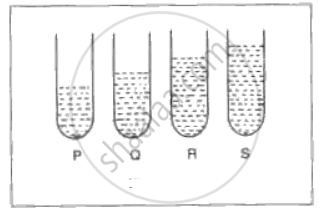
In fig. , P, Q, R and S represent test tubes each of height 20 cm which are filled with water upto heights of 10 cm, 14 cm, 16 cm and 18 cm respectively. If a vibrating tuning fork is placed over the mouth of test tube Q, a loud sound is heard.
(i) Describe the observations with the tubes P, R and S.
(ii) Give the reason for your observation in each case.
(iii) State the principle illustrated by the above experiment.
Concept: undefined >> undefined
Concept: undefined >> undefined
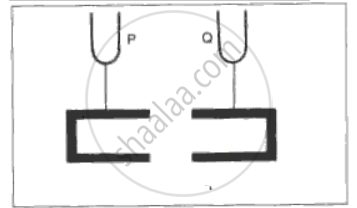
In fig. shows two tuning forks P and Q of the same frequency mounted on separate sound boxes with their open ends facing each other. The fork A is set into vibration. (i) Describe your observation. (ii) State the principle illustrated by this experiment.
Concept: undefined >> undefined
In Fig. A, B, C and D are four pendulums suspended from the same elastic string XY. The lengths of pendulum A and D are equal, while the length of pendulum B is shorter and of the pendulum C is longer. Pendulum A is set into vibrations.

- What is your observation about the vibrations of pendulum D?
- Give reason for your observation in part (a).
- What type of vibrations take place in pendulums Band C?
- Give reason for the answer in part (c).
Concept: undefined >> undefined
Differentiate between the following:
Light and sound waves.
Concept: undefined >> undefined
Differentiate between the following:
Free and forced vibrations.
Concept: undefined >> undefined
Differentiate between the following:
Radio waves and light waves.
Concept: undefined >> undefined
Concept: undefined >> undefined
Concept: undefined >> undefined
Concept: undefined >> undefined
Concept: undefined >> undefined
Concept: undefined >> undefined
Fig shows a three pin plug top. Label the three pins. Why is the top pin thicker and longer than the other two? Why are the pins splitted at the ends?

Concept: undefined >> undefined
Which of the radiations α, β and γ is similar to a beam of electrons?
Concept: undefined >> undefined
Can a concave lens form an image of size two times that of the object? Give reason.
Concept: undefined >> undefined
On keeping the stem of a vibrating tuning fork on the surface of a table, a loud sound is heard. Give reason.
Concept: undefined >> undefined
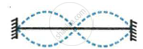
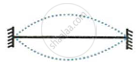
The diagram below shows three different modes of vibration P, Q and R of the same string of a given length.
 |
 |
 |
| P | Q | R |
- Which vibration will produce a louder sound and why?
- Which vibration will produce sound of maximum shrillness (or pitch) and why?
- What is the ratio of wavelength of vibrations P and R?
Concept: undefined >> undefined
