Advertisements
Advertisements
Question
Advertisements
Solution
- When one tuning fork is struck, another tuning fork of the same natural frequency starts vibrating. This is sympathetic vibration due to resonance.
- A child on a swing gains more height when pushes are given at intervals matching the natural frequency of the swing. The swing then vibrates with greater amplitude due to resonance.
APPEARS IN
RELATED QUESTIONS
The adjacent diagram shows three different modes of vibrations P, Q and R of the same string.
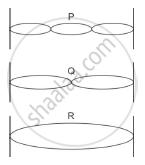
(i) Which vibration will produce a louder sound and why?
(ii) The sound of which string will have maximum shrillness?
(iii) State the ratio of wavelengths of P and R.
What are forced vibrations?
Differentiate between the forced and resonant vibrations.
In following figure shows two tuning forks A and B of the same frequency mounted on two separate sound boxes with their open ends facing each other. The fork A is set into vibration.
- Describe your observation.
- State the principle illustrated by this experiment.

When a body vibrates under a periodic force, the vibrations of the body are ______.
Which characteristic of sound makes it possible to recognize a person by his voice without seeing him?
When a tuning fork, struck by a rubber pad, is held over a length of the air column in a tube, it produces a loud sound for a fixed length of the air column. Name the above phenomenon. How does the frequency of the loud sound compare with that of the tuning fork? State the unit for measuring loudness.
Explain a person walking past a railway line, in the middle of night hears a ringing sound along with the sound of his footsteps.
What do you understand by forced vibrations?
