Please select a subject first
Advertisements
Advertisements
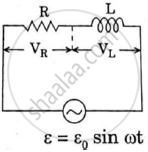
The potential difference across the resistor is 160V and that across the inductor is 120V. Find the effective value of the applied voltage. If the effective current in the circuit be 1.0 A, calculate the total impedance of the circuit.
Concept: undefined >> undefined
What will be the potential difference in the circuit when direct current is passed through the circuit?
Concept: undefined >> undefined
Advertisements
Write the range of the wavelength of the following electromagnetic radiations:
(a) Infrared rays
(b) Ultraviolet rays
(c) γ -rays
Write one use of each of the above.
Concept: undefined >> undefined
Define the term "Intensity" in the photon picture of electromagnetic radiation.
Concept: undefined >> undefined
Answer the following question.
Why a signal transmitted from a TV tower cannot be received beyond a certain distance? Write the expression for the optimum separation between the receiving and the transmitting antenna.
Concept: undefined >> undefined
Identify the part of the electromagnetic spectrum used in (i) radar and (ii) eye surgery. Write their frequency range.
Concept: undefined >> undefined
Answer the following question.
In a series LCR circuit connected across an ac source of variable frequency, obtain the expression for its impedance and draw a plot showing its variation with frequency of the ac source.
Concept: undefined >> undefined
Answer the following question.
What is the phase difference between the voltages across the inductor and the capacitor at resonance in the LCR circuit?
Concept: undefined >> undefined
Answer the following question.
Draw the diagram of a device that is used to decrease high ac voltage into a low ac voltage and state its working principle. Write four sources of energy loss in this device.
Concept: undefined >> undefined
Define the term: threshold frequency
Concept: undefined >> undefined
Answer the following question.
Plot a graph of photocurrent versus anode potential for radiation of frequency ν and intensities I1 and I2 (I1 < I2).
Concept: undefined >> undefined
Identify the part of the electromagnetic spectrum used in
(i) radar and
(ii) eye surgery. Write their frequency range.
Concept: undefined >> undefined
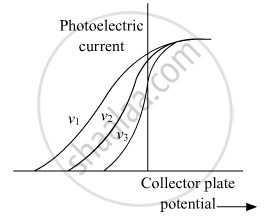
On the basis of the graphs shown in the figure, answer the following questions :
(a) Which physical parameter is kept constant for the three curves?
(b) Which is the highest frequency among v1, v2, and v3?
Concept: undefined >> undefined
Write two distinguishing features of nuclear forces.
Concept: undefined >> undefined
Name the radiation of the electromagnetic spectrum which is used for the following:
Radar and Give the frequency range.
Concept: undefined >> undefined
Name the radiation of the electromagnetic spectrum which is used for the following:
To photograph internal parts of the human body and Give the frequency range
Concept: undefined >> undefined
Name the radiation of the electromagnetic spectrum which is used for the following:
For taking photographs of the sky during the night and foggy conditions . Give the frequency range
Concept: undefined >> undefined
Define the terms "stopping potential' and 'threshold frequency' in relation to the photoelectric effect. How does one determine these physical quantities using Einstein's equation?
Concept: undefined >> undefined
Explain, with the help of a suitable example, how we can show that Lenz's law is a consequence of the principle of conservation of energy.
Concept: undefined >> undefined
Use the expression for Lorentz force acting on the charge carriers of a conductor to obtain the expression for the induced emf across the conductor of length l moving with velocity v through a magnetic field B acting perpendicular to its length.
Concept: undefined >> undefined
