Please select a subject first
Advertisements
Advertisements
Using the phasor diagram, derive the expression for the current flowing in an ideal inductor connected to an a.c. source of voltage, v= vo sin ωt. Hence plot graphs showing the variation of (i) applied voltage and (ii) the current as a function of ωt.
Concept: undefined >> undefined
Derive an expression for the average power dissipated in a series LCR circuit.
Concept: undefined >> undefined
Advertisements
The selectivity of a series LCR a.c. circuit is large, when ______.
Concept: undefined >> undefined
Choose the correct answer from given options
The phase difference between the current and the voltage in series LCR circuit at resonance is
Concept: undefined >> undefined
In the case of photoelectric effect experiment, explain the following facts, giving reasons.
The photoelectric current increases with increase of intensity of incident light.
Concept: undefined >> undefined
Gamma rays and radio waves travel with the same velocity in free space. Distinguish between them in terms of their origin and the main application.
Concept: undefined >> undefined
Define the term: stopping potential in the photoelectric effect.
Concept: undefined >> undefined
Answer briefly.
Give two uses of radio waves.
Concept: undefined >> undefined
A series LCR circuit with R = 20 Ω, L = 1.5 H and C = 35 µF is connected to a variable-frequency 200 V ac supply. When the frequency of the supply equals the natural frequency of the circuit, what is the average power transferred to the circuit in one complete cycle?
Concept: undefined >> undefined
Figure shows a series LCR circuit connected to a variable frequency 230 V source. L = 5.0 H, C = 80 µF, R = 40 Ω.
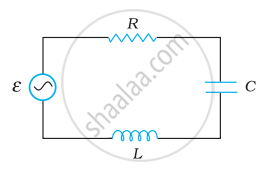
- Determine the source frequency which drives the circuit in resonance.
- Obtain the impedance of the circuit and the amplitude of current at the resonating frequency.
- Determine the rms potential drops across the three elements of the circuit. Show that the potential drop across the LC combination is zero at the resonating frequency.
Concept: undefined >> undefined
Keeping the source frequency equal to the resonating frequency of the series LCR circuit, if the three elements, L, C and R are arranged in parallel, show that the total current in the parallel LCR circuit is minimum at this frequency. Obtain the current rms value in each branch of the circuit for the elements and source specified for this frequency.
Concept: undefined >> undefined
A series LCR circuit with L = 0.12 H, C = 480 nF, R = 23 Ω is connected to a 230 V variable frequency supply.
(a) What is the source frequency for which current amplitude is maximum. Obtain this maximum value.
(b) What is the source frequency for which average power absorbed by the circuit is maximum. Obtain the value of this maximum power.
(c) For which frequencies of the source is the power transferred to the circuit half the power at resonant frequency? What is the current amplitude at these frequencies?
(d) What is the Q-factor of the given circuit?
Concept: undefined >> undefined
Obtain the resonant frequency and Q-factor of a series LCR circuit with L = 3.0 H, C = 27 µF, and R = 7.4 Ω. It is desired to improve the sharpness of the resonance of the circuit by reducing its ‘full width at half maximum’ by a factor of 2. Suggest a suitable way.
Concept: undefined >> undefined
For a series LCR-circuit, the power loss at resonance is ______.
Concept: undefined >> undefined
In a series LCR circuit supplied with AC, ______.
Concept: undefined >> undefined
The propagation of light is best described by ______.
Concept: undefined >> undefined
Each element is associated with a ______.
Concept: undefined >> undefined
Continuous spectrum is produced by ______.
Concept: undefined >> undefined
An electron makes a transition from orbit n = 4 to the orbit n = 2 of a hydrogen atom. What is the wave number of the emitted radiations? (R = Rydberg's constant)
Concept: undefined >> undefined
Absorption line spectrum is obtained ______.
Concept: undefined >> undefined
