Advertisements
Advertisements
Question
The selectivity of a series LCR a.c. circuit is large, when ______.
Options
L is large and R is large.
L is small and R is small.
L is large and R is small.
L = R
Advertisements
Solution
The selectivity of a series LCR a.c. circuit is large, when L is large and R is small.
Explanation:
Selectivity of a circuit depends on the quality of resonance. The quality factor is given by:
Q = `(w_0 L)/R`
A high value of the quality factor ensures that the resonance curve is sharp. The sharper the resonance curve, the more selective the LCR circuit is. Thus, the selectivity of the LCR circuit is large when L is large and R is small. Hence, the L is large, and R is small.
RELATED QUESTIONS
An LR circuit contains an inductor of 500 mH, a resistor of 25.0 Ω and an emf of 5.00 V in series. Find the potential difference across the resistor at t = (a) 20.0 ms, (b) 100 ms and (c) 1.00 s.
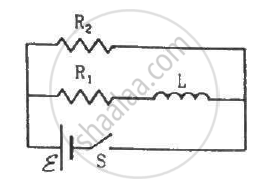
Consider the circuit shown in figure. (a) Find the current through the battery a long time after the switch S is closed. (b) Suppose the switch is again opened at t = 0. What is the time constant of the discharging circuit? (c) Find the current through the inductor after one time constant.
In an L.C.R. series a.c. circuit, the current ______.
In series combination of R, L and C with an A.C. source at resonance, if R = 20 ohm, then impedence Z of the combination is ______.
A coil of 0.01 henry inductance and 1 ohm resistance is connected to 200 volt, 50 Hz ac supply. Find the impedance of the circuit and time lag between max. alternating voltage and current.
For an LCR circuit driven at frequency ω, the equation reads
`L (di)/(dt) + Ri + q/C = v_i = v_m` sin ωt
- Multiply the equation by i and simplify where possible.
- Interpret each term physically.
- Cast the equation in the form of a conservation of energy statement.
- Integrate the equation over one cycle to find that the phase difference between v and i must be acute.
In a series LCR circuit, the inductance L is 10 mH, capacitance C is 1 µF and resistance R is 100Ω. The frequency at which resonance occurs is ______.
To reduce the resonant frequency in an L-C-R series circuit with a generator ______.
A 20Ω resistance, 10 mH inductance coil and 15µF capacitor are joined in series. When a suitable frequency alternating current source is joined to this combination, the circuit resonates. If the resistance is made \[\frac {1}{3}\] rd, the resonant frequency ______.
To an ac power supply of 220 V at 50 Hz, a resistor of 20 Ω, a capacitor of reactance 25 Ω and an inductor of reactance 45 Ω are connected in series. The corresponding current in the circuit and the phase angle between the current and the voltage is respectively:
