Please select a subject first
Advertisements
Advertisements
Draw a sketch of a sinusoidal carrier wave along with a modulating signal and show how these are superimposed to obtain the resultant amplitude modulated wave
Concept: undefined >> undefined
How are infrared waves produced?
Concept: undefined >> undefined
Advertisements
What role dose infra-red radiation play in maintain the Earth’s warmth
Concept: undefined >> undefined
What role dose infra-red radiation play in physical therapy?
Concept: undefined >> undefined
A series LCR circuit is connected across an a.c. source of variable angular frequency 'ω'. Plot a graph showing variation of current 'i' as a function of 'ω' for two resistances R1 and R2 (R1 > R2).
Answer the following questions using this graph :
(a) In which case is the resonance sharper and why?
(b) In which case in the power dissipation more and why?
Concept: undefined >> undefined
State Lenz's law. Illustrate, by giving an example, how this law helps in predicting the direction of the current in a loop in the presence of a changing magnetic flux.
Concept: undefined >> undefined
Define the term 'intensity of radiation' in terms of photon picture of light.
Concept: undefined >> undefined
How are side bands produced?
Concept: undefined >> undefined
Identify the part of the electromagnetic spectrum which is suitable for radar system used in aircraft navigation.
Concept: undefined >> undefined
Identify the part of the electromagnetic spectrum which is:
produced by bombarding a metal target by high speed electrons.
Concept: undefined >> undefined
Name the parts of the electromagnetic spectrum which is
used to treat muscular strain.
Write in brief, how these waves can be produced.
Concept: undefined >> undefined
Name the parts of the electromagnetic spectrum which is
used as a diagnostic tool in medicine.
Write in brief, how these waves can be produced.
Concept: undefined >> undefined
The carrier wave is given by
C(t) = 2sin(8πt) volt.
The modulating signal is a square wave as shown. Find modulation index.
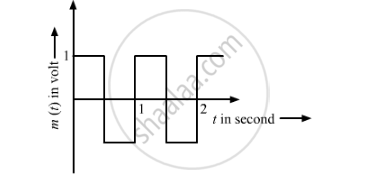
Concept: undefined >> undefined
If the earth did not have atmosphere, would its average surface temperature be higher or lower than what it is now? Explain.
Concept: undefined >> undefined
Describe a simple experiment (or activity) to show that the polarity of emf induced in a coil is always such that it tends to produce a current which opposes the change of magnetic flux that produces it.
Concept: undefined >> undefined
To which part of electromagnetic spectrum does a wave of frequency 3 × 10¹³ Hz belong?
Concept: undefined >> undefined
A voltage V = V0 sin ωt is applied to a series LCR circuit. Derive the expression for the average power dissipated over a cycle. Under what condition (i) no power is dissipated even though the current flows through the circuit, (ii) maximum power is dissipated in the circuit?
Concept: undefined >> undefined
To which part of the electromagnetic spectrum does a wave of frequency 5 × 10¹⁹ Hz belong?
Concept: undefined >> undefined
To which part of the electromagnetic spectrum does a wave of frequency 5 × 10¹¹ Hz belong?
Concept: undefined >> undefined
Predict the direction of induced current in the situation described by the following figure.

Concept: undefined >> undefined
