Advertisements
Advertisements
A device X used in communication system can convert one form of energy into another. Name the device X. Explain the function of a repeater in a communication system.
Concept: undefined >> undefined
Distinguish between point to point and broadcast modes of communication. Give an example of each.
Concept: undefined >> undefined
Advertisements
Explain the basic concept of mobile telephoning ?
Concept: undefined >> undefined
Two identical coils P and Q each of radius R are lying in perpendicular planes such that they have a common centre. Find the magnitude and direction of the magnetic field at the common centre of the two coils, if they carry currents equal to I and \[\sqrt{3}\] I respectively.

Concept: undefined >> undefined
Distinguish between point to point and broadcast modes of communication. Give an example of each.
Concept: undefined >> undefined
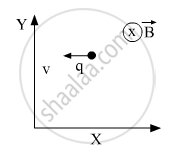
A point charge q moving with speed v enters a uniform magnetic field B that is acting into the plane of the paper as shown. What is the path followed by the charge q and in which plane does it move?
Concept: undefined >> undefined
If an electric field \[\vec{E}\] is also applied such that the particle continues moving along the original straight line path, what should be the magnitude and direction of the electric field \[\vec{E}\] ?
Concept: undefined >> undefined
A beam of monochromatic radiation is incident on a photosensitive surface. Answer the following question giving reason :
Do the emitted photoelectrons have the same kinetic energy?
Concept: undefined >> undefined
A beam of monochromatic radiation is incident on a photosensitive surface. Answer the following question giving reason :
Does the kinetic energy of the emitted electrons depend on the intensity of incident radiation?
Concept: undefined >> undefined
A beam of monochromatic radiation is incident on a photosensitive surface. Answer the following question giving reason :
On what factors does the number of emitted photoelectrons depend?
Concept: undefined >> undefined
A plane wavefront propagating in a medium of refractive index 'μ1' is incident on a plane surface making the angle of incidence 'i' as shown in the figure. It enters into a medium of refractive index 'μ2' (μ2 > μ1). Use Huygens' construction of secondary wavelets to trace the propagation of the refracted wavefront. Hence verify Snell's law of refraction.

Concept: undefined >> undefined
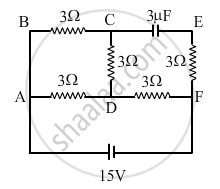
In the circuit shown in the figure, find the total resistance of the circuit and the current in the arm AD.
Concept: undefined >> undefined
Sketch a schematic diagram depicting oscillating electric and magnetic fields of an em wave propagating along + z-direction ?
Concept: undefined >> undefined
Show with the help of a diagram how the force between the two conductors would change when the currents in them flow in the opposite directions?
Concept: undefined >> undefined
In photoelectric effect, why should the photoelectric current increase as the intensity of monochromatic radiation incident on a photosensitive surface is increased? Explain.
Concept: undefined >> undefined
In a typical nuclear reaction, e.g.
`"_1^2H+"_1^2H ->"_2^3He + n + 3.27 \text { MeV },`
although number of nucleons is conserved, yet energy is released. How? Explain.
Concept: undefined >> undefined
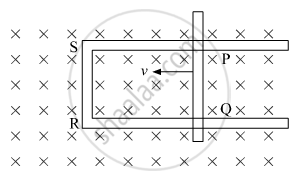
Figure shows a rectangular loop conducting PQRS in which the arm PQ is free to move. A uniform magnetic field acts in the direction perpendicular to the plane of the loop. Arm PQ is moved with a velocity v towards the arm Rs. Assuming that the arms QR, RS and SP have negligible resistances and the moving arm PQ has the resistance r, obtain the expression for (i) the current in the loop (ii) the force and (iii) the power required to move the arm PQ.
Concept: undefined >> undefined
How does the mutual inductance of a pair of coils change when
(i) distance between the coils is increased and
(ii) number of turns in the coils is increased?
Concept: undefined >> undefined
The motion of copper plate is damped when it is allowed to oscillate between the two poles of a magnet. What is the cause of this damping?
Concept: undefined >> undefined
Draw the plot of binding energy per nucleon (BE/A) as a functino of mass number A. Write two important conclusions that can be drawn regarding the nature of nuclear force.
Concept: undefined >> undefined
