Advertisements
Advertisements
Given n resistors each of resistance R, how will you combine them to get the (i) maximum (ii) minimum effective resistance? What is the ratio of the maximum to minimum resistance?
Concept: undefined >> undefined
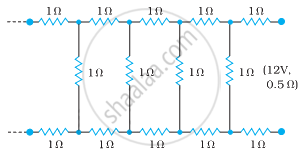
Determine the current drawn from a 12 V supply with internal resistance 0.5 Ω by the infinite network shown in the figure. Each resistor has 1 Ω resistance.
Concept: undefined >> undefined
Advertisements
Determine the current drawn from a 12 V supply with internal resistance 0.5 Ω by the infinite network shown in the figure. Each resistor has 1 Ω resistance.
Concept: undefined >> undefined
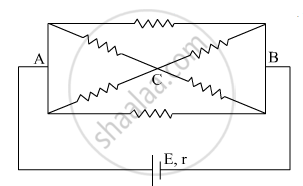
The current is drawn from a cell of emf E and internal resistance r connected to the network of resistors each of resistance r as shown in the figure. Obtain the expression for
- the current draw from the cell and
- the power consumed in the network.
Concept: undefined >> undefined
The current is drawn from a cell of emf E and internal resistance r connected to the network of resistors each of resistance r as shown in the figure. Obtain the expression for
- the current draw from the cell and
- the power consumed in the network.
Concept: undefined >> undefined
A 12 pF capacitor is connected to a 50 V battery. How much electrostatic energy is stored in the capacitor? If another capacitor of 6 pF is connected in series with it with the same battery connected across the combination, find the charge stored and potential difference across each capacitor.
Concept: undefined >> undefined
State Kirchhoff's rules and explain on what basis they are justified.
Concept: undefined >> undefined
State Kirchhoff's rules and explain on what basis they are justified.
Concept: undefined >> undefined
Given the resistances of 1 Ω, 2 Ω, 3 Ω, how will be combine them to get an equivalent resistance of (11/3) Ω?
Concept: undefined >> undefined
Given the resistances of 1 Ω, 2 Ω, 3 Ω, how will be combine them to get an equivalent resistance of (11/3) Ω?
Concept: undefined >> undefined
Given the resistances of 1 Ω, 2 Ω, 3 Ω, how will be combine them to get an equivalent resistance of (11/5) Ω?
Concept: undefined >> undefined
Given the resistances of 1 Ω, 2 Ω, 3 Ω, how will be combine them to get an equivalent resistance of (11/5) Ω?
Concept: undefined >> undefined
Given the resistances of 1 Ω, 2 Ω, 3 Ω, how will be combine them to get an equivalent resistance of 6 Ω?
Concept: undefined >> undefined
Given the resistances of 1 Ω, 2 Ω, 3 Ω, how will be combine them to get an equivalent resistance of 6 Ω?
Concept: undefined >> undefined
Given the resistances of 1 Ω, 2 Ω, 3 Ω, how will be combine them to get an equivalent resistance of (6/11) Ω?
Concept: undefined >> undefined
Given the resistances of 1 Ω, 2 Ω, 3 Ω, how will be combine them to get an equivalent resistance of (6/11) Ω?
Concept: undefined >> undefined
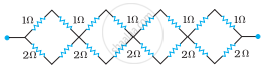
Determine the equivalent resistance of networks shown in Fig.
Concept: undefined >> undefined
Determine the equivalent resistance of networks shown in Fig.
Concept: undefined >> undefined
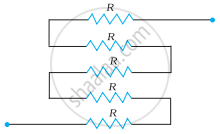
Determine the equivalent resistance of networks shown in Fig.
Concept: undefined >> undefined
Determine the equivalent resistance of networks shown in Fig.
Concept: undefined >> undefined
