Please select a subject first
Advertisements
Advertisements
A beam of unpolarised light is incident on a glass-air interface. Show, using a suitable ray diagram, that light reflected from the interface is totally polarised, when μ = tan iB, where μ is the refractive index of glass with respect to air and iB is the Brewster's angle.
Concept: undefined >> undefined
Show, with the help of a diagram, how unpolarised sunlight gets polarised due to scattering.
Concept: undefined >> undefined
Advertisements
Two polaroids P1 and P2 are placed with their pass axes perpendicular to each other. An unpolarised light of intensity Io is incident on P1. A third polaroid P3 is kept in between P1 and P2 such that its pass axis makes an angle of 45° with that of P1. Determine the intensity of light transmitted through P1, P2 and P3
Concept: undefined >> undefined
Using the phenomenon of polarisation, show how the transverse nature of light can be demonstrated.
Concept: undefined >> undefined
Two polaroids P1 and P2 are placed with their pass axes perpendicular to each other. An unpolarised light of intensity I0 is incident on P1. A third polaroid P3 is kept in between P1 and P2 such that its pass axis makes an angle of 30° with that of P1. Determine the intensity of light transmitted through P1, P2 and P3
Concept: undefined >> undefined
Show, via a suitable diagram, how unpolarised light can be polarised by reflection.
Concept: undefined >> undefined
Two polaroids P1 and P2 are placed with their pass axes perpendicular to each other. Unpolarised light of intensity I0 is incident on P1. A third polaroid P3 is kept in between P1 and P2 such that its pass axis makes an angle of 60° with that of P1. Determine the intensity of light transmitted through P1, P2 and P3.
Concept: undefined >> undefined
A point charge +10 μC is a distance 5 cm directly above the centre of a square of side 10 cm, as shown in the Figure. What is the magnitude of the electric flux through the square? (Hint: Think of the square as one face of a cube with edge 10 cm.)
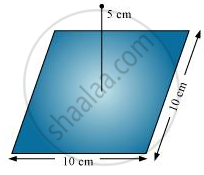
Concept: undefined >> undefined
Determine the current in each branch of the network shown in figure.
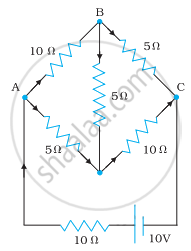
Concept: undefined >> undefined
Given n resistors each of resistance R, how will you combine them to get the (i) maximum (ii) minimum effective resistance? What is the ratio of the maximum to minimum resistance?
Concept: undefined >> undefined
Determine the current drawn from a 12 V supply with internal resistance 0.5 Ω by the infinite network shown in the figure. Each resistor has 1 Ω resistance.
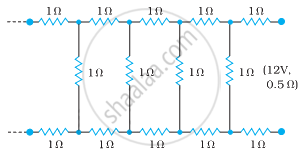
Concept: undefined >> undefined
A square coil of side 10 cm consists of 20 turns and carries a current of 12 A. The coil is suspended vertically and the normal to the plane of the coil makes an angle of 30° with the direction of a uniform horizontal magnetic field of magnitude 0.80 T. What is the magnitude of torque experienced by the coil?
Concept: undefined >> undefined
In a chamber, a uniform magnetic field of 6.5 G (1 G = 10–4 T) is maintained. An electron is shot into the field with a speed of 4.8 × 10⁶ m s−1 normal to the field. Explain why the path of the electron is a circle. Determine the radius of the circular orbit. (e = 1.5 × 10⁻¹⁹ C, me = 9.1 × 10⁻³¹ kg)
Concept: undefined >> undefined
A small telescope has an objective lens of focal length 144 cm and an eyepiece of focal length 6.0 cm. What is the magnifying power of the telescope? What is the separation between the objective and the eyepiece?
Concept: undefined >> undefined
- A giant refracting telescope at an observatory has an objective lens of focal length 15 m. If an eyepiece of focal length 1.0 cm is used, what is the angular magnification of the telescope?
- If this telescope is used to view the moon, what is the diameter of the image of the moon formed by the objective lens? The diameter of the moon is 3.48 × 10⁶ m, and the radius of lunar orbit is 3.8 × 10⁸ m.
Concept: undefined >> undefined
A small telescope has an objective lens of focal length 140 cm and an eyepiece of focal length 5.0 cm. What is the magnifying power of the telescope for viewing distant objects when
- the telescope is in normal adjustment (i.e., when the final image is at infinity)?
- the final image is formed at the least distance of distinct vision (25 cm)?
Concept: undefined >> undefined
- For the telescope is in normal adjustment (i.e., when the final image is at infinity)? what is the separation between the objective lens and the eyepiece?
- If this telescope is used to view a 100 m tall tower 3 km away, what is the height of the image of the tower formed by the objective lens?
- What is the height of the final image of the tower if it is formed at 25 cm?
Concept: undefined >> undefined
What is the Brewster angle for air to glass transition? (Refractive index of glass = 1.5)
Concept: undefined >> undefined
When a low flying aircraft passes overhead, we sometimes notice a slight shaking of the picture on our TV screen. Suggest a possible explanation.
Concept: undefined >> undefined
Calculate the momentum of the electrons accelerated through a potential difference of 56 V.
Concept: undefined >> undefined
