Advertisements
Advertisements
Questions
Two polaroids P1 and P2 are placed with their pass axes perpendicular to each other. Unpolarised light of intensity I0 is incident on P1. A third polaroid P3 is kept in between P1 and P2 such that its pass axis makes an angle of 60° with that of P1. Determine the intensity of light transmitted through P1, P2 and P3.
A narrow beam of unpolarised light of intensity I0 is incident on a polaroid P1. The light transmitted by it is then incident on a second polariod P2 with its pass axis making angle of 60° relative to the pass axis of P1. Find the intensity of the light transmitted by P2.
Advertisements
Solution
As given in the question the polaroid P1 and P2 are placed with their pass axes perpendicular to each other and polaroid P3 placed at 60°with repect to P1.
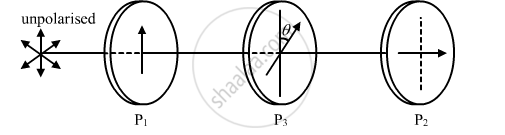
Therefore,
Intensity of light after falling on first polaroid P1, `I'=I_0/2`
Intensity of light after falling on third polaroid P3
`I'' = I'cos^2(theta)=I_0/2cos^2(60^@)=I_0/8`
Therefore the intensity `I_0/8` will pass through the P3 and angle between P3 and P2 is 30°. because of the condition given in the question.
Intensity of light after falling on second polaroid P2 =
`I'''= I'' cos^2(theta)=I_0/8cos^2(30^@) = (3I_0)/32`
