हिंदी

Two polaroids P1 and P2 are placed with their pass axes perpendicular to each other. Unpolarised light of intensity I0 is incident on P1. - Physics

Advertisements
Advertisements

प्रश्न

Two polaroids P1 and P2 are placed with their pass axes perpendicular to each other. Unpolarised light of intensity I0 is incident on P1. A third polaroid P3 is kept in between P1 and P2 such that its pass axis makes an angle of 60° with that of P1. Determine the intensity of light transmitted through P1, P2 and P3.

A narrow beam of unpolarised light of intensity I0 is incident on a polaroid P1. The light transmitted by it is then incident on a second polariod P2 with its pass axis making angle of 60° relative to the pass axis of P1. Find the intensity of the light transmitted by P2.

Advertisements

उत्तर

As given in the question the polaroid P1 and P2 are placed with their pass axes perpendicular to each other and polaroid P3 placed at 60°with repect to P1.
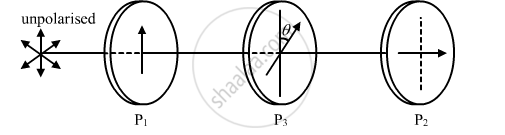
Therefore,
Intensity of light after falling on first polaroid  P1`I'=I_0/2`

Intensity of light after falling on third polaroid P3

`I'' = I'cos^2(theta)=I_0/2cos^2(60^@)=I_0/8`

Therefore the intensity `I_0/8` will pass through the P3 and angle between P3 and P2 is 30°. because of the condition given in the question.

Intensity of light after falling on second polaroid P=

`I'''= I'' cos^2(theta)=I_0/8cos^2(30^@) = (3I_0)/32`

shaalaa.com
  क्या इस प्रश्न या उत्तर में कोई त्रुटि है?
2013-2014 (March) All India Set 3

वीडियो ट्यूटोरियलVIEW ALL [3]

संबंधित प्रश्न

A ray of light passes from a vacuum to a medium of refractive index (μ). The angle of
incidence is found to be twice the angle of refraction. The angle of incidence is _______.

A) `cos^(-1)(mu/2)`

B) cos−1(μ)

C)  `2 cos^(-1) (mu/2)`

D) `2 sin^(-1) (mu/2)`


Which of the following properties shows that light is a transverse wave?


Explain how an unpolarised light gets polarised when incident on the interface separating the two transparent media.


Discuss polarisation by selective absorption.


State and obtain Malus’ law.


List the uses of polaroids.


The reflected light is found to be plane polarised when an unpolarized light falls on a denser medium at 60° with the normal. Find the angle of refraction and critical angle of incidence for total internal reflection in the denser to rarer medium reflection.


Consider a light beam incident from air to a glass slab at Brewster’s angle as shown in figure. A polaroid is placed in the path of the emergent ray at point P and rotated about an axis passing through the centre and perpendicular to the plane of the polaroid.


Figure shown a two slit arrangement with a source which emits unpolarised light. P is a polariser with axis whose direction is not given. If I0 is the intensity of the principal maxima when no polariser is present, calculate in the present case, the intensity of the principal maxima as well as of the first minima.


A polarizer - analyser set is adjusted such that the intensity of light coming out of the analyser is just 10% of the original intensity. Assuming that the polarizer - analyser set does not absorb any light, the angle by which the analyser need to be rotated further to reduce the output intensity to be zero, is ______.


Share
Notifications

Englishहिंदीमराठी


      Forgot password?
Use app×