Advertisements
Advertisements
Question
Two polaroids P1 and P2 are placed with their pass axes perpendicular to each other. An unpolarised light of intensity I0 is incident on P1. A third polaroid P3 is kept in between P1 and P2 such that its pass axis makes an angle of 30° with that of P1. Determine the intensity of light transmitted through P1, P2 and P3
Advertisements
Solution
As given in the question, the polaroids P1 and P2 are placed with their pass axes perpendicular to each other. Also, polaroid P3 is placed at an angle of 30° with respect to P1.
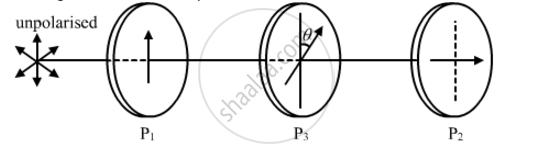
Now, we have:
Intensity of light after falling on P1 `I'=I_0/2`
Intensity of light after falling on P3, I" =
`I'cos^2(theta)=I_0/2cos^2(30^@)=(3I_0)/8`
Therefore, a light of intensity `(3I_0)/8`will pass through the P3, and the angle between P3 and P2 will be 60° because of the condition given in the question.
Intensity of light after falling on P2, I"' = I" `cos^2(theta)=(3I_0)/8cos^2(60^@)=(3I_0)/32`
APPEARS IN
RELATED QUESTIONS
Why does an unpolarised light incident on a polaroid get linearly polarised ?
The refractive indices of glass and water w.r.t. air are 3/2 and 4/3 respectively. Determine the refractive index of glass w.r.t. water.
What is the value of refractive index of a medium of polarising angle 60°?
Show using a proper diagram how unpolarised light can be linearly polarised by reflection from a transparent glass surface.
Green light is incident at the polarising angle on a certain transparent medium. The angle of refraction is 30° . Find
(i) polarising angle, and
(ii) refractive index of the medium.
Greenlight is an incident at the polarising angle on a certain transparent medium. The angle of refraction is 30°.
Find
(i) polarising angle, and
(ii) refractive index of the medium.
What is partially polarised light?
Mention the types of optically active crystals with example.
An unpolarised light of intensity 32 Wm-2 passes through three Polaroids such that the axes of the first and the last Polaroids are at 90°. What is the angle between the axes of the first and middle Polaroids so that the emerging light has an intensity of only 3 Wm-2?
Consider a light beam incident from air to a glass slab at Brewster’s angle as shown in figure. A polaroid is placed in the path of the emergent ray at point P and rotated about an axis passing through the centre and perpendicular to the plane of the polaroid.

